
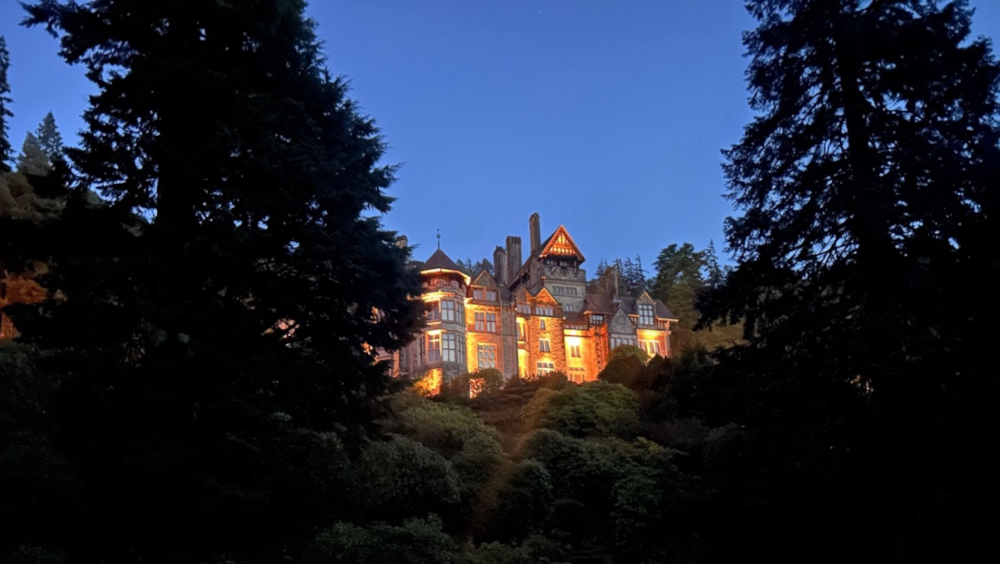
Cragside is a Victorian marvel, built to combine Mock Tudor with modern engineering. Kate Lumsden explains how this unusual house, at the forefront of technology in its time, inspired her latest novel, The Christmas Tree Murders.
The moment you step into the grounds at Cragside, you know this place is special. The gardens and woodland are beautiful and vibrant all year round – stunning in summer and atmospheric in winter – and the house itself, a Tudor Revival manor, towers over the parkland.
It was built in the late-Victorian period, to the design of inventor Lord Armstrong, and is a scientific experiment in the form of a house. It was the first house to be lit by hydroelectricity, and one of the earliest instances of domestic electric lighting.
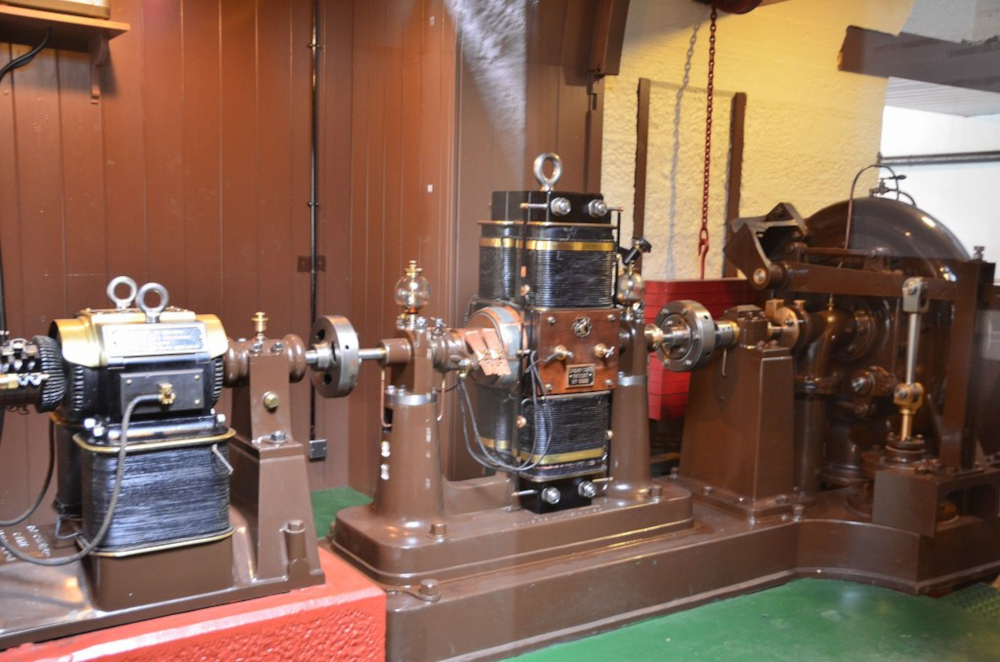
Armstrong had hydraulic lifts and dumb waiters installed, along with central heating via a system of hot water pipes and vents. The kitchen has an early dishwasher and a self-turning spit for roasting meat.
The National Trust calls it ‘Britain’s original smart home’, and it was both a home for the Armstrong family and a show home – a demonstration of all that Armstrong’s genius could achieve.
I first visited it three years ago, while on holiday in Northumberland, and that was when my new novel, The Christmas Tree Murders, began. Walking around the grounds and house, my husband and I agreed what a great setting it would make for a novel – and, specifically, for a murder mystery.
We’d probably been influenced by listening to Agatha Christie’s Poirot novels on audiobook on the drives up to and around Northumberland. I’d never written a murder mystery before, but I love reading them, and Cragside and its atmosphere seemed perfect for such a story.
Clifftop House in The Christmas Tree Murders isn’t exactly Cragside – I’ve moved my country house to the coast of Northumberland and taken various liberties with its design and technology – but a lot of my research was focused on Cragside, and it was a massive inspiration.
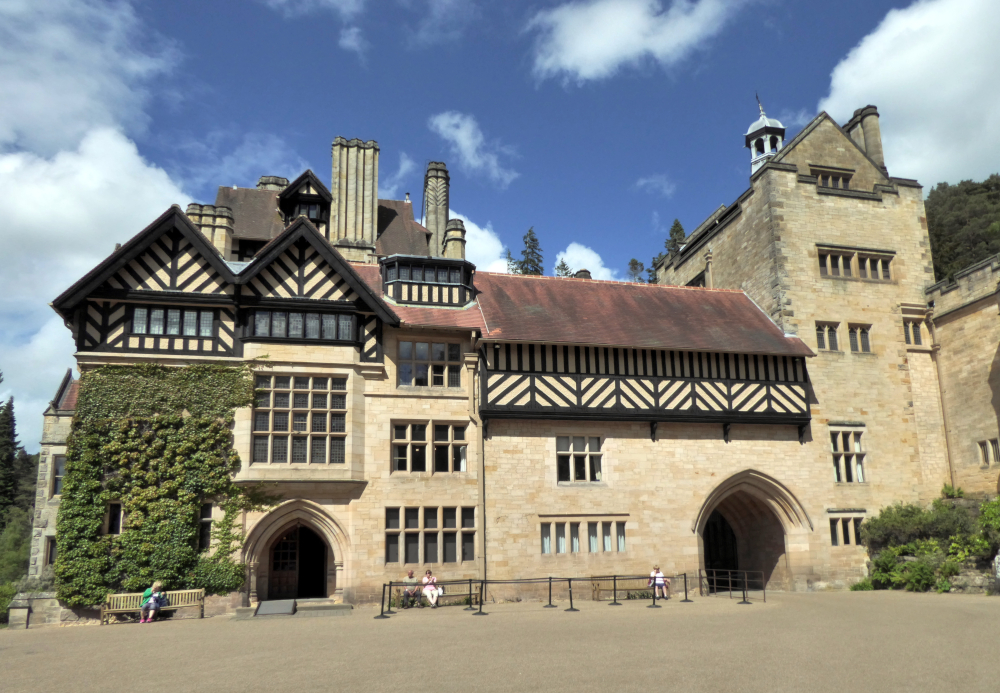
Since my first visit, I’ve been back to Cragside twice – once to stay in a holiday cottage on site, shortly before Christmas, for a few days of intensive research and writing.
The National Trust staff were incredibly helpful, and I’m so grateful to Claire Teasdale, Collections and House Manager, who kindly showed me around the house, including some areas that are usually out of bounds, and gave me so many snippets of information that I couldn’t have found anywhere else.
One thing I was especially excited to explore in the novel is how the Victorians thought about technology – what they knew, what they didn’t, what they were eager to learn, how new so much of this was. There are countless reasons why I find the Victorians so historically fascinating, but one is that they lived in a time of great social, economic and technological change, just as we do now.
Much as people today are concerned with how increasing use of AI might affect the way we think and interact with each other, so the Victorians worried about increasing mechanisation and how the pace of scientific change might impact the world and society they lived in.

These concerns are reflected in the literature of the time, in the works of Elizabeth Gaskell, H.G. Wells, Charles Dickens (most notably in his novel Hard Times) and many more.
Some of the characters within The Christmas Tree Murders are sceptical or downright hostile to technological change, while others embrace it. The novel’s heroine, Millie, the kitchenmaid, is often frustrated by labour-saving devices that aren’t really fit for purpose.
Other characters are all too aware of how technology goes hand in hand with warfare. Sir Russell, like Lord Armstrong, is both an inventor and an arms manufacturer, and the link between Victorian technological innovation and the military dominance of the British Empire cannot be ignored.
Sir Russell is very much not Lord Armstrong – he is from the wrong generation and of an entirely different character – but my research into Victorian inventors hugely influenced the novel. I read the lectures of both Lord Armstrong and Sir Joseph Swan, a key figure in the development of early incandescent light-bulbs, and various books about invention and innovation in the Victorian period.
As I wrote the novel, I was keen to emphasise the newness of the technology within The Christmas Tree Murders and to make that fact significant to the plot and the murder itself. At the heart of the novel is a death caused by electric shock (the term ‘electrocution’ didn’t yet exist, and even when it did come into use, a few years after the book is set, it specifically meant execution by electricity).

The police and the coroner know nothing about electricity – how can they possibly tell if this death was an accident or a murder? In this way, I tried to weave the fascinating history of Victorian science and technology into the plot of the book.
All in all, Cragside gave me so many jumping-off points for this novel – not only the location and its atmosphere but the history that surrounds the place and the themes that history raises. I often base the buildings in my novels loosely on real historical places, partly because it helps ensure historical authenticity, and partly because my visual imagination is quite limited.
Hartwood Hall in The Secrets of Hartwood Hall is modelled on Corsham Court, and all the locations in The Trouble with Mrs Montgomery Hurst are based on real places (the Ashpoint Brewery on Hook Norton Brewery, Wickford Towers on Oxburgh Hall, Ludwell Manor on Hanbury Hall, etc).
However, neither of my previous books have been so strongly bound up in one place and its history – the place has never been the starting point before. I can say with certainty that, even though Clifftop House has diverged from its model in some places, The Christmas Tree Murders would not exist had I never visited Cragside.
The Christmas Tree Murders by Katie Lumsden is published on 5 November, 2026.
See more about this book.
Katie Lumsden is a writer and freelance editor from London, with a passion for 19th-century literature and history. Her YouTube channel, Books and Things, has more than 38,000 subscribers.
You may be interested in reading How Victorian literature helped me write my debut novel, Katie’s feature about The Secrets of Hartwood Hall, which was shortlisted for the 2023 HWA Debut Crown.
Other relevant Historia features include:
National Trust Inspirations: various authors choose their favourite houses
Delving into the history of a house by Melanie Backe-Hansen
Edinburgh’s New Town and the 200-year history of 10 Scotland Street by Leslie Hills
Historian or novelist? Writing fiction based on facts by Julie Owen Moylan
The gift of writing historical fiction by Liz Hyder
The delights and dilemmas of using real people in historical fiction by Chris Lloyd
My problems writing about Jackie Kennedy and Maria Callas by Gill Paul
Images:
- Cragside in the evening: author’s own photo
- Two generators, the more modern one to the left, powered by a water turbine as an electricity supply to Cragside: Jim Barton for Geograph (CC BY-SA 2.0)
- Front entrance to Cragside (slightly cropped): Paul Farmer for Geograph (CC BY-SA 2.0)
- The Royal Visit in 1884 by Henry Hetherington Emmerson, with the Prince of Wales and William George Armstrong: Wikimedia (public domain)
- Sir William Armstrong by the fire at Cragside by Henry Hetherington Emmerson, 1880: Wikimedia (public domain)


