

Katie Lumsden’s debut novel, The Secrets of Hartwood Hall, is a “love letter to her favourite books” — the classics of Victorian literature. She explains how these works didn’t just inspire her writing; they also helped her to craft a book which is Victorian in its voice, feel, and richness of plot and character, but thoroughly accessible to 21st-century readers.
I read Jane Eyre when I was 13 years old – and really, that was it. I then worked my way through the rest of the Brontë sisters’ books, through every Charles Dickens novel, through as much Elizabeth Gaskell, Thomas Hardy and Anthony Trollope as I could find. Between the ages of 13 and 18, I barely read a single modern book.
These days, I read a lot more contemporary literature, too, but I still keep coming back to the Victorians. I’ve read the majority of well-known Victorian books now, so I have great fun tracking down digital editions of out-of-print works, exploring the Victorian authors we’ve almost entirely forgotten today.

Victorian literature has been very influential on my reading taste – on my life, really – so I suppose it’s no surprise that Victorian literature has been very influential on my writing, too.
Victorian books were some of the first books that made me really want to write when I was a teenager. I loved the magical storytelling, the fantastic characters, the weaving plots. I wanted to do that. I wanted to make that.
The Victorians were the writers who taught me how to build atmosphere, how to create unique and memorable characters, how to plot and pace, how to really tell stories.
A lot of the themes common in Victorian literature have made their way into my writing and into my debut novel, The Secrets of Hartwood Hall: the position of women; social rules and how to break them; the confines of the system; grief; marriage; found family.
The Secrets of Hartwood Hall is set in 1852. It follows the story of Margaret Lennox, who, after the death of her husband, returns to work as a governess. She takes up a position at Hartwood Hall, a mysterious, isolated country house in the middle of nowhere, where nothing is quite what it seems.

The novel is a love letter to my favourite books, packed with references to Victorian literature, especially Jane Eyre and The Tenant of Wildfell Hall.
Victorian books shaped its story, its themes, its characters and narrative style. The novel was inspired by all the things the Victorians wrote and talked about – and, perhaps more importantly, all the things they didn’t write or talk about.
I love Victorian literature itself so much that I always feel historical fiction set in that era needs to do something a truly Victorian novel couldn’t have done: whether that’s using a different writing style or technique; following characters’ whose voices weren’t heard at the time; or otherwise telling a story that the Victorians either couldn’t or wouldn’t have been allowed to write.
When it came to the historical research, Victorian literature was invaluable for me. Of course, I read a lot of non-fiction when researching, both modern history books and primary sources from the time – everything from conduct books for governesses to Victorian medical handbooks – but novels were massively helpful, too.

Everything I’ve absorbed from Victorian literature over the years made it feel very natural to write about this time.
Novels contain so many passing details that can be hugely telling. They can teach you about daily life, about how people lived – and how they thought they ought to live, which can be just as enlightening.
Moreover, reading and rereading Victorian literature helped me capture a Victorian voice. The Secrets of Hartwood Hall is written in first person, and I wanted to make it feel as though the protagonist, Margaret, could really have lived in the 1850s, while also making her a compelling character for modern readers.
I’ve tried to make sure that every thought she has, every line of dialogue, feels as authentically Victorian as possible.
While writing The Secrets of Hartwood Hall, I kept several Victorian novels open in Project Gutenberg on my internet browser, along with an etymology dictionary and Google Books’s amazing Ngram tool, so that if I were using a particular word or phrase, I could check how it had been used in Victorian literature.

I always think that nothing beats fiction for helping you capture the tone and voice of a time – both as it was, but also as we expect it to be as modern readers. When writing a work of historical fiction, it’s important to be accurate, to capture a time as it was – how key that is often depends on the subgenre you’re writing in. However, it’s also important that it feels right, that nothing is going to jar readers out of the story.
One example I always use is the idiom: to break the ice. It’s really old – Jane Austen used it in Sense and Sensibility in 1811, and it was around a good 150 years before that – but somehow it sounds very modern, so I probably wouldn’t have a character say it in a work of historical fiction, even though people at the time would have done so.
The importance of sounding and feeling right needs to be balanced with the importance of being accurate.
Victorian literature has helped me accurately describe the era, but it’s also helped me capture a Victorian world that readers will recognise. After all, we still read and study a lot of Victorian books today, meaning that many people’s introduction to Victorian history is through the era’s literature.
I wanted to create a setting and a cast of characters that felt and sounded authentically Victorian – even if the plot does take a slightly un-Victorian turn. I wanted to tell a story that the Victorians would never have told – but in a way they might have told it.
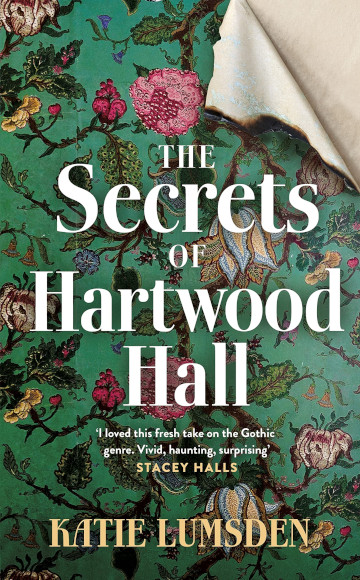
The Secrets of Hartwood Hall by Katie Lumsden is published on 30 March, 2023.
Katie is a freelance editor, copy editor and proofreader. She also has a YouTube channel, Books and Things.
If you enjoyed Katie’s feature, you may also like these:
Top ten films set in the Victorian era by Kate Griffin
A Guide to Victorian Sex by William Sutton
The Victorian theatrical world of mystery and illusion by Essie Fox
When Queen Victoria was Empress Alexandra’s interfering granny by Melanie Clegg
Gothic writers choose their favourite chilling books by Anna Mazzola
And get a taste for other authors who write fiction set in the 19th century in Victoriana: a HWA short story collection
If you like the Brontës, why not read:
The Brontë Affair: researching the scandal that enveloped literature’s most famous family by Finola Austin
And for more tips about making your book, and your characters, sound authentic, Historia’s resident writing agony aunt, Emma Darwin, has advice on Finding your historical voice, Zounds! Whatevs! How can I find the right voice for my novel? and the always useful How do you research historical fiction?


