
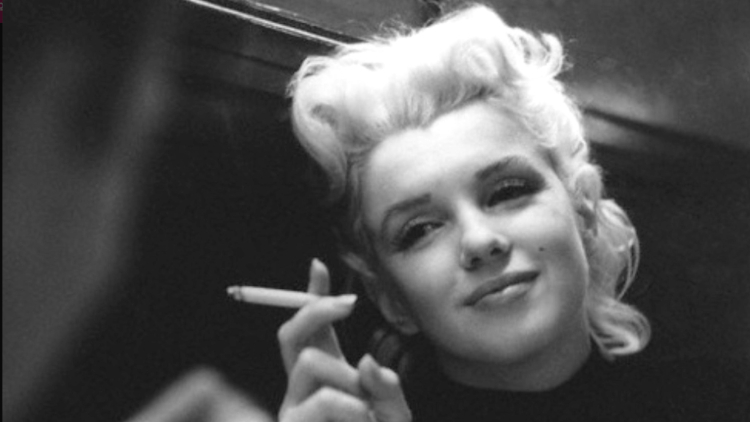
Is the historical fiction author a historian or novelist? Julie Owen Moylan considers her own experience of writing a novel based on the known facts about two iconic women in the 1950s.
Writing about real people is a challenging enterprise for both novelist and historian. How can we best sum up a life of many parts and which of us is best placed to get at the true essence of a human being?
Having spent the past two years working on a novel featuring both Marilyn Monroe and Elizabeth II based on events leading up to their first meeting in 1956, I would argue that both novelist and historian are in search of the truth… but maybe our idea of what constitutes that truth is quite different.

Novelists have a strange relationship with facts. We need some of them but not if they get in the way of our narrative arc. On the surface the question of historical accuracy should be simple.
The historian with their notebooks crammed full of reputable sources should win every time, and yet… The novelist also has a notebook crammed full of facts and we choose what to insert to suit our emotional truth. But don’t historians and biographers also do that? Maybe we are not so very different after all.
Here I must declare an interest. My first degree is in history and the writing of history, and studying of historiography is very important to me. However, one of the first things I learnt as a history undergraduate was that facts are often not at all factual. We have to examine our sources.
History was traditionally written by the powerful, the victors in battles. For centuries there was little or no history written about women or ordinary people. What was recorded were often quite basic accounts of a life. You were born. You married. You baptised children and you died. Yet even these documents are often flawed. This birth certificate, for example (above), does not contain the name of Norma Jeane’s real father.

While writing Elizabeth and Marilyn I went through the Times archive scouring the court circular for Queen Elizabeth’s appointments in the summer of 1956. I also had the schedule for the filming of The Prince and the Showgirl in order to marry up when both Marilyn and the Queen were in Windsor at the same time. There are dates and appointments. I can tell you exactly where they were, but that information doesn’t help you understand their emotional state or how they perceived the events of that summer.
Modern biography has of course moved on from those basic accounts of people’s lives. There are recorded interviews from their subjects or newspaper articles and documentaries to flesh out the biographies. Many diaries from famous people have been published and act as a great source for historians.
Of course sometimes people have written long imaginative journal entries of events that simply did not happen. Events are misremembered, dates are incorrect and unsurprisingly most people tend to make themselves the showpiece of their own diaries. To quote Queen Elizabeth: “recollections may vary”. Truth is an elusive construct at the best of times, and whose truth are we seeking when we sit down to write?
.jpg)
In the writing of Elizabeth and Marilyn, I read many of these books. Writers investigating the jigsaw puzzle of Monroe’s life. The facts are all there in black and white but in the fleshing out of that narrative, the attempt to explain the ‘why’ and ‘how’, there is a fiction being woven to assemble the finished jigsaw.
Human beings are complicated. We put on a brave face. We perform a little for our audience. We know what people want us to be like and we try not to disappoint. Behind the mask there is often another more vulnerable human being and it is this person that biographers struggle to find. That woman can be elusive if we are sticking to the facts.
Queen Elizabeth, for example, was 25 years old when her father, King George VI, died and she came to the throne. The facts tell us this very clearly but they cannot explain what it is like to stand on an aircraft steps swathed in black mourning, feeling complete shock and devastation, while looking out at the dignitaries who are all waiting for you.
.jpg)
Biographers do try to flesh out their characters but usually from the outside looking in. What they see may be the suit of armour and not the reality. It is the job of the novelist to crawl inside and excavate the emotional truth of that woman.
Literature is supposed to be a sensory experience at its best. Novelists do use the facts, but within those facts we try to put ourselves in that woman’s shoes.
When writing Marilyn, I could understand what it was like to grow up with an unstable mother where love always felt conditional and temporary as I had experienced something similar. In writing the Queen I could understand the pain of losing a parent at a young age and so in my attempt at emotional truth,
I tried to access those women through their wounds, finding the emotional centre of this novel there. Lilibet and Norma Jeane were not Elizabeth and Marilyn — but they could make you believe they were. A biographer would fail in their task if they were to write those words without evidence but a novelist can shrug and say it is the emotional truth of the matter.

Whereas a biography allows us to sit in judgement on the subjects pronouncing them interesting or dull characters, a novel invites the reader to step inside those women and feel what it’s like to inhabit lives that are so removed from our own
It creates empathy and gives women that are too perfect, too famous, and too privileged for us to care about, some of their humanity back. It strips them down to mere mortals like us. Women with wounds. Women who were abused or grieving.
Everyone has their problems, and literature is a way for us to empathise and, more importantly, to understand them. The biographer or historian can certainly fill pages with dates and facts and anecdotes but it’s the novelist who tries to find their truth from deep inside our subject.
As EL Doctorow said, “The historian will tell you what happened. The novelist will tell what it felt like.”

Elizabeth and Marilyn by Julie Owen Moylan is published on 2 April, 2026.
Julie is the author of three other historical novels: That Green Eyed Girl, 73 Dove Street and Circus of Mirrors.
Historia features on related themes include:
My problems writing about Jackie Kennedy and Maria Callas by Gill Paul
The delights and dilemmas of using real people in historical fiction by Chris Lloyd
Should historical authors feel guilt when they write real people as antiheroes? by AJ West
The challenges of writing a novel set in Morocco by Robert Wilton
Images:
- Marilyn Monroe in 1956, cropped: John Irving for Flickr (CC BY-NC-SA 2.0
- Claimed to be a birth certificate of Marilyn Monroe, born Norma Jeane Mortenson on 1 June, 1926: Wikimedia (public domain)
- US theatrical poster for the film The Prince and the Showgirl, 1957, designed by Bill Gold: Wikimedia (public domain)
- Queen Elizabeth II on her Coronation Day by Cecil Beaton, June, 1953: Royal Collection via Wikimedia (public domain)
- Marilyn Monroe in a promotional photograph for The Prince and the Showgirl, 1957: Wikimedia (public domain)
- Elizabeth II on the royal tour of New Zealand in 1953–54 (detail): Archives New Zealand Reference: AAQT 6538 W3537 box 1 via Wikimedia (CC BY 2.0)


