

Leslie Hills looks back at what intrigued her about her house, and how it set her off on a decades-long search for the history of 10 Scotland Street in Edinburgh’s New Town — the subject of her newly-published book.
When finally I paid off the mortgage on my home, number 10 Scotland Street, a Georgian main-door flat in Edinburgh’s New Town, our solicitor handed me a bundle of vellum deeds, dating back to the original sale, in 1824, to David Kedie Whytt and his wife Ann Henderson.
I laid them out on the floor of their drawing room and read until I reached the 1974 missive that bore my name. It took a long time. The cursive penmanship was sometimes cramped and difficult, but with a bit of perseverance, the script yielded. A story unfolded. Vaguely, I decided I would have a look, someday, at the man who had bought my house when it was brand new.

The bundle was set aside, and aside it stayed for quite some time, until one morning in the 1990s, researching a film, I visited the National Archives in Kew. Having found what I needed for the film, I decided to look in the catalogue for David Kedie Whytt.
In among the toils of living, making and doing, there is sometimes a moment remembered viscerally. Someone you trust tells you a great big lie; you lock eyes with a very young baby and see it thinking; the right person takes your hand.
That moment at the National Archives in Kew, when I opened the oilskin-wrapped letter, dated May 1836, and headed 10 Scotland Street, Edinburgh, is among my best.
In a flowing and elegant hand, David Kedie Whytt, retired paymaster and purser of His Majesty’s Royal Navy, is writing from 10 Scotland Street, Edinburgh, to claim the half-pay to which he is entitled, by virtue of his 31 years’ service, during and after the Napoleonic Wars.

The style and sentence structure match the quality of the handwriting. It is quite simply a beautiful letter. I left the archives knowing that after that crystalline moment in Kew’s search room, I’d pursue Mr Whytt properly.
In the pre-internet days of microfiche and huge paper indexes, it took a lot longer than it would today. As I looked further into David’s life, I discovered a complex, energetic character at the heart of an extended family, as it prevailed through conflict and change. Getting to know these people, and those who followed the Whytts in my house, became a decades-long task.
It won’t ever be finished, of course. I won’t ever know everything about this family and their wide-ranging business and friendship bonds. There will always be more to find, fresh threads to pull loose.
The pandemic of 2019 encouraged reflection. I decided it was time to sit down in the Whytt’s dining room, and make some sense of it all.
Over a year, I assembled the story of 10 Scotland Street; the world of the house, the street, and its connections far and wide; the lives, deaths, triumphs and failures of a gloriously varied bunch of characters, on an ever-changing panorama – their one common point, 10 Scotland Street.
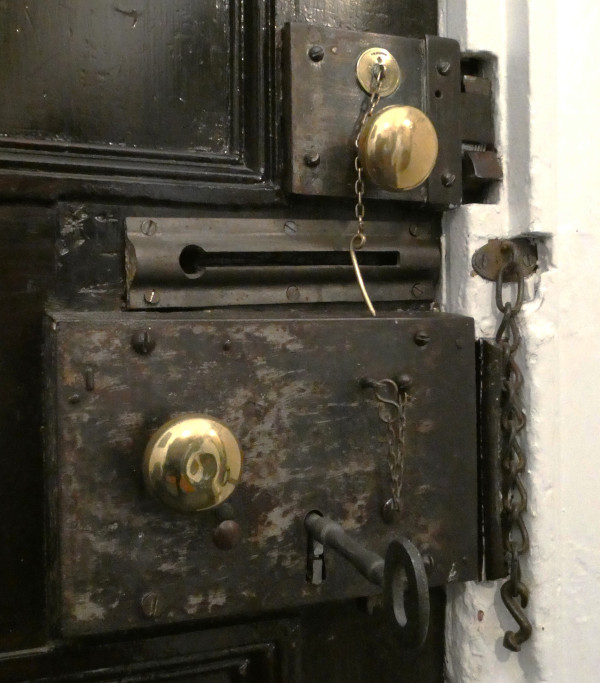
It was David and Ann’s family home from 1824 until his death over 30 years later. The house then sheltered tenants and transients for almost 70 years. A succession of owners for the next 50 showed it little love. By 1974, it was dingy and neglected but, thankfully, no one had tried to renovate it. I still turn Ann’s keys in two of her cupboards.
Two centuries before she moved in, according to Webster’s census of 1755, more than 31,000 people lived in barely one elongated square mile of towering, close-packed buildings, on either side of the medieval road running down from Edinburgh Castle to Holyrood Palace.
Advocates, aristocrats, paupers and many children lived hugger-mugger in rickety, insanitary tenements which on occasion fell down, frequently caught fire and bred crime and disease. Something had to be done.
Under the northern skirts of Edinburgh was the Nor’ Loch, into which the city’s effluent disgorged. Beyond were fields and open country. The City Fathers drained the Loch, bought up land, and held a blind competition to design a New Town.

When anonymity was lifted, they found that the design they had chosen was that of a young architect, James Craig. The Council minutes show that the City Fathers had their doubts.
They commissioned William Mylne, a mason, to produce a rectified plan. Mylne delivered a simplified grid of wide streets and squares and private gardens which was approved in July 1767.
Between then and the late 1780s, fine sandstone terraces of spacious, well-appointed houses and shops gradually covered the slopes up from Princes Street to George Street and down again to Queen Street where they looked over Lady Blair’s gardens and to the River Forth and the hills of Fife.
The houses were quickly filled with the new professional classes, the gentry, and the multitude of tradespeople required to keep them comfortable. The Council decreed the development of a second New Town, below Lady Blair’s gardens – now Queen Street Gardens.
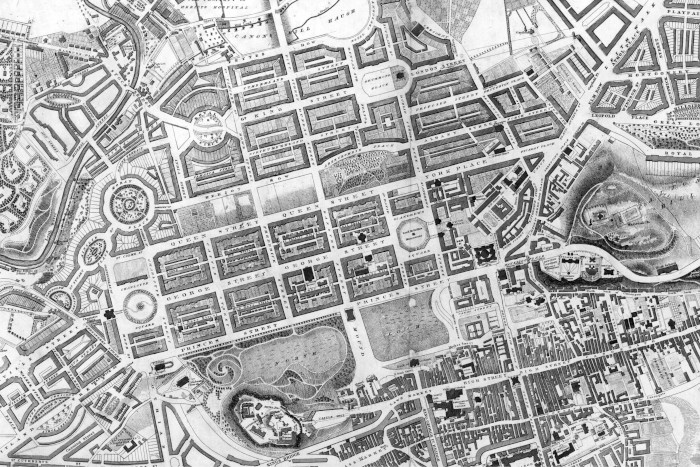
For the next 20 years, terraces were laid out, moving eastward and northwards towards the Bellevue Estate. The Council bought the Estate and Bellevue House, round which Drummond Place was built. In 1813, the City Fathers called for interest in building on Scotland Street, leading down from Drummond Place.
The story of my house, with its cast of pursers, naval agents, booksellers, silk merchants, boarding house/school keepers, horse traders, ministers of the Apostolic Church, surgeons, admirals, missionaries and washerwomen – and its widespread connections to Jamaica, Canada, Australia, Calcutta – was extracted from libraries, records offices, archives, family papers, museums, voters lists, church records, lending library records, colonial records, newspapers and journals, missionary society records… across the globe and over two centuries. My select resources list is 35 items long.
Perhaps the most astonishing moments of my long search were those when my own history crossed that of men and women who had passed through my house long before I was born.

10 Scotland Street – an opinionated history of one house over two centuries by Leslie Hills is published on 1 December.
Leslie Hills is a film producer. This is her first book.
See more about 10 Scotland Street.
You may also be interested in these features:
Rediscovering Edinburgh’s New Town by Sara Sheridan
George IV’s visit to Edinburgh in 1822 by Maggie Craig
Delving into the history of a house by Melanie Backe-Hansen
Homes for heroes: the council house revolution by Lizzie Lane
Images:
- Detail from book cover: © Scotland Street Press
- Scotland Street: © Jim Barton for Geograph (CC BY-SA 2.0)
- David Kedie Whytt’s family tree: supplied by Leslie Hills
- Scotland Street locks © Leslie Hills
- Edinburgh Castle and the Nor’ Loch: by John Slezer, Theatrum Scotiae, 1693: Wikimedia (public domain)
- Plan of the City of Edinburgh including all the latest and intended improvements by John Wood , 1823: reproduced with the permission of the National Library of Scotland


