
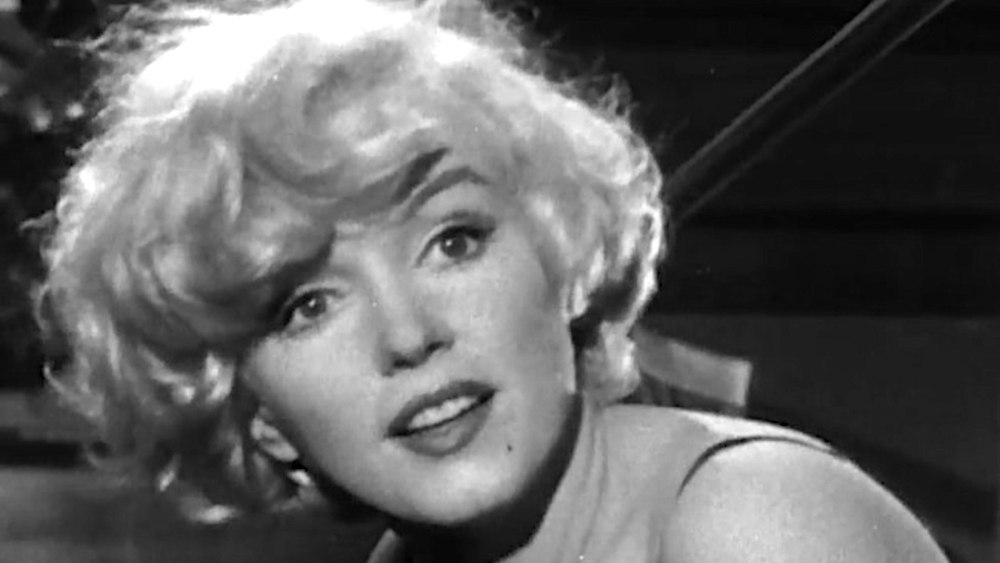
How does a historian challenge the ‘misogynistic Monroe myth’ of lateness, drinking, and emotional fragility? Not by denying it, says Lucy Jane Santos, but by showing that memories can be faulty, stories retold and reshaped for their audience – and Marilyn’s own words are largely missing. And by remembering that history, like memory, is not fixed.
If you’ve never seen Some Like It Hot, a brief sketch here will help to set the scene. Released in 1959 and directed by Billy Wilder, it follows two down-on-their-luck musicians – played by Jack Lemmon and Tony Curtis – who witness a mob hit in Chicago (the 1929 St. Valentines Day Massacre, no less) and flee the city.
Now calling themselves Josephine and Daphne, and in 1920s-style dresses, wigs and heels, they join a touring group of women musicians bound for Florida and fall in with Sugar Kane (Marilyn Monroe), the band’s ukulele player and singer.
.png)
What follows is a farce of multiple mistaken identities, romantic entanglements, and escalating absurdity – all of which culminates in one of the most famous closing lines in cinema history.
It’s an enduring classic which incorporates many different genres including crime, comedy and romance. It’s even part musical (but not enough of one to put you off if that’s not your type of thing) and part buddy movie. In short – it’s great and I love it enough to spend two years of my life researching and writing about it. If you haven’t already – go and see it!
I’ve never written a book about my favourite film before (my previous two books have been about the cultural and everyday history of radioactivity) but everyone seems to expect me to have a neat little anecdote about the first time I saw Some Like It Hot which tidily explains why I’ve written so extensively about it. But while the truth is much less obliging, in its own way, I think, it’s more instructive. Because I don’t remember it at all.
There is evidence, of a kind, of around the time I may have first encountered the film. A photograph of my teenage bedroom, dated 1993, shows a small newspaper clipping pinned to the wall – Jack Lemmon and Tony Curtis in full Daphne and Josephine mode.
So the movie must have meant something to me, or I wouldn’t have kept the clipping. But, on the other hand, it’s just one among hundreds of pinned images in a chaotic mix of my obsessions, so it didn’t necessarily mean everything to me at the time – though I do still have it.
And yet, when I later told friends from my early 20s that I was writing this book, their reaction was unequivocal. Of course I was writing about Some Like It Hot. Hadn’t it always been my favourite film? Hadn’t I talked about it constantly? So somewhere between that pinboard and those friendships, something had shifted and the film had become my film.
.jpg)
And that uncertainty, as it turns out, illustrates perfectly exactly where my problems began. Because memory – our own as much as anyone else’s – can be a treacherous foundation on which to build history. It is patchy, selective and – perhaps most importantly – largely shaped by what comes after.
And – as it turns out – when you’re writing about something as iconic as Some Like It Hot there is no shortage of memories and anecdotes. On the contrary, there are almost too many. But when you start to sift through them all, patterns emerge and you realise you are hearing the same voices, telling the same stories, and gradually, almost imperceptibility, forming a hierarchy.
In this particular case it is two voices that dominate above all others – Billy Wilder and Tony Curtis. And between them they have effectively narrated the film’s afterlife. They learned what stories worked, what drew laughter and, like any good raconteurs, they honed in on which ones got the best reaction — especially when the subject was Marilyn Monroe.
Almost everyone – whether they’ve seen the film or not, seemingly — knows the stories about her lateness, the forgotten lines, the drinking and emotional fragility. Those tales have been told so often that they have hardened into fact.
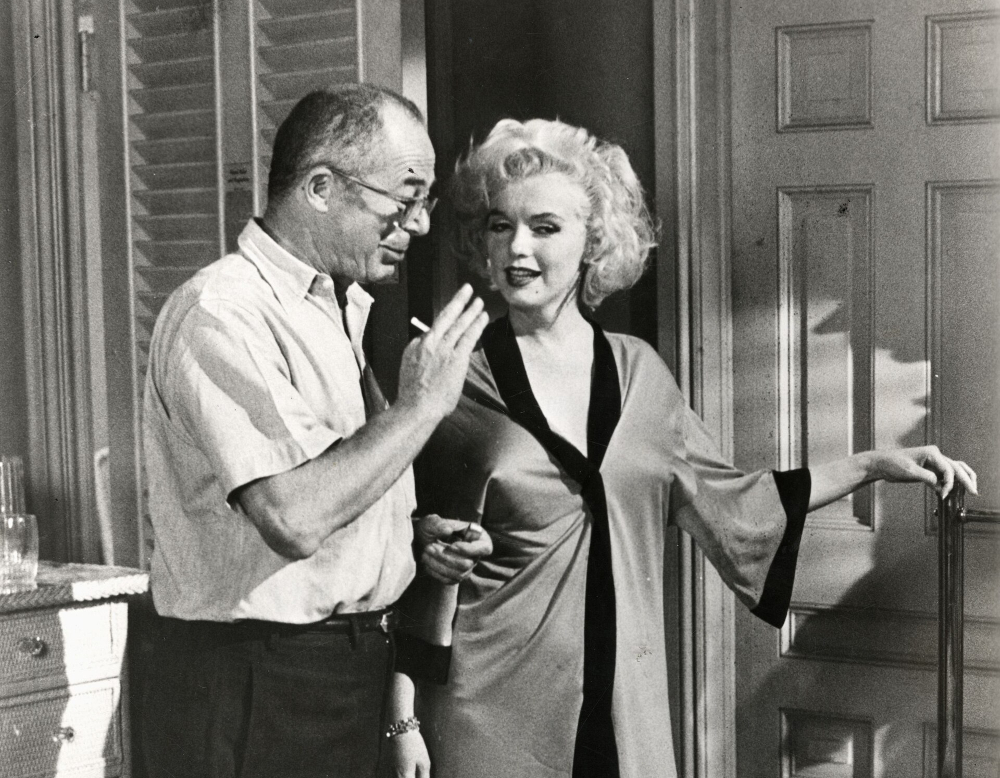
But, like any well-rehearsed anecdote, when you stop to look at them in detail they raise as many questions as they answer. Were things really so simple? Was Monroe truly as difficult as this version of events suggests? Or are we hearing a narrative shaped as much by the pleasure of storytelling (and hindsight) as the truth?
And one of the biggest difficulties here is that the most important counter-voice is largely absent. Publicly, she said very little about the experience, but there are memories from friends and family of how she felt which hint at her deep anxiety.
For example, after an early preview of the completed film, she is reported to have been distraught and convinced that audiences would laugh at her – not with her in the way she intended. We don’t know if she subsequently changed her mind as she recognised what the film became.
What we do have, however, are fragments – letters, notes, marginalia – that offer fleeting glimpses of her experience during filming. In them, we see her thinking about her performance, worrying about scenes and reflecting on her work. We can read her notes on how to approach Sugar’s vulnerability or trace the actress’s emotional state before, during and after filming.
The reason we have them at all is due to the way that her personal effects were preserved — after her untimely death at the age of 36 years old in 1962 — through a complicated chain of inheritance before, eventually, being dispersed through high-profile and very lucrative auctions.

There are, of course, ethical questions here. The transformation of personal belongings into commodities is not an uncomplicated good. But for historians, these materials offer something rare – access to the unguarded.
But while these traces do matter – and were incredibly important to me in writing the book – they do not fully redress the imbalance. And in the absence of her voice, others had time to fill the space — and not always generously.
There were multiple reunions, like the gathering at the Hotel del Coronado, the beautiful grand hotel in San Diego that stood in for the Seminole Ritz in the movie. There in 1984, for the 25th anniversary of filming, the surviving cast and crew revisited the locations and retold their now-canonical stories.
There were also lots of books, interviews and documentaries with each adding another layer. With every telling, the anecdotes became smoother, sharper and more certain.
As one commentator observed of Wilder, his stories are so well told, so often repeated, that we have passed the point where their factual accuracy can be easily disentangled from their narrative appeal.
Tony Curtis presents an even more complicated case. He spoke extensively about the film across decades and his accounts shift in tone and substance depending on his mindset at the time. In some periods, he is warm, even nostalgic; in others his recollections are clouded by bitterness, personal turmoil, or even seemingly the desire to provoke.
At one point he even made incredibly controversial and problematic claims – about Monroe, the exact nature of their relationship and events on set – that are impossible to substantiate and were later softened or retracted completely.
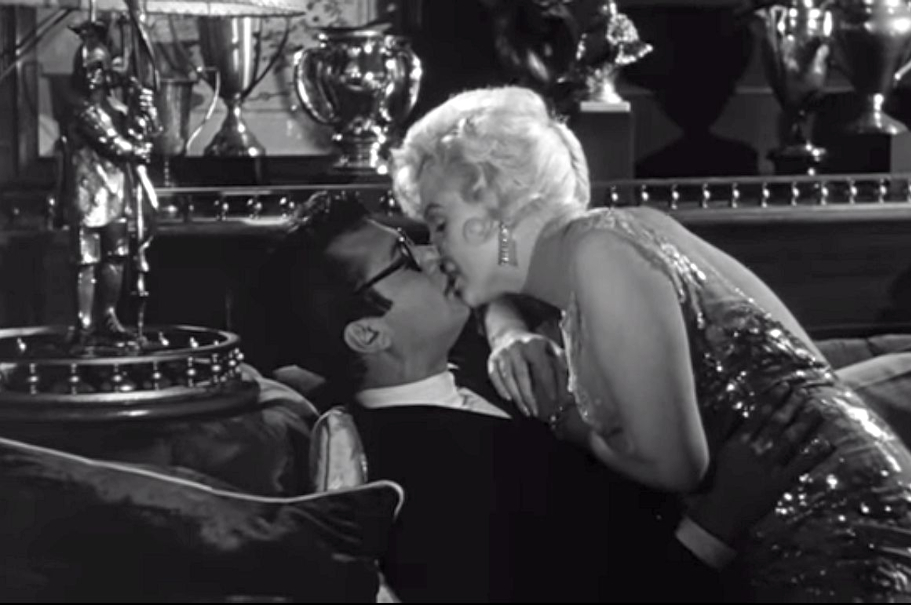
His most famous remark about Monroe – where he supposedly compared kissing her to kissing Hitler – offers a useful example. Even though people on set remembered him saying it over the years he variously denied it, or reframed it as irony, or as a flippant response to a foolish question. Finally, he conceded that he had said it, though not seriously. Which version of the story do you believe?
Which brings us back to the central difficulty – and the point at which a historian’s task becomes something more than discovery but also about discernment.
Writing this kind of history is not simply a matter of gathering information – although I was very pleased to find fresh sources of newly archived material to draw upon – it’s also about weighing voices that are unevenly distributed and shaped by time. The task, then, couldn’t possibly be to recover a single, definitive account – after all too much time has passed, and too many stories have been told – but to hold competing narratives in tension.
And, crucially, it is about asking what happens when those imbalances go unchallenged.
So I place a very large emphasis of my work in the broader context of the dismantling of what we might call the ‘misogynistic Monroe myth’ – that persistent tendency to reduce her to a set of failings, often exaggerated and frequently detached from context. It’s a myth sustained not only by hostility but by habit – by the ease with which certain stories are told and retold without scrutiny. In the years after her death, an entire industry emerged devoted to examining, reinterpreting, and at times, dismantling her life.

The woman became the symbol and the symbol proved remarkably resistant to correction. As Sarah Churchwell has observed in The Many Lives of Marilyn Monroe, much of this material tends towards what might fairly be described as ‘trashing Marilyn’: she found that in her survey of 300 biographies, most took a notably mean-spirited tone to say the least. But it is also clear that even in the well-meaning accounts the author often circles back to the same set of stories.
To counter this narrative meant returning to the sources and reading against the grain of well-known accounts, testing their claims and paying attention not only to what was said but to what was omitted. And what becomes clear when you widen the lens, is that Monroe was working under extraordinary pressure – including professional, personal and medical – in an industry that was not always equipped, or inclined, to accommodate vulnerability.
The behaviours that were framed as uniquely problematic begin to look rather different when set alongside the broader realities of Hollywood at the time. This reassessment does not require us to ignore the difficulties of the Some Like It Hot production, and by most accounts – and, indeed the studio production records – it was indeed challenging. There were delays, frustrations and moments of genuine strain.
To challenge that myth is not to replace it with another, more flattering fiction. It is, instead, to complicate the picture and to acknowledge the contradictions and accept uncertainty. And to remember that history, like memory, is not fixed. It is something we return to, again and again – each time with the chance to see it a little differently.
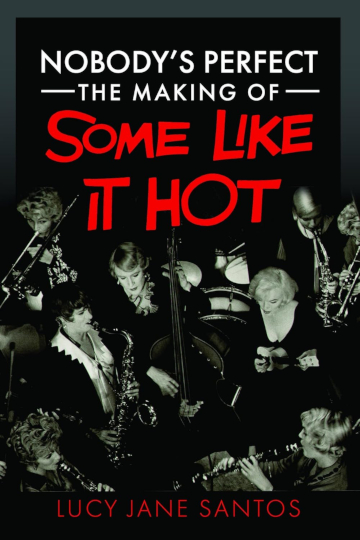
Nobody’s Perfect: The Making of Some Like It Hot by Lucy Jane Santos is published on 30 August, 2026.
Read more about this book.
Lucy Jane Santos is a writer, presenter and consultant researching the unexpected places where science, culture and consumerism meet. Her work ranges across beauty, science, technology, popular entertainment and nightlife, uncovering fresh angles and new insights into the moments that have shaped the modern world.
Lucy has written a couple of features for us about one of her main fields of research – – radiation history:
Looking for radioactivity in Las Vegas
How to radium party
Related Historia pieces include:
Historian or novelist? Writing fiction based on facts by Julie Owen Moylan, which also looks at writing about Marilyn Monroe
My problems writing about Jackie Kennedy and Maria Callas by Gill Paul
The delights and dilemmas of using real people in historical fiction by Chris Lloyd
Should historical authors feel guilt when they write real people as antiheroes? by AJ West
The Minister for Illusion: Goebbels and the German film industry by Catherine Hokin
Magicians and film-makers, masters of illusions by Liz Hyder
The Ghosts of Silent Film by Essie Fox
Images:
- Marilyn Monroe in the Some Like it Hot trailer, 1959: Wikimedia (public domain)
- Some Like it Hot poster, 1959: Wikimedia (public domain)
- Tony Curtis and Jack Lemmon in the Some Like it Hot trailer, 1959: Wikimedia (public domain)
- Director Billy Wilder and actress Marilyn Monroe during the filming of Some Like It Hot (cropped): Touring Club Italiano via Wikimedia (CC BY-SA 4.0)
- Tony Curtis, Jack Lemmon and Marilyn Monroe from the trailer for the film Some Like It Hot 1959: Wikimedia (public domain)
- Marilyn Monroe and Tony Curtis in a promotional image for Some Like it Hot, 1959: Wikimedia (public domain)


