
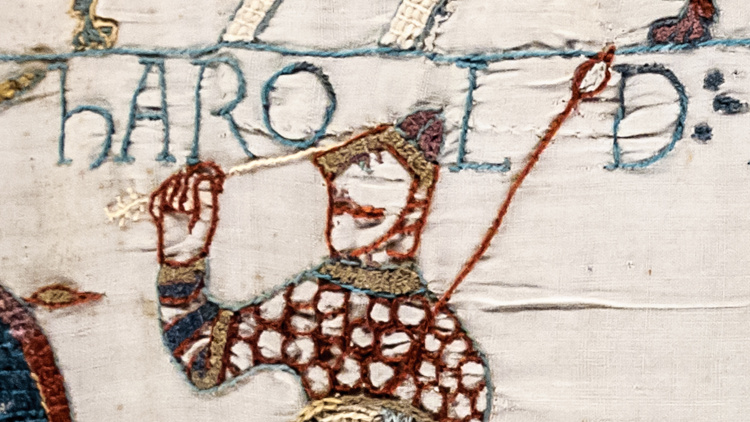
When the Bayeux Tapestry comes to the British Museum next year it’ll be easier for many of us to see for ourselves the moment that changed English history for ever: Harold Godwinson shot in the eye at the Battle of Hastings. But, says Paul Bernardi, that may not be what happened on 14 October, 1066. His explanation may be one in the eye for our accepted image of King Harold II’s death.
It’s one of the most iconic images from the history of these isles. What’s more, it happened during what historian Tom Holland called “…the most pivotal event in English history.”
I am, of course, referring to the death of King Harold II of England at the Battle of Hastings in October 1066. As generations of schoolchildren have been taught, for much of the day, the Saxon shieldwall held firm (for the most part) on top of Senlac ridge, until Harold was mortally wounded by an arrow that struck him in the eye.

But is it true? Is that what really happened? Have we been misled all this time about the king’s true fate and, if so, why?
I should begin by saying that the Norman army did contain a sizeable contingent of archers on that autumn day. It could well be probable that King Harold was struck by one, or maybe more, arrows during the battle. What I would contest, however, is that an arrow was the – or the sole – cause of his death.
Where does the arrow story come from then? Well, the most well-known evidence comes from the Bayeux Tapestry which was created within a few years of the battle. Almost everyone will be familiar with the scene that shows a Saxon clutching an arrow that protrudes from his face, under the Latin text which states: “King Harold was killed”.
Checkmate then? Not quite. Firstly, there’s two figures in that scene: one clutching the arrow and the other being hacked down by a Norman knight. Are they supposed to be the same man or different? The former is doubtful given that man 1 has a shield and man 2 has no shield but carries a war axe. We can’t be certain which one is Harold.
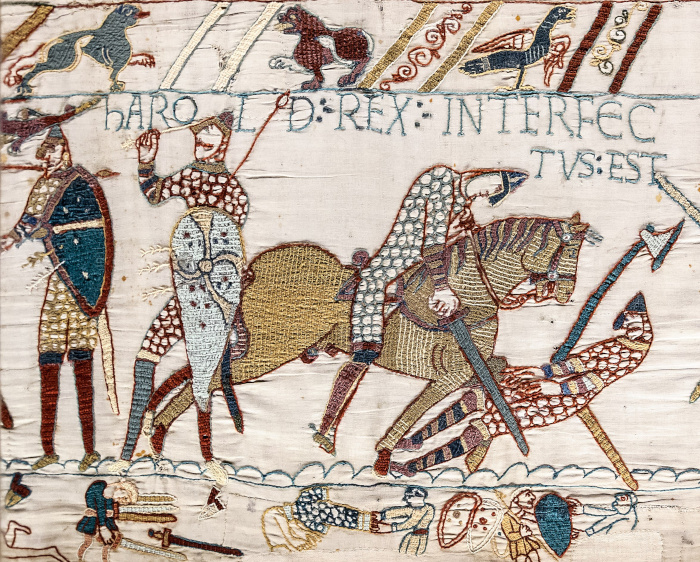
More damning, however, is the claim that the man on the left doesn’t even have an arrow in his eye. Rather, this current depiction is the result of several restorations over the years. Modern analysis shows he was originally holding a spear above his head.
Note: as will become clear, I believe the man on the right is Harold.
What about the chronicles? Two of the most famous chroniclers of the era (William of Malmesbury and Henry of Huntingdon) both mention the arrow:
“His brain was pierced by an arrow.” (William)
“The whole shower sent by the archers fell around King Harold and he himself sank to the ground, struck in the eye.” (Henry)
However, both men were writing in the 12th century, a good few decades after the events. By then, they would not have had access to anyone with a living memory of the day.
Are there any more contemporary sources? Yes, and this is where it becomes interesting.
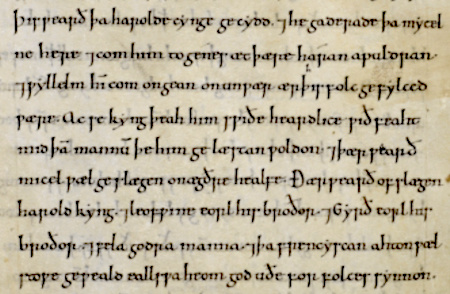
There are four. None of them makes mention of death by optical penetration. Two of them (the Anglo-Saxon Chronicle and William of Jumièges) provide little in the way of information about the battle and, as such, might be excused for not going into that level of detail.
That leaves us with two. Firstly, William of Poitiers’ Gesta Guillelmi. William was close to the Conqueror, having been his personal chaplain. Though he was not at the battle, he could talk to many of those who had been. He offers a very detailed account of the battle but – and this is the key point – frustratingly does not say how Harold died.
Why? Surely, he knew. Yet he didn’t see this important enough to include in his, otherwise, very comprehensive account? If the arrow story was true, there would have been no reason not to include it. If you’ll forgive the anachronism, it’s a hugely cinematic scene that would hold great appeal to his readers.
Then there’s the Christian theme. What could illustrate God’s judgement better than the noble savage being struck down by an arrow from on high? A fitting end for a supposed oath-breaker. But Poitiers remains silent. For me, that says two things: firstly, it didn’t happen; secondly, what did happen was far less savoury and far more damaging to his master’s reputation.

This brings us to the Carmen de Hastingae Proelio (or Song of the Battle of Hastings), attributed to Guy, Bishop of Amiens. It is held to be the earliest known source, written within months of William’s coronation, in early 1067.
The Carmen states that, late on in the day, Duke William spotted King Harold in the thick of the fighting, casting down all and sundry with his sword. Seizing the opportunity, William, with a small group of knights, charged and succeeded in killing Harold.
The manuscript then lists the gory details of the injuries inflicted: pierced with a lance, beheaded with a sword and disembowelled with a spear. It goes on to say that his ‘thigh’ was hacked off and carried away some distance (spot the euphemism).
This account is the most plausible and likely the most accurate for one key reason. To achieve his objective, William had to cut the head off the snake. If Harold survived, the Duke’s prospects would have been bleak. Winter was coming; he was in a foreign land with no friends and little hope of reinforcement or resupply. Thus, Harold had to be killed, and very obviously so.
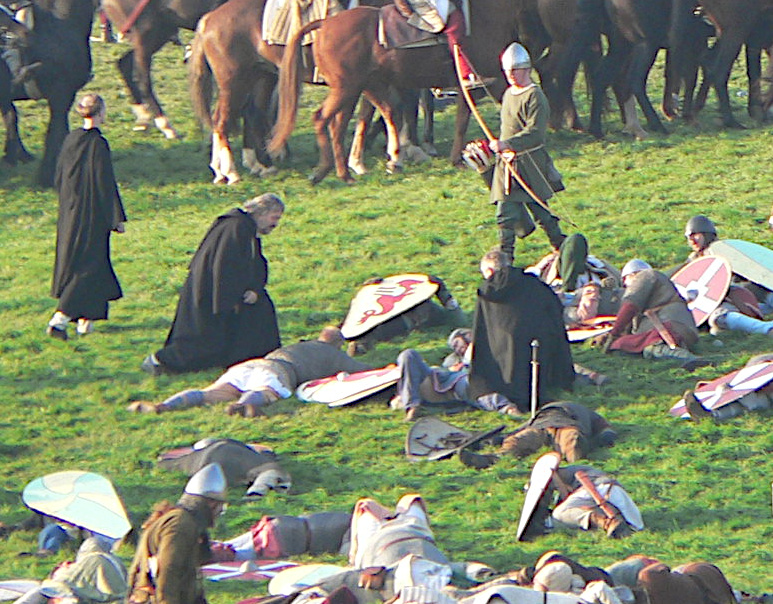
Hacking the man to pieces with a group of like-minded individuals was the only, really definitive solution. To leave it to chance in the form of a lucky bowshot… No.
For further – admittedly circumstantial – evidence, in the aftermath of the battle, Harold’s ‘common-law’ wife, Edith Swan-neck, went to the battlefield to find the king’s body for burial.
Apparently, she could only identify his remains by certain marks known only to her (a florid birthmark on his backside, perhaps?). Edith’s ordeal, therefore, appears to back up the Carmen’s assertion.
In summary, we may never know exactly what happened. The Normans did loose a prodigious number of arrows during the battle, so there is a fair chance that one or more struck the king. But we also know that William was in a very precarious situation; he had to kill Harold outright rather than risk him slipping away into the gathering gloom.
Finally, as history tends to be written by the victors, a little bit of airbrushing to protect their man’s heroic reputation would not be unusual.
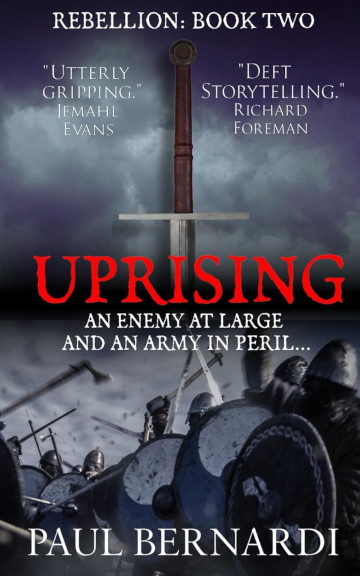
Uprising by Paul Bernardi was published on 16 April, 2025. It’s the second book in his Rebellion series.
Paul Bernardi studied Anglo-Saxon History at the University of Leeds and now writes historical fiction set in this period.
With 1066 and the Bayeux Tapestry being in the spotlight at the moment, we have a review of BBC TV’s King & Conqueror by Annie Whitehead, the historian and author.
And when the Tapestry comes (home?) to this island on loan to the British Museum in September, 2026, we’ll also have a feature linked to the exhibition.
Historia stories related to Paul’s include:
The Norman Conquest in Numbers and
After Hastings by James Aitcheson
Writing about 1066: a male club? by Ellen Alpsten
The Normans: Conquest Through Adaptation by Ruadh Butler
Murder and the law in Anglo-Saxon England and
Anglo-Saxon women with power and influence by Annie Whitehead
A life of war in Anglo-Saxon Britain by Edoardo Albert
England’s Twice-Crowned Queen by Patricia Bracewell
The royal women of 10th-century England and ‘England’ in the 10th century by MJ Porter
Images:
- Harold Godwinson’s death, Bayeux Tapestry, scene 57: Myrabella for Wikimedia (public domain)
- Norman archers, Bayeux Tapestry, scene 51: Wikimedia (public domain)
- Description of the battle in Anglo-Saxon Chronicle D (Cotton MS Tiberius B IV, f. 80r), detail: © British Library (CC BY 4.0)
- Beheaded man, Bayeux Tapestry, scene 54: Wikimedia (public domain)
- See 1
- Searching the dead, Battle of Hastings reenactment, 2006: Snake3yes for Flickr (CC BY 2.0)


