

Was CS Lewis a misogynist? Many people think he was, often based on what’s called the ‘Susan problem’ in The Last Battle. But while researching her debut novel, a mystery based on his life in Oxford in the 1940s, Maureen Paton found plenty of evidence to show that he was not; in fact, he challenged the gender stereotypes of the time.
Does a biofiction author who dares to turn a real person into a secret detective have a right to claim any expertise on the established facts of his life? Heck, yes! Historical novelists have the challenge of rooting their heroes in certain reality to give a reassuring air of authenticity that persuades readers to suspend their disbelief when the fiction takes off.
It’s all about plausibility. As the best-selling fantasy author Victoria Aveyard put it in a recent Bookseller interview, “I always strive for the moments of realism because that makes you believe all the unreal things.”

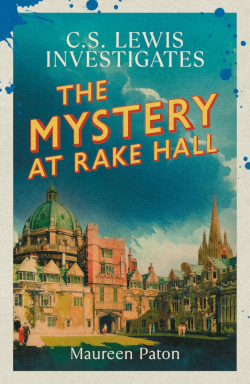
Before creating an alternative life in 1947 for the Oxford academic and author CS Lewis in my debut historical crime novel, The Mystery at Rake Hall, I went to the primary source of Lewis’s own words as well as several biographies.
Alongside more than 30 published works, he also wrote thousands of letters. And all my research convinced me that this middle-aged bachelor don had just the right real-life qualities for his fictional alter ego to fight against evil and the exploitation of women in post-war Oxford.
So I find it beyond exasperating when the ill-founded allegation that Lewis was a misogynist still keeps on lazily doing the rounds of the literary pages because of a couple of misinterpreted quotes by two female characters in Lewis’s final Narnia novel, The Last Battle.
It’s known as the Susan Problem, with Jill Pole and Polly Plummer criticising Susan Pevensie, one of the heroines of The Lion, the Witch and the Wardrobe and Prince Caspian, for no longer being interested in Narnia, having switched to “nylons and lipstick and invitations”. Intellectual snobbery or elitism, maybe, for sneering at the superficiality of what we might now call an ‘airhead’. But a sign of misogyny on Lewis’s part to put those words into their mouths? Hardly!

After reading the Chronicles of Narnia in childhood, I first came across Lewis’s adult books in my first year at university when I studied The Allegory of Love on my English course. Published in 1936, its empathy for women was an eye-opener — and has stayed with me ever since.
In his opening chapter on Courtly Love, he lambasts the French poet Chretien de Troyes for a caveman attitude in his poem Erec and Enide, which Lewis calls “almost certainly an early work [in which] the later rules of love and courtesy are outraged at every turn [in this] story of married love… only a passive role is… allowed to [Erec’s wife Enide].
“[Before their marriage, he and] her father talk of her in her presence as if she were a child or an animal…and just as he had allowed Enide to groom his horse for him before their marriage, so, in their journeyings [afterwards], he lets her watch and hold the horse all night, while he himself sleeps at ease beneath the cloak which she has taken from her own back to cover him. We are… in a world where women are merely the mute objects of gift or barter,” he thunders.
Nine years later, Lewis again showed his feminist credentials in 1945’s That Hideous Strength, the final novel in his science fiction trilogy. The book’s heroine, Jane Studdock, manifestly brighter than her slow-on-the-uptake husband Mark but lacking his status as a university Fellow, is seething with frustration at her limited life as a faculty wife.

Lewis writes her so well that he must have encountered many such female academics who despised the idea of what Jane calls “the little woman of sentimental fiction, running for comfort to male arms”.
After all, one of his women friends was the celebrated crime novelist Dorothy L Sayers, who – along with a fictitious college scout’s daughter – I’ve turned into my fictionalised Lewis’s partner in crime-fighting because… it seemed only logical, m’lud.
Jane regards Mark and two other male characters as “complacent, patriarchal figures making arrangements for women as if women were children or bartering them like cattle.” And more than once she expresses resentment at being expected to ask her husband’s permission for anything. All of which speaks clearly across the decades to our modern sensibilities.
This is not to deny that Lewis had his moments of sexism (though no evidence of the more serious offence of misogyny, or woman-hatred) in his callow youth. The charge sheet against him back in 1927 shows that the then 28-year-old Lewis voted alongside the majority of Oxford dons to impose quotas on the number of women admitted to degree courses for fear that positive discrimination might lead to lower academic standards.
.jpg)
“There was fierce opposition, of course, our female antagonists being much more expert than we in the practice of ‘whipping’ in the parliamentary sense,” he added mischievously with a showboating bravado in a letter to his brother Warren on 9 July that year.
But as The Allegory of Love revealed, the older and wiser Lewis went on to become a far more evolved human being who had put away such childish things as the playful baiting (on paper) of what he had nicknamed “the wimmen”. And when he began writing his Narnia adventures in the late 1940s, much of the action is seen from the point of view of his cherished girl characters, who prove themselves more than equal to the bravery and enterprise of the boys.
He did allow Father Christmas in The Lion, the Witch and the Wardrobe to assert that “wars are ugly when women fight”, but that was not so much a lapse of Lewis’s feminism as an example of his old-fashioned gallantry. I suspect he would have voted against recruiting women for frontline fighting, having found First World War combat horrible enough even as a man according to his memoir #SurprisedByJoy.
But it’s only right and just to acknowledge that Clive Staples Lewis was way ahead of his time in challenging gender stereotypes. He emphatically does not deserve to be demonised by the M-word.
The Mystery at Rake Hall by Maureen Paton was published on 24 April, 2025, and the paperback on 1 January, 2026.
Maureen is a freelance arts journalist and non-fiction author. The Mystery at Rake Hall is her fiction debut, with a second CS Lewis Investigates novel – The Gargoyles Mystery – out in 2027.
Historia features on similar topics include:
Historian or novelist? Writing fiction based on facts by Julie Owen Moylan
My problems writing about Jackie Kennedy and Maria Callas by Gill Paul
The delights and dilemmas of using real people in historical fiction by Chris Lloyd
Should historical authors feel guilt when they write real people as antiheroes? by AJ West
Images:
- The Searcher by Ross Wilson, statue of CS Lewis looking into a wardrobe, Belfast (cropped): klndonnelly for Flickr (CC BY 2.0)
- Young woman, illustration from The Ladies’ Home Journal, 1949: Internet Archive (public domain)
- King Arthur chasing the White Stag, illumination from manuscript of Chrétien de Troyes’ Érec et Énide, c1275: BnF, Manuscrits, Français 24403 fol 119, via Wikimedia (public domain)
- Photo of CS Lewis by John S Murray from the US edition of Till We Have Faces: A Myth Retold, 1957: Wikimedia (public domain)
- Front cover of first edition of The Last Battle, low resolution, used for identification in the context of critical commentary of the work for which it serves as cover art: Wikimedia


