How best to write a novel about events in recent — and still sensitive and painful — history? That was the question Bryan J Mason faced when he began his trilogy set in Northern Ireland during the Troubles. His solution may be surprising, but it reflects the reality of life there.
Although a recognisable period in our recent history, ‘the Troubles‘ is a curiously understated name, sounding more like a euphemism. The period to which it refers, 1969–2001, saw a brutal sectarian conflict resulting in over 3,500 deaths and more than 47,000 injuries on the island of Ireland and the UK mainland.
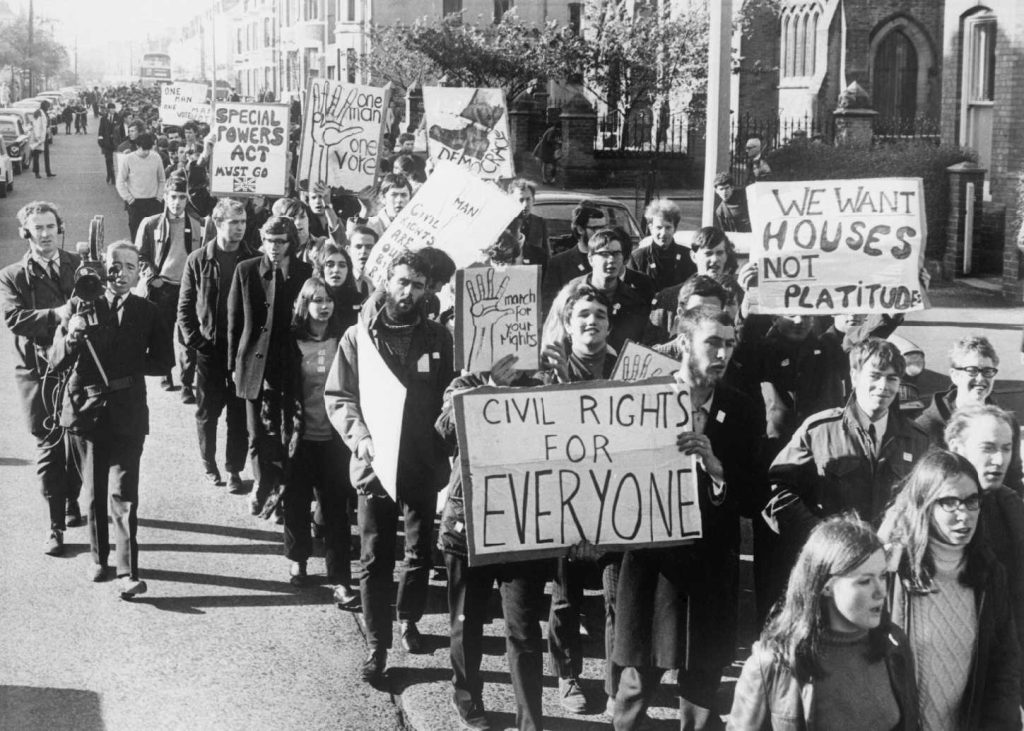
There have been references to ‘the troubles’ as a synonym for violent conflict since the Plantation of Ulster in 1609 when English and Scottish settlers received land from the native Irish, but matters came to a head in the late 1960s when civil rights marches met with violence from those opposed to them.
The Troubles were a life-changing experience for everyone who lived through them, and even though the Good Friday Agreement of 1998 ushered in a path to peace, enmity and repercussions still linger. A week rarely goes by without past events being cast into the spotlight.
The recent announcement by the British Government to repeal and replace the controversial Legacy Act, which provided immunity from prosecution, is a case in point.
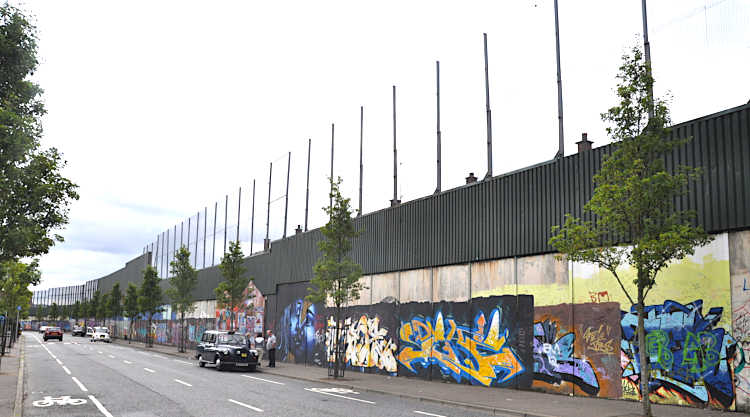
The Peace Line, erected between the Catholic Falls Road and Protestant Shankill Road is still there. And not to mention the Irish language rap group Kneecap helping conjure up memories of antagonism and punishment beatings.
Why then write a black comedy crime series set during the period, and how can humour be sensitively injected into such a time that featured so much pain and suffering?
I first visited Northern Ireland around 1995 and, although everything about the place seemed entirely familiar, it was clear that things were far from normal. As a keen follower of current affairs, I was aware of the political situation, but my brief time there impressed two things on me.

I stayed at the Europa Hotel (‘the most bombed hotel in Western Europe’), which offered guests free local newspapers. I picked one up and read a story, then I picked up another; it covered the same story but had an entirely different complexion. When I read a third, with a further variation, it became apparent that matters were not black and white. No one side had a monopoly on the truth, on understanding or of wisdom.
But then something else happened. I talked to people who had lived through the Troubles, and I found the combination of warmth and wit, which was often tinged with grim irony, attractive. The phrase ‘gallows humour’ was never more appropriate.
This is illustrated by a Northern Irish friend’s response when I invited him to my book launch event in Belfast. He asked, “What’s the dress code? Is it informal or black balaclava?”
As a history graduate, I have long been fascinated by the political world and wanted to write a story about what would happen if I introduced a complete outsider into the closed sectarian atmosphere of Northern Ireland during the Troubles.
In doing so, I felt a dual responsibility, not only to accurately reflect what really happened but also to entertain. My storyline employs a fictionalised account, some of it comic, but graphically referencing some awful real-life episodes.

I decided to invent a situation that would fit the strange times. My detective hero, Harry Burnard, arrives in Belfast seeking an exciting career in the most dangerous part of the United Kingdom. He himself is a loner and has a strongly held belief about who he is: Jewish. Identity is such a strong feature of life in Northern Ireland, and the theme is an ongoing critical one across the trilogy.
Harry is appointed to lead a team in the Royal Ulster Constabulary (RUC), ‘The Squad’; a bunch of abandoned oddballs who are only allowed to work on criminal cases and not terrorism. But there is no crime, only terrorism, so they have nothing to do except cases of pet disappearance and drunkenness.
Harry sets about uncovering crime, and in doing so, the characters blend a black comedic approach with real, often shocking, events and outrages. The Squad love bestowing nicknames (in a nod to sectarian violence, two PCs, Tommy Tarr and Jimmy Bird, are almost identical in appearance and known as ‘Tarred and Feathered’.)
As well as dealing with the horrors they experience, almost every character is obsessed with biscuits and have to navigate a bewildering array of acronyms, many of which start with the letter ‘U’; UVF, UDR, UDA, UFF, IRA, INLA, FRU and RUC.
I do not shy away from portraying the paramilitaries involved in the conflict and prefer to concentrate on their similarities and blinkered approach. The IRA’s ‘Mad Man’ McGeehan and UDF’s ‘Mad Man’ McGoohan are killed off by their own side in a case of mistaken identity, before their replacements ‘Wild Dogs’ Doran and Duneen find themselves victims of a botched assassination.
The current incumbents give a nod to Irish history with the loyalist ‘Wild Cat’ Carson and republican ‘Wild Cat’ Collins holding a tentative grasp on power in their own separate enclaves.
The theme of identity and deluded identity extends to the use of double agents, informants, and collusion. The real-life Freddie Scappaticci, the biggest agent the British Security Service had in the IRA, has inspired my character Carlo Fontaine. Only in my case the code name ‘Stakeknife’ has been replaced by ‘Cucchiaino’, which is Italian for teaspoon.
There has been a gratifying positive reaction to the series, not least from readers in Northern Ireland, and I can feel the resonance with other works of fiction, such as the BBC TV Drama Blue Lights, set in present-day Belfast and Anna Burns’s Man Booker Prize-winner novel Milkman.
A recent five-star review captures what I strove to achieve: “Laugh out loud funny… but scary as hell too. A perfect combo.”
The title of the first novel in the series refers to a question asked to identify religious affiliation. “Are you a Billy, or a Dan, or an Old Tin Can?” In other words, are you Protestant, or Catholic? But what if, like Harry Burnard, you are neither? What happens to an old tin can? It is kicked down the road, of course. Harry discovers an ambiguity in his own identity and must avoid that fate.

Dead On by Bryan J Mason is published on 5 November, 2025. It’s the second Harry & The Squad novel. An Old Tin Can began the trilogy, which will conclude with There Are No Happy Endings in 2026.
Read more about this book.
You may also be interested in these Historia features:
The never-ending Battle of the Boyne and Why the Glorious Revolution was . . . well, neither, both by Angus Donald
The Other Conquest – 850th anniversary of the Norman invasion of Ireland by Ruadh Butler
Why I wrote about Irish history by Tom Williams
Images:
- The Peace Line, Belfast: Rune S Selbekk for Store norske leksikon (CC BY NC SA 3.0)
- Belfast students march for civil rights, 1968: IWM Central Office of Information Agency Collection HU 55866 (Non-commercial Use)
- The Shankill Road, Belfast, during the Troubles: Fribbler for Wikimedia (CC BY-SA 3.0)
- Royal Ulster Constabulary GC Land Rover Tangi passing Belfast City Hall: Wikimedia (CC BY-SA 2.0)
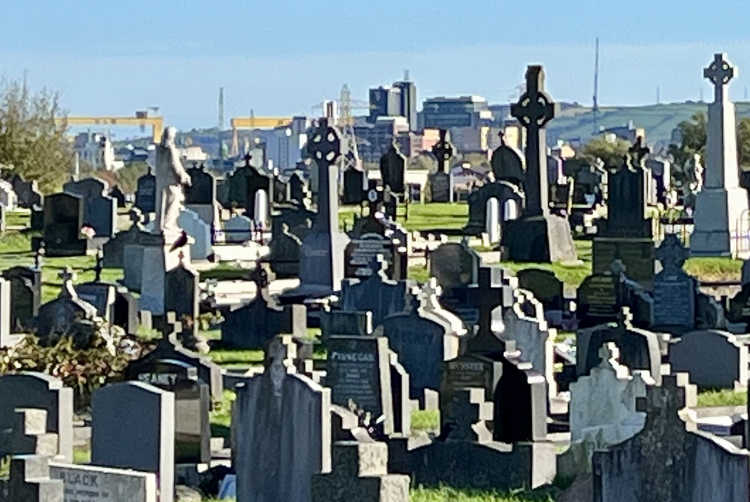
- Gravestones in Milltown Cemetery, Andersonstown area of West Belfast, with the iconic yellow Harland & Wolff shipyard cranes in the distance: © Bryan J Mason


