
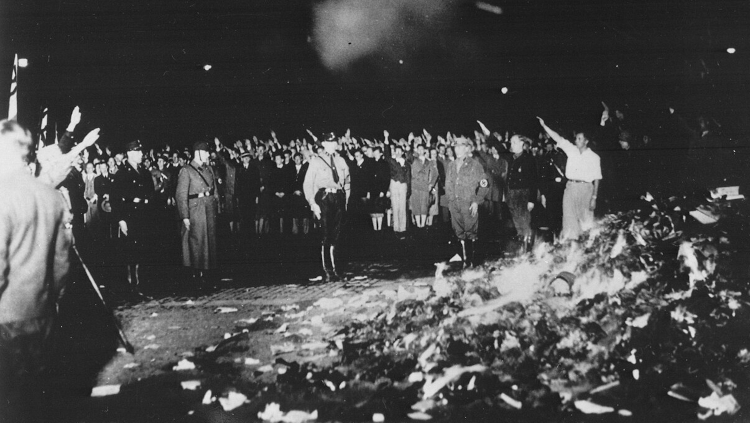
Chris Lloyd, author of the Occupation series of crime novels about Nazi-occupied Paris, argues that the widescale looting of books, now largely forgotten, was more sinister and insidious that the famous book-burnings of the 1930s. Because it wasn’t done for display; it was for a calculated culture war.
“You don’t have to burn books to destroy a culture. Just get people to stop reading them.” — Ray Bradbury
Many of our images today of book burning stem from the infamous public bonfires of forbidden books under the Nazis. It’s an image that shocks, but it is also an image that has obscured a lot of the truth.

Much has been written and filmed about the art theft committed by the Nazis in the countries they occupied, but in many ways the widescale looting of books, which has become largely forgotten, was much more sinister and insidious.
In The Art of Occupation, the fourth book in the Eddie Giral series about a French police detective in Paris under the Nazis, I write about art theft. About Hermann Goering’s shopping trips to Paris, where he would sip champagne and take his pick of ‘confiscated’ art.
About the bravery of Rose Valland, the curator at the Jeu de Paume – where the Nazis temporarily stored the stolen art – in secretly recording the destination of every piece of art looted and placed on a train to Germany. About the attempts of the Resistance to save as much of the art as possible before it was removed. But I also write about the theft of books and, perhaps more tellingly, the reasons for their theft.
To return to the image of the Nazis hurling forbidden books or books by authors out of favour with the regime into the flames, it’s important to remember that this only took place over a short period of time, when they first came to power. By 1941, when The Art of Occupation is set, the Nazis had long since stopped burning books, and the reasons for that were perhaps even more shocking than the sight of literature and thought reduced to ashes in front of baying crowds.

The image of the Nazis as cultural vandals destroying any intellectual thought or any manifestation of it has been persistent, but even they knew that more important than destroying what they loathed was controlling it.
Instead of burning books, they gathered them up and kept them, using them to study the people they deemed to be their enemies for their own purposes. They turned from thuggish attacks on books by Jews, Communists, intellectuals and any other group that frightened them to studying them, which was far more disturbing.
Among the reasons why they studied the books was to know the ways in which they could influence or attack their creators. Hitler spoke of an antisemitism of reason, one aimed at justifying the actions taken against Jews and at the elimination of any privileges they might hold by appearing to adhere to legal and intellectual niceties. The Nazis adopted a pseudo-intellectual and scientific policy regarding books and writers opposed to their beliefs aimed at attracting support from academia and the public in general to further their own cause.
They also understood the importance of the printed word. Not only were they using it to study the people they regarded as their enemies, to find their weaknesses and vulnerabilities, to use their own culture as a weapon against them, but by stealing books, they were also robbing cultures of their history and heritage, the stories and learning passed down through generations that defined them.

The theft of their literary culture was a way of robbing them of their history and their collective memory and subsequently controlling it.
In Paris, the first step was shortly after the start of the Occupation, when the Occupiers drew up an inventory of publishers, booksellers, libraries and even bouquinistes by arrondissement. This eventually led to the Liste Otto of forbidden publications, on the basis of which French police raided seventy publishing houses, closing eleven of them and seizing over 700,000 books.
The next step were the Jewish and émigré libraries, bookshops and private libraries where the Occupiers stole some 400,000 books in the autumn of 1940. Affected authors ranged from Georges Duhamel, a critic of the Nazis and Vichy, to Shakespeare, GK Chesterton, Virginia Woolf and Thomas Mann. Even Gone With the Wind was out of bounds. Unlike the art that was looted, the vast majority of the books taken were never recovered.
In the summer of 1940, the Einsatzstab Reichsleiter Rosenberg or ERR, formed by Alfred Rosenberg with Hitler’s blessing to collect confiscated artworks for a proposed collection in Germany, took over the Alliance Israélite Universelle on Rue de la Bruyère.
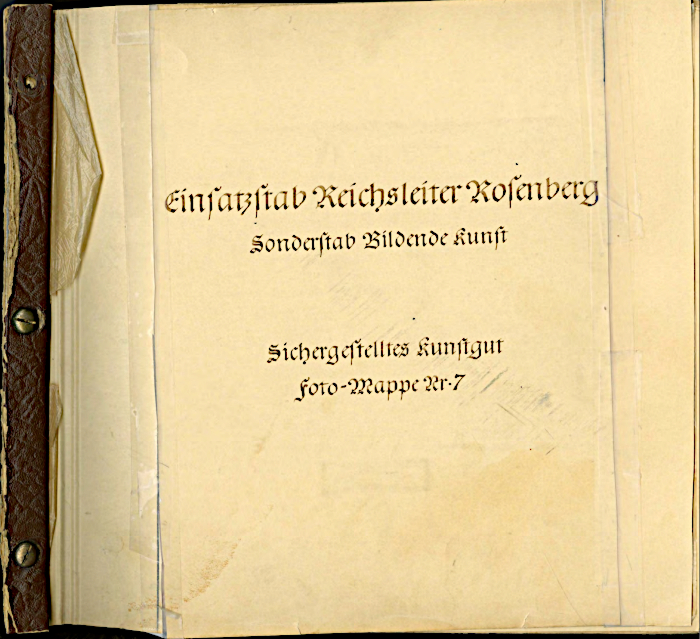
By the end of August, the shelves of the library had been emptied of their original 50,000 volumes and refilled with books looted from other libraries, awaiting in turn their shipment to Germany. Unique and irreplaceable volumes were stolen and never recovered, including copies of the Talmud.
Other Jewish libraries fell victim to theft, as did the émigré libraries. For centuries, Paris had been home to political and intellectual refugees, who had all contributed to freedom of thought, creating important libraries in the city. Each of them, Russian, Polish, Ukrainian, were also looted.
Private collections fared no better. The Rothschilds, Léon Blum, Georges Mandel – a right-wing politician who fell foul of Vichy – Ida Rubinstein, all saw their collections taken. A lot of their books were of great cultural value, first editions signed by their authors: Proust, Gide, Malraux, Valéry and Dalí.
It’s not just books, but the libraries themselves that were irreplaceable. Even when individual books are saved, the collections of which they were a part became at best fragmented. They were built up over decades or centuries, the sum of the people or societies that created them.
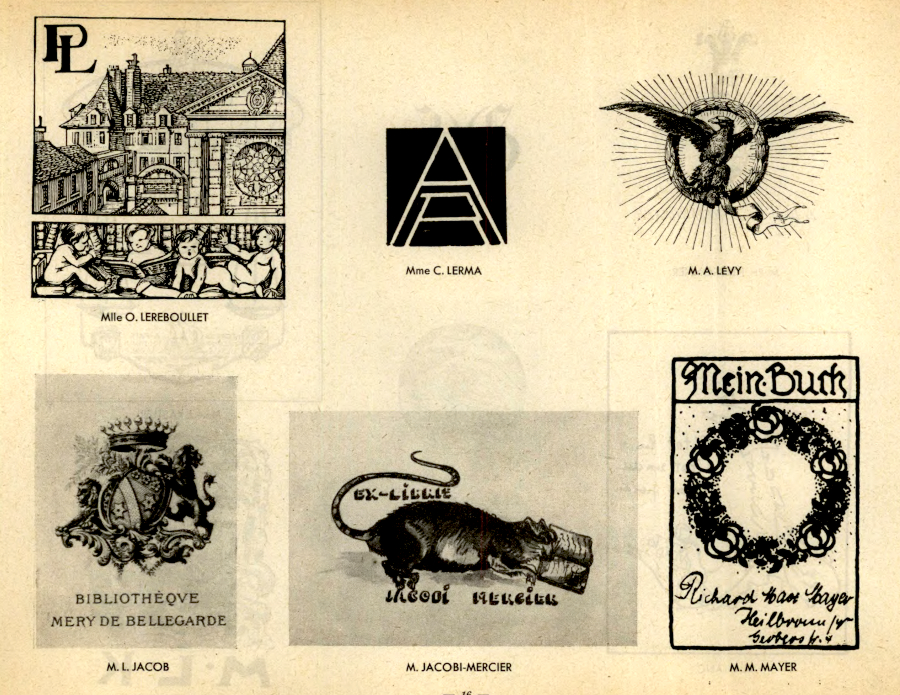
They were the heart of a community, the channel for their culture, language and identity. By stealing the books from the shelves, the Nazis stole the essence of the culture that founded and nurtured the library.
Stolen individual books do not carry the same weight in the public imagination as stolen paintings. An individual painting may be worth millions, a book will not. But collectively, the theft of books – of thought, of memory and of culture – was arguably infinitely more damaging.
The greatest theft of books in history occurred during the Second World War. Most of the books were never recovered, many are reported to be still in existence on library shelves around Europe and have not been returned, but it has gone largely unremembered.
To return to the quote at the beginning of this feature, you do not need to burn books, you just need to remove them to control a culture and deny its existence.
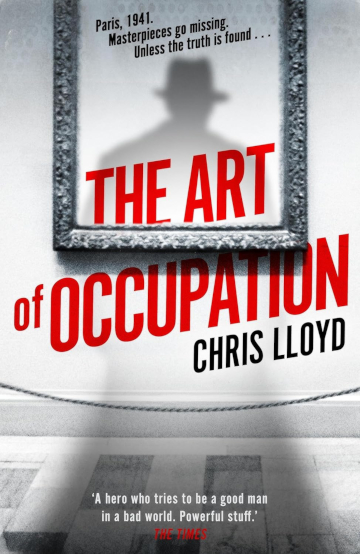
The Art of Occupation by Chris Lloyd is published on 14 May, 2026. It’s the fourth in his Occupation series.
Chris has written about the historical background to his other books:
The delights and dilemmas of using real people in historical fiction
The bureaux d’achats: how the Nazis bled France dry
The French Resistance: shadier than you think
We also interviewed Chris after he won the HWA Gold Crown Award in 2021 for The Unwanted Dead, the first book in the Eddie Giral series.
More related Historia features:
How WWI veterans saved Britain’s treasures in WWII by Caroline Shenton
Language and the Nazi propaganda machine by Catherine Hokin
And, on how libraries help people in times of war, Bethnal Green’s underground wartime library by Kate Thompson and
Can books save lives? by Louise Morrish
Images:
- Book burning in Berlin by Georg Pahl, 11 May, 1933 (captioned Die öffentliche Verbrennung undeutscher Schriften und Bücher auf dem Opernplatz Unter den Linden in Berlin, durch Studenten der Berliner Universitäten! The public burning of non-German writings and books on Opernplatz Unter den Linden in Berlin, by students of Berlin universities!): Bundesarchiv, Bild 102-14597 / Georg Pahl via Wikimedia (CC-BY-SA 3.0)
- A member of the SA throws confiscated books into the bonfire during the public burning of ‘un-German’ books on the Opernplatz in Berlin, 10 May, 1933: United States Holocaust Memorial Museum via Wikimedia (public domain)
- Two young German men, one in an SS uniform, examine materials plundered from the library of Magnus Hirschfeld, director of the Institute for Sexual Science, 6 May, 1933: United States Holocaust Memorial Museum via Wikimedia (public domain)
- Display of books burned by the Nazis, Yad Vashem (slightly trimmed): David Shankbone for Wikimedia (CC BY-SA 3.0)
- Title page of Einsatzstab Reichsleiter Rosenberg für die Besetzten Gebiete (‘Hitler Albums’) photograph album volume 7: US National Archives Catalog Photographic Albums, c1940–1942 (unrestricted use)
- Photographs of bookplates from looted French libraries, Répertoire des biens spoliés en France durant la guerre 1939–1945 vol 7: Répertoire des biens spoliés (RBS), Tome VII, Ministère de la Culture (France) (Etalab Open License 2.0)


