
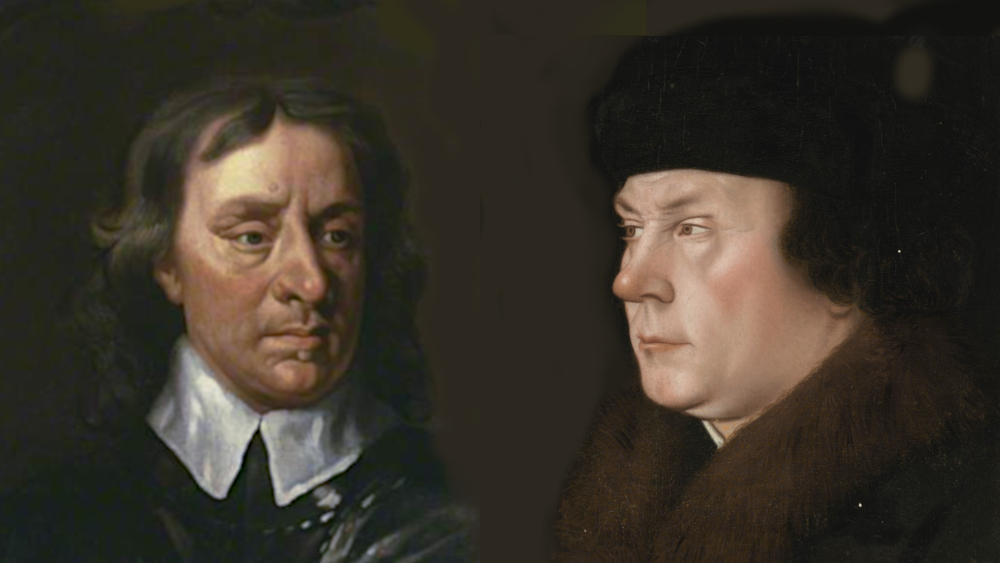
What links Thomas and Oliver Cromwell, apart from the name? They were related, and for at least three centuries people have got the two confused. Both led dramatic changes to church and state. And, as Miranda Malins explains, there are other “uncanny historical parallels” between the two powerful statesmen.
One of the Edwardian music hall sensation Marie Lloyd’s most popular songs blended drunken violence with popular history, describing A Bit of a Ruin that Cromwell Knocked About a Bit. In it, she wryly compared being assaulted outside a pub called the Oliver Cromwell to Oliver’s destruction of an Abbey.
“Those who’ve studied history sing and shout of it”, she sang. And her audiences did, night after night, so it was no wonder Marie’s narrator derided the men in the tale for having “both got Cromwell on the brain”.
But which Cromwell? Though Marie sang of Oliver, her hit song played on the common historical muddle between the two famous Cromwells – Thomas and Oliver – who had been popularly conflated for generations.
01.jpg)
As early as the 18th century, travellers touring England noted the confusion they encountered at ruined churches and castles about which Cromwell had inflicted the damage: was it Thomas during the dissolution of the monasteries in the 1530s, or Oliver during the Civil Wars of the 1640s?
Writing of visiting Wingfield Manor in Derbyshire, the travel writer John Byng noted how “My guide… was puzzled, as all countrymen are, about the two Cromwells; the destroyer of monasteries and the destroyer of castles.” Oliver came off worse in this tradition, regularly picking up the blame for acts committed under Thomas’s Reformation. “Whenever I enquire about ruins I always get the same answer,” Byng complained, “that it was some papish place, and destroyed by Oliver Cromwell, to whose share is laid even much more devastation than he really committed.”
Even today the mix-up remains. Indeed it has been the work of centuries to conflate Thomas and Oliver to create a national bogeyman to soak up local traditions and explain moments of historic change. Yet the two Cromwells were actually linked by much more than popular misunderstanding, as I discovered researching my new book about the family, The House of Cromwell.
Oliver was in fact Thomas Cromwell’s great-great-great-nephew and inherited more from Henry VIII’s chief minister than his name alone: heraldry and lineage stretching back to mythical Welsh princes; competing family traits of conservatism and radicalism; a wider family trying to hang onto the great estates Thomas acquired through the dissolution of the monasteries; and, perhaps most intriguingly of all, his forebear’s contested reputation.
This began as soon as Oliver emerged onto the national stage in 1644. In a satirical pamphlet, the Royalist writer Peter Hausted mock-celebrated Oliver’s part in the Parliamentarian Puritans’ campaign for religious reform by casting him as the iconoclastic heir to his ‘grandparent’ Thomas:
Arch Deacon Cromwell’s visitation
Hath cleansed all (in whose pure veins doth run
The reforming Blood and virtues of his Grand
Parent, that Man of Iron, whose tough Hand,
Armed with his Father’s Hammer, at one Blow
Made many a stately Abbey lie full low)…
Blessed Reformation!

Thus Oliver, the military leader coming to be known as ‘Ironsides’, derived his strength and reforming zeal from his ancestor Thomas, the “Man of Iron”’, who his father (commonly supposed a blacksmith) had armed for this work “with his Father’s Hammer”. Oliver was now an “Arch Deacon” and his campaign a “visitation” just as that sent out to all religious houses by Thomas, Henry VIII’s Vice-Gerent in spiritual matters, had been.
For Oliver’s admirers, by contrast, his association with Thomas was a positive one. His Latin secretary, John Milton, later wrote of Oliver’s surname that it was “a name distinguished of old in the State-administration of England when it was under good Kings, and distinguished still more in connexion with the first restoration or establishment among us of the Protestant Religion”.
From either viewpoint, with the Civil Wars, history appeared to be repeating itself through the vehicle of the Cromwell family as a Cromwell once again spearheaded dramatic changes to church and state.
The uncanny historical parallels only grew as Oliver ascended to the centre of power, ultimately becoming king in all but name himself as Lord Protector. Was this the ultimate revenge for Charles I’s predecessor Henry VIII cutting off Thomas Cromwell’s head? Some at the time certainly saw it this way.
,_Earl_of_Essex_-_486204_-_National_Trust.jpg)
At the Restoration of the Stuart monarchy in 1660, the historian Henry Spelman’s son Clement framed a new national story: that “The King [Henry VIII] makes use of a Crumwell [Thomas] to dissolve the monasteries, and [G]od of a Crumwell [Oliver] born in a dissolved monastery to punish the King [Charles I] . . . Thus our punishment sprang from our sins”.
If the public relished comparing and conflating the two great Cromwells, what of Oliver himself? Oliver knew of and respected the link between them, helping Thomas’s direct descendants who were Royalists mitigate their fines at the end of the war, and keeping a family pedigree in the royal palaces.
At his state funeral, the banner of Thomas’s branch of the family was carried in the procession, and Oliver’s descent from Thomas’s nephew and adopted son Richard Cromwell (alias Williams) was proclaimed proudly in the biographical plaque hung at the foot of his coffin in Westminster Abbey.
When I began The House of Cromwell, I set out only to answer the question of whether the two Cromwells were related, expecting little more than an interesting genealogy. But instead I uncovered one of the most remarkable dynastic stories in British history: the tale of the same obscure family which, within a century, produced two of Britain’s most powerful and controversial commoners.
_-_Oliver_Cromwell_(1599%E2%80%931658)_-_1949P27_-_Birmingham_Museums_Trust.jpg)
Examining Thomas and Oliver together for the first time, and from within their shared family, transforms our understanding of both towering figures, while revealing other fascinating lesser known Cromwells.
Like Thomas’s great-granddaughter, the brilliant surgeon, scientist and author Catherine Tollemache, and her brother, the traitor Edward Cromwell who joined the Essex Rebellion.
Armed thus to strip away centuries of propaganda and myth-making, we can restore the Cromwell family to the heart of Britain’s national story, alongside the Tudor and Stuart dynasties they shaped; Thomas and Oliver Cromwell, together once more, but now for the right reasons.
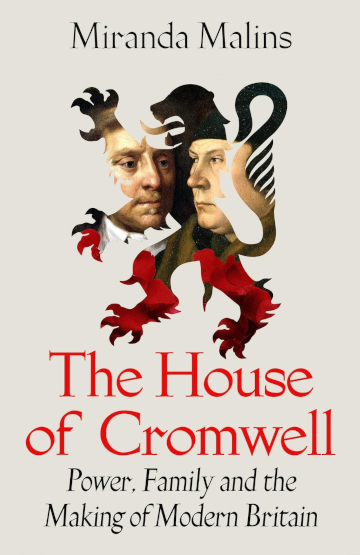
The House of Cromwell by Miranda Malins is published on 24 September, 2026.
Miranda is a historian specialising in the history of Oliver Cromwell, his family, and the Civil Wars and Commonwealth period. Her previous books were novels about Cromwell’s daughters: The Puritan Princess and The Rebel Daughter.
You may also be interested in Miranda’s Historia feature about Oliver Cromwell’s daughter Frances.
Other related pieces in Historia include:
Oliver Cromwell’s war on Christmas? by Stuart Orme
Killing a king: the execution of Charles I by Leanda de Lisle
Running with the regicides: Why I decided to venture into the Restoration by SG MacLean
Good Boye or devil dog? Prince Rupert’s poodle by Frances Owen
Fiction and the English Civil Wars by Jemahl Evans
Henry VIII, impotence and the thorny question of male heirs by Carol McGrath
Tardiness and Tempest: Henry VIII’s Courtship of Anne Boleyn by Alison Weir
The scandalous Seymours by Alexandra Walsh
TV review: The Mirror and the Light by Tracy Borman
Images:
- Composite image of Oliver and Thomas Cromwell from portrait of Oliver Cromwell after Sir Peter Lely: Cromwell Museum via Wikimedia (public domain) and portrait of Thomas Cromwell after Hans Holbein the Younger, Hever Castle, c1532: Wikimedia (public domain)
- Thomas Cromwell by Hans Holbein the Younger, 1532–33: the Frick Collection via Wikimedia (public domain)
- Oliver Cromwell by Samuel Cooper, c1653: Duke of Buccleuch collection via Wikimedia (public domain)
- Thomas Cromwell, c1530: National Trust, Petworth House via Wikimedia (public domain)
- Oliver Cromwell by Sir Peter Lely, 1653–54: Birmingham Museums Trust via Wikimedia (public domain)


