

Jennifer Godfrey writes about some of the suffragettes involved in the window smashing campaign in 1912, and the careful planning that went into their latest mission.
In June and July 1912, 112 years ago, suffragette prisoners were being released from prison having served time for window smashing. Some had completed their full sentence but others were released early because of ill health owing to prison life and in some cases the effects of hunger striking and being forcibly fed.
Having been imprisoned for smashing eleven windows in Regent Street, 46-year old nurse Sarah Jane Carwin from London was released after enduring forcible feeding. Margaret Macfarlane, originally from Dundee but living in London at the time, was released at the end of June 1912 having been fed forcibly. Her weight had dropped from 7st 5lb to 6st 6lb.

My second, newly-released, book, Secret Missions of the Suffragettes, Glass Breakers and Safe Houses, details this particular mission in Part One. Known as the Great Militant Protest, this Women’s Social and Political Union (WSPU) mission was led by Emmeline and Christabel Pankhurst.
Like all their missions, the planning was meticulous and the drive for members to get involved relentless. Meetings were held in some of the WSPU’s favourite venues, the Savoy Theatre and the Connaught Rooms in Great Queen Street.
Calls for action were made at these meetings and written instructions then followed. Members were told to attend the rooms above the Gardenia Restaurant in Catherine Street. They were not to tell anyone about the mission and to arrive at the venue with the ticket provided and not displaying any WSPU colours — purple, white and green.
There they were met by a Mrs McLeod and Marion Wallace Dunlop for further instructions. The latter was a famous suffragette and the first to go on hunger strike for the cause in July 1909. In this 1912 mission, Marion directed the glass breakers, greeting them and then ensured they were armed with stones and toffee hammers, put them in pairs and groups and sent them on their way to their specific destination.

The date for this protest was set for the evening of 4 March, 1912. The authorities knew of the plan as the Metropolitan Police had a special branch dedicated to watching and infiltrating the suffragettes and their plans.
To catch this special branch unawares Emmeline Pankhurst wrote to some of the members asking that they attend on the evening of 1 March to smash windows. This protest therefore occurred over two evenings and over 270 women were arrested as a result.
This large number of arrests was an intentional part of the mission — the aim was to over-fill Holloway. Instructions had been issued to glass breakers telling them to smash and stand still until arrested. They all packed bags with the expectation that they would attend the police station, be bailed by the WSPU and, at most, serve seven days’ imprisonment. Sentences actually ranged from 14 days to six months, with Emmeline Pankhurst receiving a sentence of nine months.
The sheer number of connections and friendships existing and developed by the suffragette glassbreakers struck me when I was researching, and when writing I aimed to tell as many of these stories, and how they interrelated, as possible.

There were many pairs of sisters, mothers and daughters, and WSPU members and friends from as far away as Scotland and New York travelling to take part in this mission. Many mothers left young families behind and some lost their paid employment.
Despite all of this, the archives and accounts evidenced acts of defiance, strength and courage, and support and love for each other. Glaswegian glass breaker Theresa Gough, 44, said, “We have each been witness of some wonder worked by that omniscient love which is the very basis of our movement.”1
On 11 June, 1912, imprisoned glass breaker grandmothers Janet Augusta Boyd (61), Mary Ann Aldham (54) and Gertrude Jessie Heward Wilkinson (60) sang together. Poems were created and smuggled out to be published in a booklet that was then sold to raise funds for the cause.
I have included one of these poems as it provides an interesting insight into the character of some of the suffragettes transferred to Winson Green prison in Birmingham. In addition to poetry, handkerchiefs and cloths were secretly embroidered with the signatures of suffragette prisoners.

One handkerchief with sixty-six signatures embroidered in various colours was started by experienced militant suffragette and glass breaker Mary Ann Hilliard, 46, while she served her sentence in Holloway.
Mrs Janie Terrero, 53, wrote accounts of her time in Holloway where she went on hunger strike, was forcibly fed during two periods, and released a few days early (in June, 1912) on health grounds. She embroidered twenty signatures onto a handkerchief whilst in prison. These belonged to the women who had endured hunger strike with her in Holloway.
A strong theme was the suffragettes’ loyalty and love for the cause. Glass breaker Mary Nesbit said, “I was deeply impressed by the wonderful spirit of loyalty and love for the cause and for our leaders – all irrespective of class, creed or age, were unwavering.”2 Mary, aged 53 years, was arrested with Irish Women’s Suffrage Society (IWSS) member Blanche Bennett for smashing Baker Street Post Office on 4 March.
Glass breaker Zoe Proctor wrote in her autobiography: “I found as hundreds of others had done already, that Mrs. Pankhurst’s personality deepened our enthusiasm for the cause. She had a gracious presence, a beautiful voice and such dignity that it was easy to trust to her leadership.”3 This opinion was shared by suffragette Winifred Mayo, 33, who along with her 68-year-old mother, Alice Monck-Mason, smashed Regent Street windows.

In 1958 during a BBC interview Winifred recalled that she “had a tremendous admiration and affection for” Mrs Pankhurst, that she “carried immense audiences with her” and that she’d “heard her speak in the Albert Hall before the days of microphones and her voice carried to the farthest seat. She filled the Albert Hall.”4
Like the other suffragettes Winifred was an immensely interesting character with many layers of interest, skill and specialism. She helped establish the Actresses’ Franchise League (AFL) and as well as giving elocution lessons to WSPU speakers, advised suffragettes about make-up and costume so that they were better equipped to evade capture by the police.
The second part of my book explores behind the scenes of the movement including the safe houses used for suffragettes to rest, recuperate and hide in, the disguises used to evade arrest and alias names used to give if arrested.
There are also chapters exploring the codes used by the WSPU to communicate when planning and executing secret missions as well as the Jujitsu self-defence training provided to a security team protecting Emmeline Pankhurst, known as ‘the Bodyguard’.
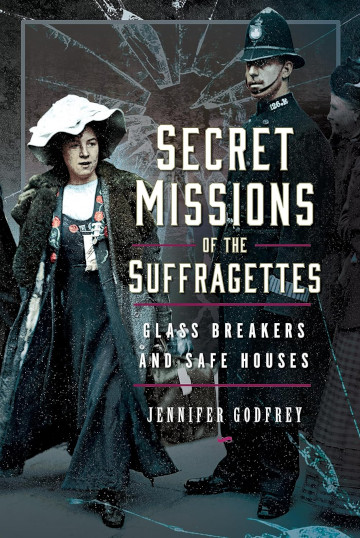
Secret Missions of the Suffragettes, Glass Breakers and Safe Houses by Jennifer Godfrey was published on 30 March, 2024.
Read more about Jennifer’s book. She’s also written Suffragettes of Kent, out in 2019.
jennifergodfrey.co.uk
Facebook
Twitter/X
Instagram
LinkedIn
Notes:
1 Gough, Theresa, Karmie, MT Kranich, Holloway Jail, 28 April, 1912, cited in Literature of the Women’s Suffrage Campaign in England, edited by Carolyn Christensen Nelson, Broadview Press, 2004, p158
2 Purvis, Jane, Women’s History Review, The prison experiences of the suffragettes in Edwardian Britain, Routledge, 1995, 4:1, 103–133
3 Proctor, Zoe, Life and Yesterday, Favil Press, 1960, p95
4 BBC Archives, 13 July, 1958
You may also be interested in reading these related features:
Lady Constance Lytton: The Suffering Suffragette by Michelle Birkby
Finding the decadent women of the 1890s by Jad Adams
Six godmothers of archaeology by Alexandra Walsh
Images:
- Detail of Mary Ann Hilliard’s embroidered handkerchief, 1912: Jack1956 for Wikimedia (public domain)
- Margaret Macfarlane in a Home Office police surveillance photograph, 1912: Wikimedia (public domain)
- The window of Swan & Edgar after it had been smashed, 1912: LSE Women’s Library Collection on Flickr (no known copyright restrictions)
- Women queuing outside Bow Street, 1912: LSE Women’s Library Collection on Flickr (no known copyright restrictions)
- Mary Ann Hilliard’s embroidered handkerchief, 1912: see 1
- Emmeline Pankhurst, c1910: LSE Women’s Library Collection on Flickr (no known copyright restrictions)


