
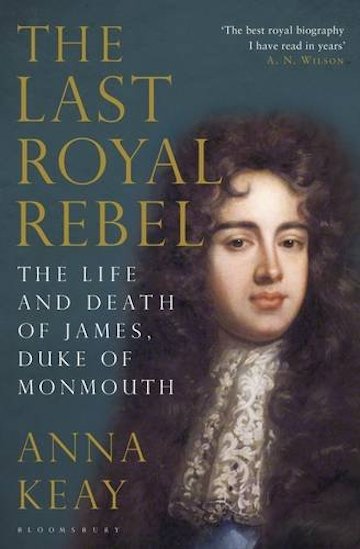
 During the horrific, botched execution of James, Duke of Monmouth, in 1685, the crowd remained silent and ‘many cried’, until, incensed by the ‘barbarous usage’ of the duke, they surged forward and would have torn the executioner to pieces had soldiers not prevented it. Yet the label on Monmouth’s portrait in the National Gallery reads: ‘charming, ambitious, unprincipled’. In The Last Royal Rebel, the Life and Death of James, Duke of Monmouth, Anna Keay shows us a complex, often contradictory man: a frivolous, pampered royal bastard with an astute political mind; a gambling spendthrift who becomes a war hero; a much-maligned man brought low by his sense of what was right and fair, and his need to be loved by his father.
As the ‘natural’ son of Charles II and a fortune-seeking lady of dubious morals named Lucy Walter, James’s early years involved rapid removals and kidnap evasions as Charles’s agents tried to seize him from his mother. When they finally succeeded the boy was nine and could not read, write or count to twenty. Later, however, he became an efficient Master of the Horse, managing the daily business of hundreds of men and horses. He also became the army general who wrote the very manual by which James II’s troops defeated him on Sedgemoor. In his royal posts, Monmouth was highly intelligent and effective, but he frittered away his own money on all manner of superfluous luxuries. He and his wife, heiress Anna Scott, Countess of Buccleuch, spent thousands of pounds annually on clothes alone.
To an extent, Monmouth was first saved from utter dissipation at the age of twenty-two, when he discovered his vocation as a soldier. The transition to professional army officer, though, was short-lived, primarily because he allowed himself to be manipulated by Whig politicians and schemers such as Robert Ferguson, whose self-declared ambition was to always be ‘in a plot’. After the death of his father, Monmouth became the figurehead of a rebellion to seize the crown from the Roman Catholic James II, a rebellion he did not believe in or wish to take part in. Contrary to the rumours put about by James II’s agents and Whig politicians – for disparate purposes – Monmouth never wanted to be king. But, as Keay says, ‘(he) demonstrated an almost unfathomable sense of what honour and justice required of him, together with a strange seam of naivety’ – and this was his downfall.
Keay’s immensely readable book provides valuable insight into a fascinating period of political and religious tension, demonstrating Charles II’s fickle approach to state-craft and how court life, notably in Whitehall, was conducted. We see how Monmouth grows from a ‘selfish wastrel to principled politician’. Had he been born in an earlier century, Monmouth would have given Shakespeare a splendid tragic hero, whose fatal flaw was not that he was unprincipled, rather that he was too principled. Monmouth’s life was the stuff of drama and fiction, and this biography kept me reading to the very end despite knowing the sad outcome from the start.
The Last Royal Rebel is out in hardback from Bloomsbury.
Jane G. Harlond is a full-time author, whose historical fiction examines aspects of how time and place influence a person’s life-choices and identity. Her novels include The Empress Emerald set in the first half of the twentieth century (Famelton Publishing, 2014), and The Chosen Man, set in the seventeenth century (Penmore Press, 2015).


