
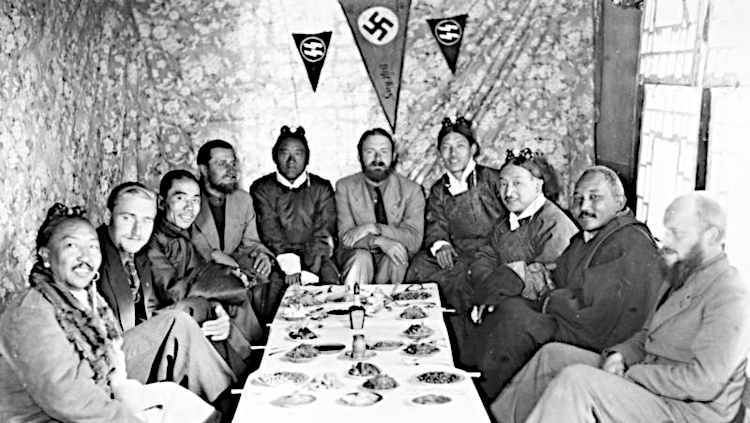
Among the many beliefs that contributed to Nazi racial doctrine, one of the facets of the ‘Aryan Myth’ was the idea that Aryans were descended from the people of Atlantis, some of whom went to live in Tibet. Elisabeth Storrs writes about a 1938 SS-led expedition to Tibet to find evidence to support this theory.
I have a vivid memory of seeing Raiders of the Lost Ark on a rainy Saturday in a run-down cinema in 1981. I had no expectations other than knowing George Lucas of Star Wars fame was the writer, and Steven Spielberg, creator of Jaws, was the director.
The film turned out to be a homage to 1930s–40s movie serials. I escaped into a matinee with hectic action, adventure, romance and big laughs as I watched the exploits of a gun-toting renegade archaeologist hell-bent on a quest. Little did I know the movie would go onto win five Academy Awards and become a cultural icon.

The central premise of the movie was the Nazis’ obsession to acquire the lost Ark of the Covenant (the container that held the Biblical Ten Commandments) which Hitler believes will make his armies invincible if possessed. Outlandish, you say? I also thought the concept preposterous until I discovered that truth is, indeed, stranger than fiction.
Heinrich Himmler was particularly fond of occult fancies. He supported the pseudo-scientific SS Deutsches Ahnenerbe (Ancestral Heritage Research Institute) which sent scholars to recover various ancient relics, including the Holy Grail, on the basis these objects held supernatural qualities. He didn’t see the Grail as a Christian religious symbol but a stone of light that fell from the diadem of a sun god thereby conferring divine powers.
Spielberg is said to have heard stories from a Jewish camp survivor about such expeditions which influenced the various narratives of his Indiana Jones movies.
One Ahnenerbe excursion hit world headlines in 1938. The Schäfer Expedition was charged with locating traces of Atlantis in Tibet. The theory was that survivors of the inundation reached certain highland areas in the Himalayas, Canary Islands and Bolivian Andes. Forged in ice and snow, these super-human ‘proto-Aryans’ migrated across the world to create the foundations of all great civilisations. However, other than those who reached Scandinavia and northern Germany, they fell prey to the perils of interbreeding with ‘base’ races which diluted their power

The leader of this bizarre adventure was a young SS officer, Dr Ernst Schäfer– the Nazi’s own version of Indiana Jones. As a hunter, explorer and scientist, Schäfer was Himmler’s poster boy – good looking, ambitious, macho and brilliant. He’d already gained fame in the early 1930s for previous expeditions in China (he bragged he was the first man to bag a panda).
His skill as a zoologist is undoubted, as was his preparedness to compromise his scholarly integrity. He trekked into Tibet to find traces of proto-Aryans, locate a Yeti, and obtain evidence of the wacky World Ice Theory which ‘scientifically’ explained how Atlantis came into existence and was subsequently destroyed.
Along the way, his team conducted valuable scientific work gathering various plant and animal species and recording geological features. Bruno Beger, an SS ethnologist, measured the features of Tibetans including making head casts.
When the British press began calling the team’s presence a ‘Nazi invasion’, the group beat a hasty retreat in August 1939 fearing the British might intern them. Himmler personally met their plane on the tarmac in Munich.

Schäfer eventually released a movie, Secret Tibet, in 1943 depicting his team’s exploits. However, by the end of the war, Schäfer’s and Beger’s adventures in the Himalayas were superseded by their dark racial studies projects and scientific experiments in concentration camps.
Despite the kookiness of the Schäfer Expedition, the Ahnenerbe also supported serious archaeological excavations throughout the mid-1930s. Reputable prehistorians made Faustian Bargains by promulgating a spurious theory the Indo-Aryans emerged in the Stone Age as a warrior race to spread their culture south and east across Europe.
The ‘Aryan Myth’ about this ‘Master Race’ became a toxic ethos that asserted Nordic-Germanic peoples were superior ‘bearers of culture’ threatened by the ‘sub-humans’ who were ‘destroyers of culture’ such as Romani, people of colour, Slavs and, particularly, Jews. Ultimately it was used to justify conquest, dispossession and murder.
I first learned about the Ahnenerbe when researching Fables & Lies. My novel tells the story of the Berlin museum curators who safeguarded their nation’s treasures from aerial bombardment. One such curator was Wilhelm Unverzagt, the director of the Pre and Early History Museum. Unverzagt was determined to protect the priceless Priam’s Treasure discovered by Heinrich Schliemman at Troy. He was also a Nazi and an Ahnenerbe archaeologist who sought Himmler’s patronage to both protect himself from his rivals as well as advance his career.

My protagonist, Freyja Bremer, is a museum assistant raised on Nazi dogma who works for Unverzagt. The spine of the novel follows Freyja’s love affair with Darien Lessing, an archaeologist who opens her eyes to the rot beneath the Regime’s lies.
Her awakening leads her to a dangerous resistance to assist a Jewish doctor and his Gentile wife. Intertwined is Freyja’s forced marriage to Kaspar Voigt, one of the Ahnenerbe’s ethnologists (who tags along on the Schäfer Expedition), and her quest to discover what her husband’s racial studies research entails.
Unverzagt was in no way involved in the Ahnenerbe’s most heinous activities during the war. However, he was an example of one of the many German scholars who made a deal with the Devil. By twisting history to serve power they brainwashed soldiers to believe Germany had the right to reclaim ‘ancestral lands’ in Poland, Russia and Ukraine because they were reincarnations of the Aryan Ostro-goths and Scythians who once ruled the region.
I hope you will be interested in reading Fables & Lies, which also highlights the experience of ‘ordinary’ Berliners during the war rather than battles and acts of great heroism. Instead, it shows history is never neutral, and courage can be found in the smallest acts of defiance.

Fables & Lies by Elisabeth Storrs is published on 28 April, 2026.
Find out more about this book.
You may enjoy Elisabeth’s other Historia feature, She Wolves, Night Moths and tomb whores.
Read these related features:
Making room for the master race: the true scope of Himmler’s Lebensborn programme by Catherine Hokin
Building better humans? Eugenics and history by Louise Fein
How WWI veterans saved Britain’s treasures in WWII by Caroline Shenton
Six godmothers of archaeology by Alexandra Walsh
The triumph of Greek myths and the destruction of a civilisation by Hilary Green
The World As It Never Was by Edward Brooke-Hitching
Images:
- Tibet expedition, reception for dignitaries. Among them are L–R) Beger, Geer, (top) Tsarong Dzasa and Schäfer, Wienert, Möndro (Möndo), Essen,.1938: Bundesarchiv, Bild 135-KA-10-072 via Wikimedia (CC-BY-SA 3.0)
- Members of the Tibet expedition: (standing) Rabden Khazi, Bahadur Thapa, Schäfer; (sitting) Krause, Geer, Wienert, Beger. 1938: Bundesarchiv, Bild 135-KA-10-063 / Krause, Ernst via Wikimedia (CC-BY-SA 3.0)
- Ernst Schäfer, 1938: Bundesarchiv, Bild 135-KB-14-083 via Wikimedia (CC-BY-SA 3.0)
- Bruno Beger measuring a Tibetan woman’s head while posing as a dentist, 1938: Bundesarchiv, Bild 135-KB-15-089 / Krause, Ernst via Wikimedia (CC-BY-SA 3.0)
- Headdress from ‘Priam’s Treasure’: sailko for Wikimedia (CC-BY-SA 3.0)


