

Sean Lusk’s debut novel, The Second Sight of Zachary Cloudesley, was inspired by an 18th-century clock he found in a back alley of Istanbul’s Grand Bazaar. Why would British clockwork be of interest in the Ottoman Empire? So began his interest in the Levant Company, once a powerful force, now hardly remembered.
Almost everyone knows something about the East India Company – its huge wealth, its corruption, its cruel excesses, and the long shadows of its legacy.
Yet at one time the Levant Company was just as renowned, holding a charter awarded by Queen Elizabeth I in 1592 for trade between England and the Levant, the Levant encompassing the Ottoman Empire and territories held at the time by the Venetian Republic.

In an echo of modern geopolitical hypocrisy, successive English governments voiced anti-Turkish (and anti-Muslim) sentiment while ensuring the arms trade to Constantinople thrived, along with exports of wool and tin and imports of silks and currants (an important sweetener before sugar imports from the Caribbean).
The importance of the Ottoman trade for England’s balance of payments influenced its foreign policy, for instance restraining English intervention on the side of Poland in the Polish-Lithuanian Commonwealth’s 1621 war with the Ottoman empire.
The groundwork for the Levant company was laid by Queen Elizabeth’s representative (and spy) William Harborne, who was sent to Constantinople in 1583 bearing gifts for Sultan Murad III. These included a surprising number of dogs, including “three fair mastiffs, three spaniels, two bloodhounds, one common hunting hound, and two greyhounds in coats of silk.”

The Levant Company’s members, usually around 300 in number, were all required by royal charter to be freemen of the city of London. They were known as ‘Turkey Merchants,’ and the company’s representatives in the Levant were ‘factors’, with trading stations (or ‘factories’) in Constantinople, Smyrna and Aleppo.
The Company had no colonial ambitions, though in its need to fend off hostile Spanish vessels and Barbary piracy, it armed its ships with the latest weaponry and was thus an early manifestation of English (later British) naval power in the Mediterranean.
In 2017 I was wandering the back alleys of Istanbul’s Grand Bazaar when, in a dusty corner of a dimly lit shop filled with old maps, rusty swords and chipped porcelain, I came across a clock. It was inscribed “Geo. Clarke, Leadenhall, 1752,” which made me curious. How did such a clock find its way here?
The shopkeeper span me a yarn about its provenance, while assuring me that he could get me the necessary export licence – for a price. I didn’t want to own the clock, but I did want to own its story.
.jpg)
In the early 18th century, the Turkish market for clocks, watches and other finished goods expanded rapidly, and English manufacturers were keen to compete with dominant French traders, for both commercial and political reasons.
While the clock I found in Istanbul’s Grand Bazaar (similar to the one pictured) was of a simple and rather old-fashioned design, by mid-century clocks and automata – sophisticated clockwork mechanisms that mimicked the movement of living creatures – were dazzling the Ottoman court and, no less, the respective courts of France and Great Britain. In a sense Europe was in the grip of a clockwork arms race.
In 1756 war – arguably the first world war – broke out, dragging in almost every European power and affecting all corners of the then-navigated globe. The Seven Years’ War of 1756-63 naturally affected the Ottoman trade severely.
The British-Prussian alliance was ultimately victorious over the French-Austrian-Spanish alliance. The Ottoman Empire remained cautiously neutral throughout, though was soon once more at war with Russia, a war it lost decisively.
In the aftermath of the Seven Years’ War, Britain’s trading position in North America, South Asia and the Far East was greatly enhanced, and the East India Company’s power and wealth had never been greater; so much so that it lent the British Government money to help pay the cost of the war in return for an extension of its monopoly.

Yet at precisely this time, with the Industrial Revolution powering economic expansion, the Levant Company entered what was to prove terminal decline.
Why? In part the company was burdened by old-fashioned regulation, and its attempts to modernise its membership and make itself more appealing to investors were overshadowed by the East India Company’s success.
Another factor was plague: successive waves of bubonic plague affecting Egypt, Turkey and other Ottoman territories meant costly and often hazardous quarantines for goods imported from the Levant.
And while the outcome of the Seven Years’ War strengthened Britain’s global position and opened up new trade routes, it depressed the Mediterranean trade, which became more costly, sporadic and unprofitable.
Turkey, too, was not the prosperous power of half a century earlier. Military defeats destabilised its economy and its wealthy merchants, tipping it into the spiral of decline which came to it being described much later as ‘the sick man of Europe.’

Had it not been for stumbling upon that strange-looking clock made on Leadenhall Street in 1752, I would have learnt none of this.
I wouldn’t have been drawn into journeys along the trading routes in Greece and Italy, nor spent days in the reading rooms of the British Library relishing the letters and diaries of the factors and ambassadors of the time. I wouldn’t have learnt of plague and smallpox, of childbed fever or of the lives of midwife-men and wet nurses.
Nor would I have written my novel, which in the end is only a little about the clocks themselves, but a good deal about those who created both the clocks and astonishing automata which enthralled Europe at the time – writing girls and parading peacocks and chess-playing men.
It’s a novel about the women and men whose lives were made adventurous and perilous in equal measure by the rise and fall of the now largely forgotten Levant Company.
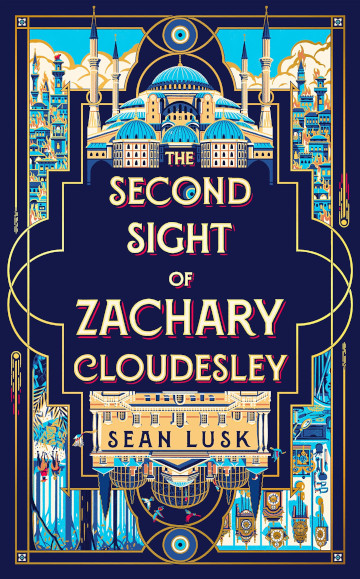
The Second Sight of Zachary Cloudesley by Sean Lusk is published on 9 June, 2022.
This is Sean’s first novel. For his short stories, he has won the Manchester Fiction Prize, the Fish Short Story Prize, the Cambridge Short Story Prize and the second prize in the Bridport Short Story competition.
For more about England’s dealings with the Ottoman Empire, see Sultana Isabel: Elizabeth I and the Ottoman Empire by Jerry Brotton.
If you’re intrigued by 18th-century automata, you may enjoy Anna Mazzola’s latest novel, The Clockwork Girl, which feature a writing girl such as Sean mentions. Why not read Essie Fox‘s review, too?
Read about the life of Lady Mary Wortley Montagu, the 18th-century smallpox inoculation pioneer, in Jo Willett‘s feature. And The Empress and the English Doctor by Lucy Ward is a new book about another two innovaters in the fight against this terrible disease.
Several Historia features mention the East India Company, including:
Unforgettable legacies of the East India Company by Vayu Naidu
Finding empathy – the complexities of writing Robert Clive by Diana Preston
Re-examining the history of Empire in fact and fiction by Tom Williams
Images:
- A General View of the City of Constantinople, hand-coloured engraving: Yale Center for British Art, Paul Mellon Collection (public domain)
- Constantinople, aquatint and stipple engraving, after 1850: Yale Center for British Art, Paul Mellon Collection (public domain)
- M Levett, Negociant Anglais, portrait of English Turkey merchant Francis Levett, chief representative of the Levant Company in Constantinople 1737–1750, after a painting by Jean Etienne Liotard: Wikimedia (public domain)
- Lantern clock by Henry Barrow, mid-18th century: Auckland Museum via Wikimedia (CC BY 4.0)
- Constantinopolis amplissima, views of Constantinople (Istanbul) by Matthäus Seutter, c1730: Wikimedia (CC BY 4.0)
- The Mechanical Turk, chess-playing (fake) automaton by Wolfgang von Kempelen, c1770: Wikimedia (public domain)


