
Emma Darwin examines the importance of faith during a turbulent period of European history, and how difficult it is to convey the “visceral” quality and power of religious belief when writing historical fiction. Evoking love comes more easily to us, yet love and faith have often been in conflict, as in her latest novel, The Bruegel Boy.
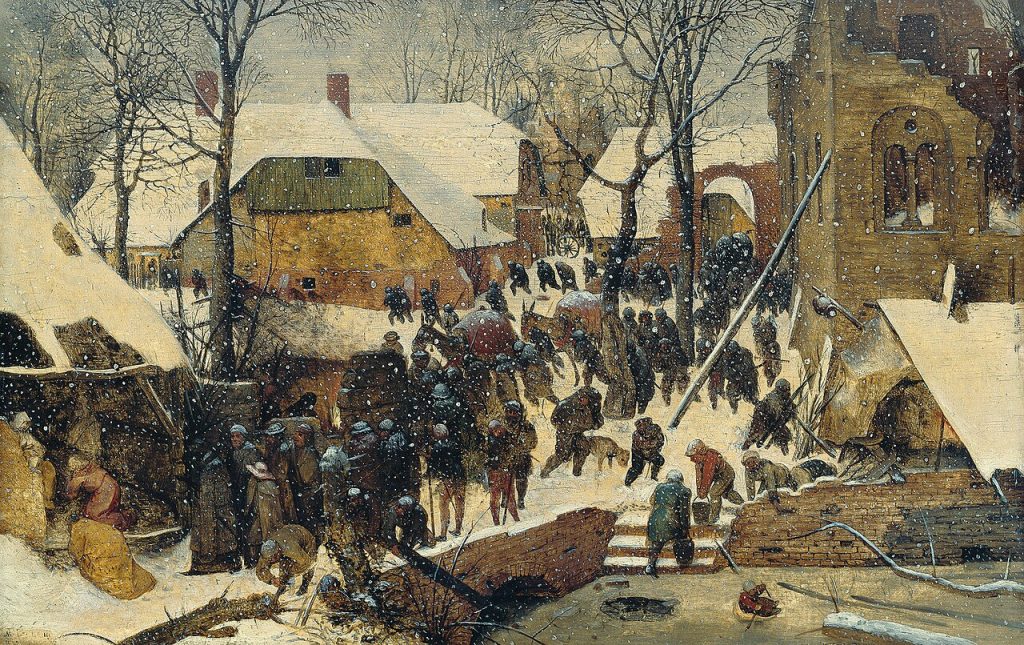
I decided to write a novel about Pieter Bruegel the Elder when I discovered that in his Adoration of the Magi in the Snow the soldiers mingling with the villagers are not only Herod’s, but Philip II of Spain’s.
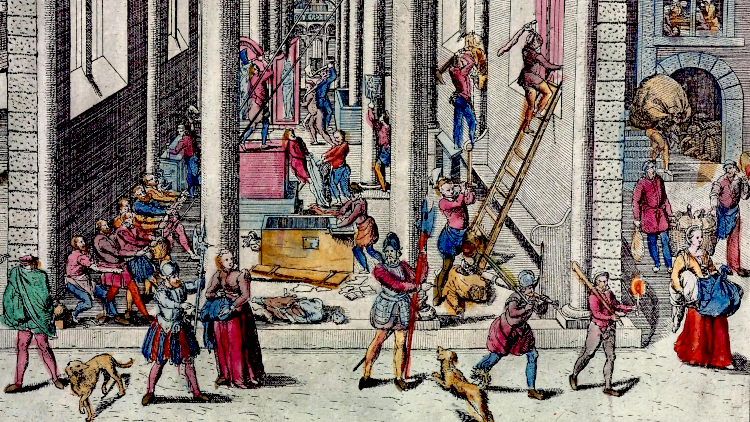
Bruegel painted it in Antwerp or Brussels, in 1563, just three years before 400 cities, towns and villages across the Low Countries exploded into an organised, revolutionary, image-smashing ‘art-storm’: the Beeldenstorm. It was the start of the Revolt of the Netherlands against political rule from Madrid, and religious rule from Rome.
Why do people smash religious images, I asked myself as I embarked on The Bruegel Boy: what is the source of their power that people are so desperate to destroy them?
What is the power of any image, come to that, that we will stare at, buy, commission, cherish, or report it to the police – or the Inquisition? And what does that mean for a painter like Bruegel, who paints religious scenes but also jokes, satires, horrors, landscapes, festivals and above all gloriously ordinary people?
It’s his understanding of humans that so endears Bruegel to us. In ‘Musée des Beaux Arts’1, W H Auden pinpoints how the “Old Masters understood that human suffering takes place / While someone else is eating or opening a window or just walking dully along.”
In Bruegel, they might equally be sliding on the ice or chatting up a pretty boy – and yet among all the someones, we see the suffering, and the salvation, of humanity.

Our direct knowledge of Bruegel’s outer life is very limited, and of his inner life is nil. This gave me plenty of space to imagine, but I didn’t feel equipped to write on the spaces inside his mind and body. And yet his calling to be a painter must have been as central to his self as vocation is to those who seek a monastic life.
So I invented young Gillis Vervloet, whom Bruegel finds wandering in Antwerp after being banished from his family for a crime he didn’t commit, and who has known he must be a priest since he was a small boy.
Gil is useless at grinding colours and boiling glue, but he’s good at keeping accounts and drafting contracts and, though he’s skinny, ordinary and red-haired, he has a gift for being still…
‘Don’t move!’ said Mijnheer Bruegel behind him. ‘Stay just as you are.’
Gil was too accustomed to joining his brothers in catching a loose beast to disobey a command made in that tone. Mijnheer gave a soft grunt, like Hanne when she had a pie-crust crimped just right, and Gil saw, out of the tail of his eye, how he pulled a cloth from where it covered a wooden panel clamped in a stand.
If this was payment for breakfast and the cloak, Gil would pay it willingly. He offered up the pain in his arm and back, the fire in the leg that took his weight, and the cramp in the other toes, and when that did not serve to ease them, set his mind to telling over the Catechetical Instructions of Sint-Thomas van Aquinas.

Vocation in art and vocation in faith: that would be my way in to Bruegel and his world. Fiction explores the things that matter to humans by putting them under pressure, so I gave Gil a second mentor, radical priest Pater Paulus, to support his passionate aspiration to the celibate Roman Catholic priesthood – and then made him fall deeply in love with a woman who loves him back.
That was when things got difficult. Gil’s love, desire and need for Doortje was easy to evoke: our society’s storytelling is saturated with sexual love. The writer barely has to do more than tell the reader ‘he loved her more than life itself’, or show the reader the beloved through their lover’s eyes, to convincingly motivate every action, however drastic, that follows.
But evoking Gil’s love, desire and need for a life of built round transcendent communication with the divine was much, much more difficult. At first, everything I wrote either felt like the wishy-washiest of New Age woo-woo, read like offcuts from the Westboro Baptist Church, or slowed the narrative pace to a crawl. And yet if Gil’s inner conflict was to drive the plot convincingly, and the outcome never be a foregone conclusion, the two, opposing forces on his psyche had to feel absolutely equal and absolutely irreconcilable.

The Bruegel Boy is structured around Gil in old age, once again homeless.
To end his days peacefully in a monastery in the Saarland forest, he must convince the Abbot that despite his dubious youth he’s not a heretic, and discover the fate of a beautiful statue of St Michael which the abbey lost in their own, brief Beeldenstorm.
So, what does Gil have that will help him stay at St Bartholomëus?
He has the account of his life which he will present to the abbot, which he is willing to swear before God is true in essence – though to God, and God alone, he’d admit it’s a little, well, hazy, in some of the details.
And he has the story which, God knows already, is not so very different, and is stored in his aching body.
Somewhere between those two – between what he has written, and what he knows, lies the answer to what happened to St Michael.
_in_Antwerpen_1566_Frans_Hogenberg.jpghttps://commons.wikimedia.org/wiki/File:Beeldenstorm_(Iconoclastic_Fury)_in_Antwerpen_1566_Frans_Hogenberg.jpg)
It’s not that historical fiction never works with humanity’s spiritual drives. In reading for the HWA Gold Crown of 2023, I’d found religion showing up as a personal or group identity, a moral and ethical system, a job, a power structure, or a component of politics – and usually in the form of a handy plot-obstacle.
But I’d also been taken aback by how many novels dodged it altogether, even though history tells us, and shows us, that every society in the world is shaped by how it deals with the fundamental human sense of a realm that exists beyond the physical and material.
In Bruegel’s world, what is happening when you kneel before the statue of a saint to ask for that saint’s aid is so important, so psychologically and emotionally visceral, so crucial to life in this world and the next, that some people are prepared to kill or be killed over it – or take an axe to the statue.
My job in The Bruegel Boy was to bring alive what my characters felt and thought, and what they did because of it.

The Bruegel Boy by Emma Darwin was published on 6 November, 2025.
Read more about this book.
1 The version of The Fall of Icarus that Auden evokes in the poem is now generally thought to be a copy by another artist – very possibly one of Bruegel’s artist sons – of a lost original.
Emma grew up in London, with interludes in Manhattan and Brussels, where her lifelong love of Pieter Bruegel the Elder was born. She’s taught for Oxford, Goldsmiths and the Open University as well as giving workshops and tutoring and mentoring individual writers. Her Substack, This Itch of Writing, is linked to by writing teachers, editors and courses around the world around the world.
For several years, Emma wrote Historia’s historical fiction writing advice column, Dr Darwin’s Writing Tips, which she only stopped because her Substack was covering much of the same ground. Emma’s Historia column is more about historical fiction than general writing, so you might like to read both.
There’s more historical writing advice in Historia:
Show, don’t tell, Write what you know: do they work for historical fiction? and
Serious play: the fiction-writer’s balancing act, both by Jem Poster
And you can browse our writing advice and writing tips tags (I know, a bit of redundancy) to find many more features in which authors talk about their own experiences of researching and writing books and getting published. Many offer specific advice and/or tips for writers, especially new authors.
Some Historia features which look at faith and religion:
Nördlingen, a town where history is past and present by JC Harvey, about the Thirty Years’ War
Fake news, or the Horrid Popish Plot by Anna Abney
The truth about nuns in 16th-century Florence by DV Bishop
Christian versus pagan: was Charlemagne’s conquest of Saxony the first crusade? by Angus Donald
A game of gods: religion in a changing Roman world by Simon Turney and Gordon Doherty
Hungary’s vanished village Jews by Jill Culiner
Images:
- The destruction in the Cathedral of Our Lady in Antwerp, the signature event of the Beeldenstorm, 20 August, 1566, by Frans Hogenberg (detail): Wikimedia (public domain)
- The Adoration of the Magi in the Snow by Pieter Bruegel the Elder, 1563: Museum collection Am Römerholz, via Wikimedia (public domain)
- Landscape with the Fall of Icarus after Pieter Bruegel the Elder, c1560: Royal Museums of Fine Arts of Belgium, Brussels, via Wikimedia (public domain)
- Portrait of a monk by Sofonisba Anguissola, c1566: Wikimedia (public domain)
- Beeldenstorm in een kerk (Iconoclasts in a church) by Dirck van Delen, 1630: Rijksmuseum via Wikimedia (public domain)
- The destruction in the Cathedral of Our Lady in Antwerp, the signature event of the Beeldenstorm, 20 August, 1566, by Frans Hogenberg: Wikimedia (public domain)


