

It’s hard to be more historical and contemporary in these days of Covid jabs than this past month, when two important anniversaries in the history of immunisation against serious contagions have taken place. In April 1721 Lady Mary Wortley Montagu inoculated her daughter, Mary, with smallpox, but although the little girl survived, inoculation wasn’t widely taken up. Then, 225 years ago, on 14 May 14, 1796, Edward Jenner inoculated a boy with cowpox and this time the process, called vaccination, gained acceptance. Lady Mary’s biographer, Jo Willett, tells Historia more about this remarkable woman’s life.
Lady Mary Wortley Montagu’s involvement in the fight to cure smallpox is becoming increasingly well-known. It feels particularly relevant to us at this moment, of course. Less well-known is Lady Mary’s campaign to protect her favourite sister, who suffered a paralysing psychotic breakdown in 1729 which left her unable to care for herself for the rest of her life. Lady Mary would not have recognised the term, but she was an early mental health pioneer.
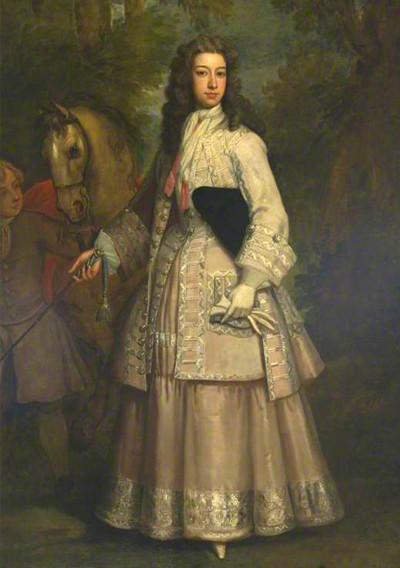
In early eighteenth-century aristocratic society, marriages were almost always arranged; Lady Mary’s own elopement was an exception to this rule. Her favourite sister, Frances, was married off to John Erskine, Earl of Mar, on 20 July 1714. Their mother had died when they were very young and their father, the Duke of Kingston, was desperate to marry off his children.
Mar was a widower, much older than Frances, with a son by his first marriage. Significantly he was a Scot and a Jacobite. As an acquaintance quipped, “there is a good Whig marr’d by taking a Scottish Jacobite for her Husband.” For Mar, marrying Lady Frances brought him status and, above all, wealth.
For fourteen years Sister Mar, as Lady Mary called her, made the most of her marriage. Only a week after the birth of their only child, Mar left wife and newborn daughter to head north to Scotland. There he led the Jacobite troops in a Scottish rising which sought to depose George I. When the campaign went disastrously wrong, Mar narrowly escaped with his life and was forced into exile with his family in France.
His estates were forfeit to the English King but he agreed to inform on his fellow Jacobites, for which he received an annual pension. In time this began to dry up and the couple were forced to rely on Sister Mar’s annual trust fund. The government back in London agreed to allow Mar’s brother, Lord Grange, to buy back the Scottish Mar estates. This gave him total control over the income they generated and also crucially over Sister Mar’s money.

Lady Mary had not realised that Sister Mar’s mental health was suffering thanks to all these pressures. In 1727, for instance, Mary wrote advising her sister to keep herself busy by galloping a horse by day and drinking a moderate glass of champagne by night. If only.
In 1728 Sister Mar suffered the breakdown from which she would never recover. Her husband was quick to pack her off back to England, ostensibly to rent out a house for income, but presumably also to absolve himself from having to look after her. He would never see her again.
The question now arose as to what was to be done with Sister Mar. Mar in Paris, his brother Grange in Scotland, and his son Tom Erskine in London all wanted to keep their hands on the money. As the Mars saw it, Sister Mar’s illness merely constituted a drain on resources. Now Mary had been reunited with her sister she understood the gravity of the situation.
Many years later she wrote that madness could not “be cured by the enjoyment of… extravagant wishes.” Mental illness was no different from such physical ailments as gout or asthma. She could also see that it was vitally important her sister had proper financial support for as long as she was unwell. Sister Mar should have first call on what was, after all, her own income.
“Lady Mary has already begun to tamper with lawyers,” Tom Erskine wrote to his uncle Lord Grange, “you see what must be the consequences of this.” When Grange tried to meet with Lady Mary to resolve the issue the two had a stand-up row.
Grange’s main aim as regards his sister-in-law was to minimise her care costs. So he decided to move her to one of the family properties in Scotland. She was dispatched north in a carriage.
When Lady Mary got wind of this she swung into action. The lord chief justice swiftly issued a warrant. Mary headed after the party on horseback. She managed to intercept them at Stevenage and waved the warrant under their noses. They were forced to turn back.
Next Lady Mary petitioned a body called the Commission of Lunacy to pass judgement on the case. And then the Court of Chancery. They ruled in her favour and Grange was ordered to pay an annual sum to Lady Mary to cover her sister’s fees.
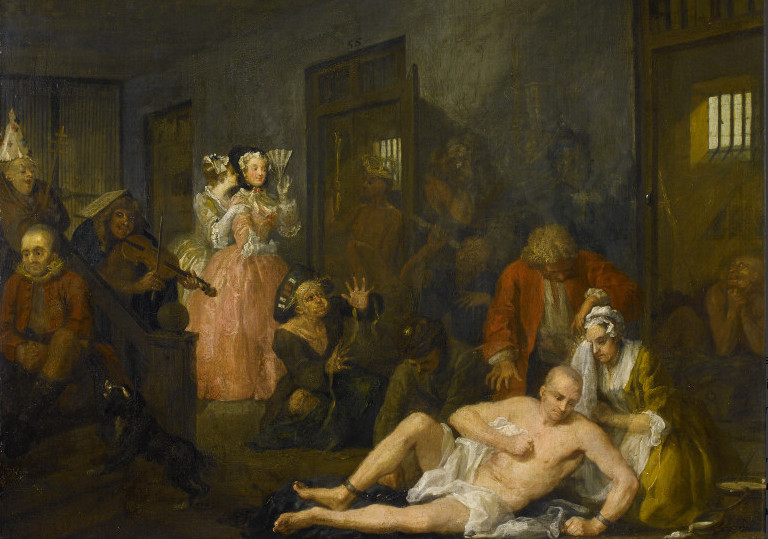
Mary chose a private asylum in Hampstead for her sister. Hogarth’s famous engraving shows how the mentally ill were generally treated at the time. Bedlam was the most celebrated of many asylums, where people were encouraged to observe the inmates for their own amusement.
The owner here was a Dr Richard Hale, who had been called as an expert witness by the Commission of Lunacy. Hale believed in giving his inmates some physical freedom, rather than keeping them chained up. He encouraged them to socialise and treated them with kindness.

Mary administered her sister’s allowance of £500 a year (just under £70,000 today).
Grange constantly portrayed her as excessively grasping, For the next eight years she suffered the indignity of having to send Grange detailed accounts twice a year, itemising her expenditure on her sister’s care.
From Paris, Mar continued to argue loudly that he needed a greater split in his favour. Worse, their contemporaries tended to side with him. As Pope wrote of Mary: “She turns her very Sister to a Job.”
Sister Mar lived for another thirty years. In time Lady Mary lost control of her sister’s finances. When Sister Mar died, penniless, still in an asylum, Lady Mary’s response was very simple: “She was really honest and loved me”.
Mary had fought hard to ensure her sister was treated with dignity and respect. True to form, she had learned from her experience, applied her brain to finding the best solution and trusted her instincts.
When we consider how far our own society has changed in its attitude towards mental health in the last twenty years, Lady Mary feels, as so often, ahead of her time.

The Pioneering Life of Mary Wortley Montagu: Scientist and Feminist by Jo Willett was published on 30 March, 2021 and reissued on 13 May, 2021.
Jo is a producer of TV comedy and drama. She began her career on EastEnders, before going on to executive produce series such as Pie in the Sky and Love Hurts. She won a BAFTA for A Rather English Marriage and an Emmy for Dirty Tricks.
For earlier Historia features about mental health, see Did Roman soldiers suffer PTSD? and Stockholm Syndrome in Ekaterinburg?
Find out about past medical practices in Elizabethan medicine: spectacularly wrong – and likely to kill you; Health and Hellfire: Personalising the Plague in 17th Century London; The monarch with the magic touch; A charmed life: childbirth and superstition; The Darker Quacks – between folklore and science and The Great Pandemic.
There’s more about Jacobite risings in The Battle of Killiecrankie; The never-ending Battle of the Boyne; 1719: the forgotten Jacobite rising; Raising the Jacobite standard: Glenfinnan, 1745; Damn’ Rebel Bitches: Research Then and Now and Remembering Culloden.
Images:
Lady Montagu in Turkish dress by Jean-Etienne Liotard,, c1756: via Wikimedia
Frances Pierrepont, Countess of Mar by Godfrey Kneller, 1715: with thanks to Reinette
John Erskine, Earl of Mar, with his son Thomas by Godfrey Kneller, probably c1715: via Wikimedia
A Rake’s Progress VIII: The Madhouse by William Hogarth, 1734: © Sir John Soane’s Museum, London
Lady Mary Wortley Montagu by Charles Jervas, c1716: via Wikimedia


