
James Burge reviews the Feminine power: the divine to the demonic exhibition at the British Museum and finds contradiction, transgression and dazzling mental gymnastics in 4,000 years of art, faith and history from around the world.
Visitors to this show are guided through a well-lit labyrinth, past a series of displays – one might almost say shrines – each one featuring a different feminine god or spirit. These have been selected from cultures over the past 4,000 years from all parts of the world. That is a very broad base and it is hard at first not to puzzle about quite how to deal with it.
Some archetypes do present themselves immediately. The well-rehearsed female role of the caring nurturing, motherly creator, for example. An amiable spirit from Africa called Mami Wati exemplifies this, as does the Virgin Mary.

On the reverse side, there is no shortage of destructive goddesses. Kali, the knife-toting, blood-drinking, skull-wearing deity, revered to this day from Kolkata to Camden, is wonderfully represented in a 2021 work by Kaushik Ghosh. Snake-haired Medusa is another variant.
But they are all outdone by lion-headed Sekhmet, the Egyptian deity. We are told that she got into a bit of a rage and tried to eat the entire human race. She was eventually halted by the subterfuge of a river of beer, stained red to look like blood.
It is easy to see these bold archetypes as probably serving the interests of a ruling (mostly male) elite. After all, someone who is just a nurturer is easy to disempower, even easier if backed up with sly warnings of dire outcomes if control is relaxed.
But an emphasis on frightening feminine power points in two directions. It is heartening to discover, for example, that women in India today find inspiration in Kali’s rage as they struggle against sexual abuse.
Occasional modern works in the exhibition provide an interesting counterpoint. They also furnish the star of the show: Lilith, the first wife of Adam and consort of Satan. She is impish, contrary and destructive. In Kiki Smith’s arresting 1994 bronze figure her body is black and her eyes blue.
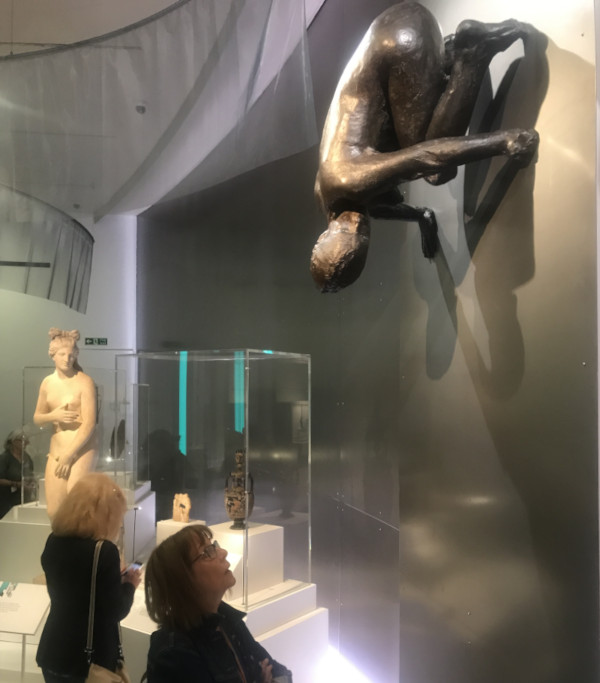
She is naked but, as Mary Beard puts it, hard to ogle. She breaks the law of gravity by squatting on the vertical surface of a wall, from which high vantage point she surveys the exhibition and its visitors. Her intense gaze of concerned interest suggests that she is taking the show seriously.
There is much more to be found here. Not all spiritual beings are the cynical constructs of ruling elites.
In fact, over time, the people do get a say about which gods rise to prominence, just as publishers decree what books shall be published but it is the mass of readers which influences which ones will be movies.
Similarly, the haphazard, slow social business of re-telling and reimagining determines which stories and characters maintain their position in the spirit world. In time it even decides where the faith of the people shall be placed.
It also fills its world with contradiction and transgression.
Bloodthirsty Kali’s slaughter can also be seen as liberating. Medusa might be a victim. Genders are not respected. To the Yoruba, the primal force of the universe is an androgynous being.

It is nice to know that there are female as well as male (also androgynous) versions of the Rapa Nui (Easter Island) Statues available.
Ishtar, Goddess of Sex and War, beautifully represented as confidently naked with a lioness on each side, goes into battle intoning the words, ‘I am woman, I am exuberant man’.
Lakshmi, goddess of the earth’s fecundity, and Vishnu, her husband and keeper of cosmic order, also merge into one dual-sex entity.
Even that nice, respectable Athena is a cross-dresser and, as Mary Beard points out, that most recognisable of museum regulars, the naked Greek/Roman statue of Venus was seen, in her early days, as shocking and subversive.
But if it’s femininity and transgression you’re after you should meet Sheela-na-gig. You’ll find her by the door, welcoming the punters with a view of her gaping vulva. That’s what Sheelas do.
They can be found, mostly on churches, all around Western Europe. This one is from Ireland. She is, it has to be said, rather artlessly portrayed. Perhaps the vulva has had a little bit more thought put into it than the face, but there is not much in it.

Sheelas, who have had their share of disapprobation in their time, are never sensuous. Perhaps that is how they have managed to get away with it.
Much has been written about medieval marginalia and grotesques but I have never come across a truly credible scholarly account of precisely what Sheelas are doing there and why: Collective Imagination 1 – Official Culture 0.
Perhaps that is the message of the show. Under the impish inspiration of Lilith, the wandering imaginations of humanity manage jointly to perform challenging, dazzling and liberating mental gymnastics.
They also seem to come out pretty firmly on the side of women, their rights and their fulfilment.
Feminine power: the divine to the demonic is at the British Museum from 19 May to 25 September, 2022, before going on tour to Australia and Spain.
James Burge writes books about the Middle Ages and makes videos.

His Dante’s Invention was published in paperback in May, 2013, and Heloise And Abelard in September, 2018.
Jim recently reviewed The World of Stonehenge exhibition (also at the British Museum) for Historia.
He’s also reviewed a number of TV programmes and films for us, including:
The Windermere Children
The Crown, season 3
Charles I: Downfall of a King
Civilisations
Victoria and Abdul
British History’s Biggest Fibs With Lucy Worsley
Images (all provided by the British Museum or James Burge):
- Lilith by Kiki Smith, 1994. Image ©Pace Gallery
- Kali Murti by Kaushik Ghosh, India, 2022. Image ©The Trustees of the British Museum
- Lilith looks at visitors looking at her: ©James Burge
- Queen of the night (Ishtar), relief, c1750 BCE, Iraq, painted clay ©The Trustees of the British Museum
- Sheela-na-gig: ©James Burge


