
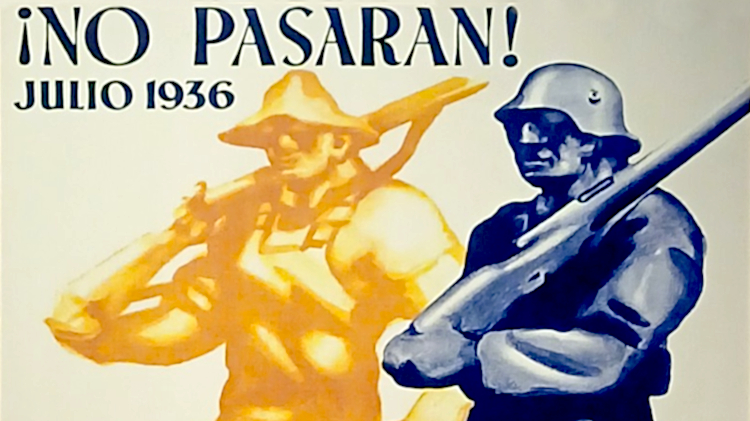
The legacy of the Spanish Civil War is still felt in Spain today, 90 years after it began. A culture of deliberate forgetting has meant that some of the darker truths about what happened are still covered up, as Catherine Hokin explains.
My latest novel, The Man She Had to Save, takes place during the Spanish Civil War which began 90 years ago, in 1936, when a group of Nationalist generals, including Francisco Franco, led a military coup against the democratic Second Spanish Republic.
The story, which involves a Luftwaffe pilot as one of its key characters, looks in particular at Nazi Germany’s extensive involvement on Franco’s side, a relationship which continued into World War Two as the general rewrote the definition of neutrality.
.jpg)
I was always going to write this book; I’ve been fascinated with the Spanish Civil War for a long time. What I didn’t realise, however, until I started to actually do it, was how little I understood. My first exposure to the subject was through George Orwell’s Homage to Catalonia.
I was young and idealistic when I read it. I thought travelling across Europe to fight fascism in Spain was romantic. I was also taught at school that General Franco was a ‘benevolent dictator’. Neither of those things, of course, were true. War is anything but romantic, and Franco was a tyrant. And what I hadn’t comprehended was the depth of the brutality, repression and fear.
Paul Preston describes the three-year war as a holocaust and attempts to conclusively establish the number of the dead remains difficult. Republican bodies were frequently buried in mass graves and they remain lost to their families to this day.
What can’t be denied, however, is the extent of the violence which went far beyond the battle lines. Estimates suggest that 500,000 people were killed, including over 200,000 Republicans who were murdered extra-judicially during and after the war. Others died in brutal Nationalist prisons or were worked to death in Nazi camps.

Franco, who declared martial law over Spain in 1936 and kept it in place until 1948, had no interest in reconciliation once he’d secured victory. Instead he called on Spanish citizens to join in the punishment of former Republicans or be guilty of treason themselves, enshrining that duty in Spain’s legal framework as the Law of Political Responsibilities.
The civil war was based on hatred and invested in terror. Unfortunately, it seems that the history books Franco so cleverly rewrote can still be far too kind to him.
A survey in 2025 reported that more than 21 per cent of the Spanish population believe the dictatorship years were good ones, a view that’s particularly marked among 18–24-year-olds. That’s a worrying statistic, but is it so surprising when Spain – despite long and often agonising struggles – continues to wrestle with the question of how to shine a truthful spotlight on its past?
Confronting something as devastating as a civil war is not easy: memories frequently remain as divided as the conflicts which bore them. For the 40 years of Franco’s dictatorship, the Nationalist viewpoint – which was as embedded in the school curriculum as it was in law – was the only viewpoint allowed. Republican experiences were denied and repressed and as hidden as the missing bodies until relatively recent times, and the public sphere was as secretive as the private was forced to be.

Walk round Madrid and you’d never know there’d been extensive fighting there. There are no plaques, there is no museum. You could visit Alicante without ever knowing about Campo de los Almendros, the camp which once held 30,000 Republican prisoners in horrific conditions. Like the others Franco set up, he had this one cleared when he was finished with it and all official photographs destroyed. The plaque there today is tiny.
There are people trying to redress the balance. The virtual museum of the Spanish Civil War is a wealth of resources. The Madrid Bombardeado map created by Enrique Bordes and Luis de Sobrón enables visitors to walk round a very different city. Films like The Silence of Others have shown a new audience that the lost and the crimes perpetrated against them have not and cannot be forgotten. But battles remain to be fought, particularly if the far right continues to gain ground in Spain.
In 1975, in the wake of Franco’s death, Spain’s political parties came together in a Pact of Forgetting – or a Pact of Silence as its opponents christened it – in an attempt to move forward and smooth the transition to democracy by drawing a veil over the dictatorship’s abuses. What that meant in reality was removing accountability from any of the criminals involved with the Franco regime – the Amnesty Law enacted in 1977 remains in force to this day – and hiding the truth of the slaughter.

Efforts have been made since 2007 to overturn parts of this amnesia, most notably in 2022 when President Sanchez signed the Law of Democratic Memory, whose aims include helping to locate and identify the tens of thousands of bodies still lying in unmarked graves.
Unfortunately, the political situation is as unstable in Spain as everywhere else due to the rise of the far-right, in this case the Vox Party. They are gaining ground and are fundamentally opposed to the new law – in Aragon, which is ruled by a right-wing coalition including Vox, it has already been repealed.
The Man She Had to Save is a book filled with secrets and lies because that reflects the Spain in which it was set. So many of the country’s memories are still battling for the light; so many will never be publicly acknowledged. Forty years of what was state-mandated forgetting has cast a long shadow over what is a wonderful, vibrant country.
I’m not romantic about the civil war any more. I shed a lot of tears researching my book and once again it felt as if history was looming. Because in a time when truth-telling becomes increasingly the preserve of those with the deepest pockets and the shallowest reserves of humanity, I can’t help but think that Spain’s past and its future holds lessons for us all.

The Man She Had to Save by Catherine Hokin is published on 15 July, 2026.
Find out more about this book.
Catherine Hokin writes fiction inspired by World War Two and the Cold War. Many of her novels are set in Berlin. She’s based in Glasgow.
Read more of her Historia features:
The fall and rise of fascism
Segregation and suffering in the cities of occupied Europe
Kindertransport and other responses to the WWII refugee crisis
The lost cities of Berlin
Making room for the master race: the true scope of Himmler’s Lebensborn programme
Language and the Nazi propaganda machine
The legacy of the village of Lidice
The Berlin blockade, 1948–9: the first Cold War stand-off
The Minister for Illusion: Goebbels and the German film industry
Concentration camps and the politics of memory
The ‘hidden’ Nazis of Argentina
An appearance of serenity: the French fashion industry in WWII
Further reading: other Historia features connected to this one include
The Spanish Civil War: a war against children by Maggie Brookes
The Nazi plan to seize Gibraltar by Graham Hurley
Judith Allnatt‘s review of Acts of Love and War by Maggie Brookes, set during the Spanish Civil War
Images:
- Spanish Civil War poster: photo by the author
- George Orwell and Eileen O’Shaughnessy with members of the ILP unit on the Aragon Front outside Huesca, 13th March 1937: Wikimedia (public domain)
- Francoist troops taking away Republican militiamen from a mountain during the Battle of Guadarrama, July-August 1936 (colourised): Cassowary Colorizations for Flickr (CC BY 2.0)
- Victory parade of Spanish national troops and the German Condor Legion in honour of General Francisco Franco in Ciudad de Leon, May 22, 1939: Wikimedia (public domain)
- Francisco Franco, portrait, probably 1940s: Wikimedia (public domain)


