
The Historical Writers’ Association (HWA) is delighted to announce the Crown Awards longlists for 2026, celebrating the best in historical writing, fiction and non-fiction, published during 2025–2026.
There are three awards categories: HWA Gold Crown, HWA Non-fiction Crown, and HWA Debut Crown, and 12 books in each category. Read on to find out about all 36 books, their publishers, and what our judges say about them.
The books longlisted for the HWA Crown Awards for 2025 are:
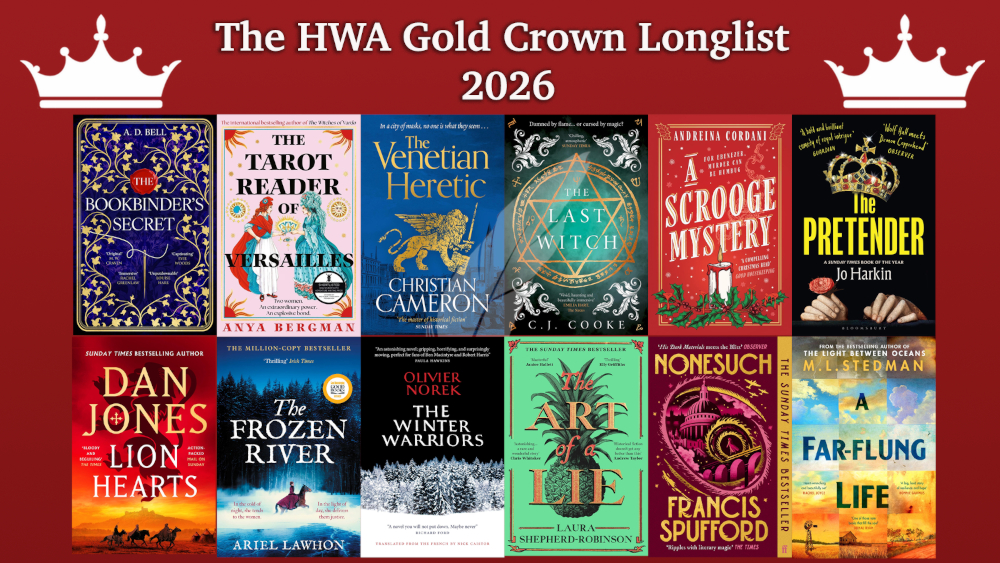
Gold Crown Award
The Bookbinder’s Secret by AD Bell (HQ)
An apprentice bookbinder at the turn of the 20th century is drawn into a dangerous intrigue. At once an enthralling mystery and a love letter to the lost art of bookbinding.
The Tarot Reader of Versailles by Anya Bergman (Manilla Press)
A rich blend of meticulous historical research into the extraordinary life of Marie-Anne Lenormand; magic, political intrigue at the heart of the French Revolution. It offers a vivid description of a world on the brink of violent transformation and its possible wider repercussions.
The Venetian Heretic by Christian Cameron (Orion)
A vivid historical escape to Venice through the story of an Englishman who left his life of slavery behind him. This masterful storytelling dives into the streets of Venice bringing intrigue, sword fighting, revelries, and conspiracy.
The Last Witch by CJ Cooke (HarperCollins)
The true story of Helena Scheuberin’s defiance against one of Europe’s most notorious witchfinders is a gripping fusion of well-researched history, gothic horror, and psychological suspense. Its haunting atmosphere and fierce female solidarity make it a powerful and unforgettable historical novel.
A Scrooge Mystery by Andreina Cordani (Zaffre)
A very original idea and a fabulously fun read. This is a totally absorbing sequel to A Christmas Carol which transports you back to Dickens’s London.
The Pretender by Jo Harkin (Bloomsbury)
A fictionalised telling of the early life of Lambert Simnel – pretender to the throne of Henry VII – which combines enviable stylistic verve with a wonderfully warm heart.
Lion Hearts by Dan Jones (Head of Zeus — an Aries Book)
The wars in France have created an unbreakable brotherhood that only fighting for your very survival can do. The Essex Dogs once fought and killed for each other. And must do again, reunited in Lion Hearts. Dan Jones gives us an epic conclusion to a truly memorable trilogy.
The Frozen River by Ariel Lawhon (Swift Press)
A masterfully-told story which immerses you in a small close-knit rural community in 18th-century Massachusetts, told by an unusual but totally relatable main protagonist: wife, mother, and compassionate midwife. We could not put this book down.
The Winter Warriors by Olivier Norek translated by Nick Caistor (Open Borders Press)
Cold, brutal, gripping. Grounded in reality and drawing from actual eyewitness accounts, The Winter Warriors is an inspiring retelling of an almost-forgotten war.
The Art of a Lie by Laura Shepherd-Robinson (Mantle)
Sprightly crime caper set in a confectionery shop in vivacious Georgian London. Threaded with twists and turns and memorable characters, sparkling with wit and pathos.
Nonesuch by Francis Spufford (Faber & Faber)
A rich, immersive and assured blending of history and fantasy set in a claustrophobic World War Two London. Full of stylish prose; genre-bending too.
A Far-flung Life by ML Stedman (Doubleday)
Poignant and tragic family saga from the late 1950s set on a vast Western Australia sheep station; very memorably portrayed. Bleak, beautiful and epic, yet full of character nuance.
The HWA Gold Crown Award judges are: Amy McElroy (chair), Ellen Alpsten, Rebecca Batley, Sharon Bennett Connolly, Jean Fullerton, Andrew Lockett, Miranda Malins and Thomas Mogford.
Non-fiction Crown Award
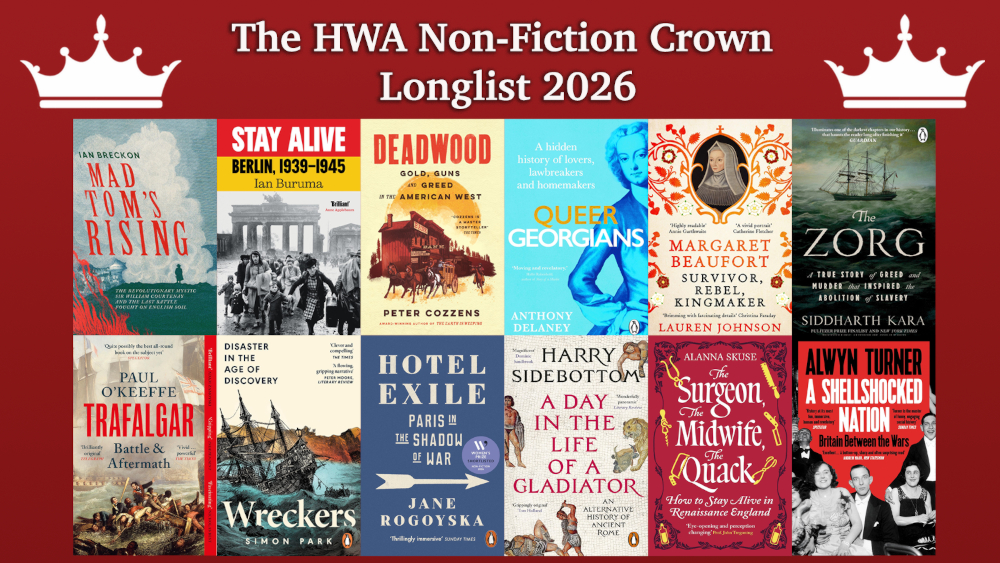
Mad Tom’s Rising: The Revolutionary Mystic Sir William Courtenay and the Last Battle Fought on English Soil by Ian Breckon (Icon Books)
Mad Tom’s Rising is the forgotten story of a mysterious character who incited and inspired a desperate people to rise up in the hope of a saviour. Well researched and written as an escalating drama, it provides insight into the conditions of the rural poor at the turn of the Victorian period, while telling the story of a delusional mad man who aspired to a seat in parliament but ended up instigating the ‘last battle fought on English soil’.
Stay Alive by Ian Buruma (Atlantic Books)
A haunting, subtle and profound study of daily life in Hitler’s capital during World War II. The judges were particularly struck by the humanity of Buruma’s account. He is admirably sensitive to the varieties of courage, compromise and complicity Berlin’s inhabitants displayed in their struggles to survive – without ever losing sight of the wider moral struggle as the city descended into a horrifying nihilistic darkness.
Deadwood by Peter Cozzens (Atlantic Books)
Immensely readable, this portrait of a Wild West town paints a vivid and balanced picture, combining facts about how Deadwood came to be, the lives of the people there, and commenting on big events and trends, but also focusing on individuals and fleshing out legendary characters. It gives the reader a true picture of life in the Wild West, and offers an engaging story of human behaviour.
Queer Georgians by Anthony Delaney (Doubleday)
Drawing on extensive archival research, Queer Georgians uncovers the lives, relationships and communities of queer people in Georgian Britain. The judges were particularly impressed by Delaney’s thoughtful and nuanced approach, and his ability to illuminate both individual lives and the complex society in which they lived.
Margaret Beaufort: Survivor, Rebel, Kingmaker by Lauren Johnson (Head of Zeus)
This biography fully illuminates the woman deemed the ‘Tudor Matriarch’: mother of Henry VII, Margaret Beaufort. Among other aspects, the author tackles head on the myths, some propagated by Margaret herself, that she had always fully dedicated herself to her only son and had not desired more children. Evidence-based and sympathetically told, this biography challenges the hitherto commonly accepted assessment of the character and private motivations of one of the most famous mothers in history.
The Zorg by Siddharth Kara (Doubleday)
A fascinating and engaging exploration of the details of the ship and the impacts of its voyage, with interesting detective work to ascertain the author of the letter which was so pivotal to the story. A key contributor to the turn against the Transatlantic slave trade, it’s an important episode of history deserving of a wide audience.
Trafalgar: Battle & Aftermath by Paul O’Keeffe (Vintage/Bodley Head)
An incredibly detailed account of the Battle of Trafalgar and its wider context. Well-researched and engaging, the book conveys action and drama, and isn’t afraid to deal with the battle’s more uncomfortable and emotional aspects. The judges especially praised the author’s vivid story telling and the inclusion of less well-known characters and their personal experiences.
Wreckers: Disaster in the Age of Discovery by Simon Park (Viking/Penguin)
Focusing on shipwrecks, failures and encounters with indigenous peoples, Wreckers offers a fresh perspective on the familiar story of the Age of Discovery. Simon Park combines impressive scholarship with vivid storytelling, producing an original and highly readable account which brings overlooked stories and perspectives compellingly to life.
Hotel Exile: Paris in the Shadow of War by Jane Rogoyska (Allen Lane/Penguin)
The judges were impressed by the unique and effective way in which the author tells the story of Paris, before, during and after the German occupation of WWII through the perspective of the Hotel Lutetia and its important roles throughout: first as a refuge, then a German intelligence HQ and finally a reception centre for those returning from Nazi concentration camps. This was moving, informative and engaging narrative and an important story to tell.
A Day in the Life of a Gladiator: Those Who Are About To Die by Harry Sidebottom (Penguin)
The judges liked the format and structure of this book, which allows for a detailed picture of the daily lives of the gladiators while also leaving room to give the reader information on other aspects of life in Ancient Rome. Packed with detail, with an emphasis on the gladiator’s core values and beliefs, it also encompasses other, often forgotten, characters, and brings the subject to life with a deft mix of scholarship and interesting anecdotes.
The Surgeon, The Midwife, The Quack: How to Stay Alive in Renaissance England by Alanna Skuse (Oneworld Publications)
Excellently researched, The Surgeon, The Midwife, The Quack guides the reader through the changing face of medicine with wit and humour. From medieval ideas and the evolution of treatments, set against a changing world, Skuse reveals stories of fascinating characters alongside some gruesome tales, while also providing a readable story through a pivotal period of medical history.
A Shellshocked Nation: Britain Between the Wars by Alwyn Turner (Profile)
A Shellshocked Nation is a riveting portrait of a country and a people finding their feet after the death and destruction of the Great War. Making expert use of contemporary news stories – together with the fiction, music and film of the era – Turner’s book is thoughtful, perceptive and nuanced, and hugely entertaining to boot. The nation’s pulse can rarely have been taken with such style and aplomb.
The HWA Non-fiction Crown Award judges are: Annie Whitehead (chair), Melanie Backe-Hansen, Charlie Corn, Philippa Lacey, Matt Lewis, Mathew Lyons and Jo Romero.
Debut Crown Award
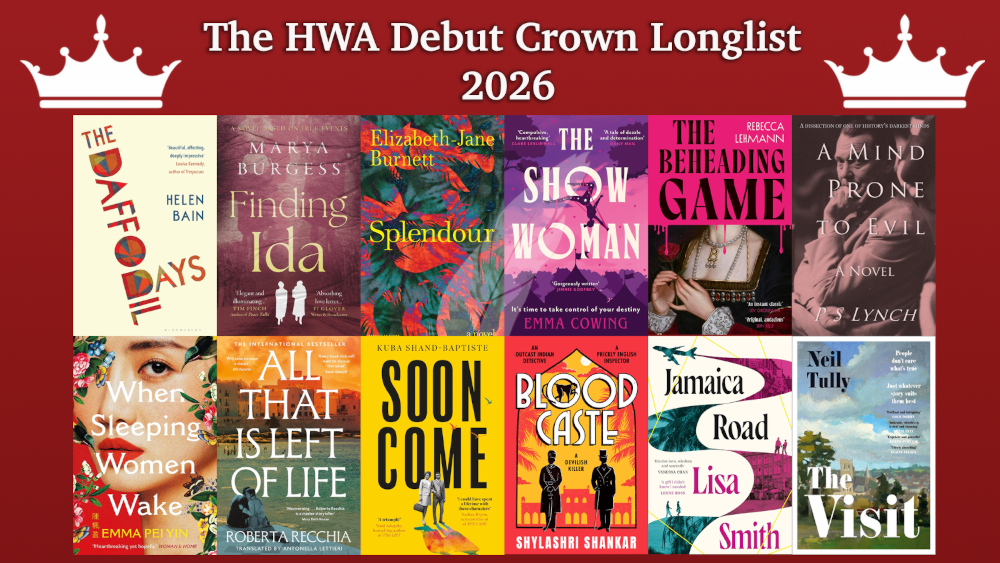
The Daffodil Days by Helen Bain (Bloomsbury)
The unravelling of Ted Hughes and Sylvia Plath’s marriage takes centre stage in this account of a pivotal year in their life in rural Devon. Intriguing and exceptionally well-researched, but also unsentimental and intimate. Helen Bain has allowed readers to visualise and have a ringside seat to their lives through the rural community where they lived. A debut novel that will enhance Plath’s reputation.
Finding Ida by Marya Burgess (The Book Guild)
Faith, loss and forgiveness inspire this emotional story of two sisters whose lives go in different directions during the occupation of Poland during WWII. While the war destroys one sister, the other finds love and adventure. Compelling and intriguing, with a great sense of place, this is also a thoughtful and poignant debut.
Splendour by Elizabeth Jane Burnett (Particular Books/Penguin)
Set against the background of Kenyan colonialism, friendship, family, and the lasting impact of the Mau-Mau war, Splendour paints a vivid description of history, loss and resilience. A deeply compassionate read that is very evocative of the time and place.
The Show Woman by Emma Cowing (Hodder & Stoughton)
A wonderful story of an impressive and undaunted touring female circus troop who have to contend with a myriad of hardships in order to over come their own struggles. The gritty, sparkling world of the fairground alongside adventure, romance and crime make for a gripping story line that also emphasises courage, grief and ambition. A truly compelling novel.
The Beheading Game by Rebecca Lehmann (Harvill/Vintage)
This novel has an extraordinary starting point, which is that Anne Boleyn somehow puts herself back together after her beheading and sets out swearing vengeance. The story is told with such verve and conviction that we are swept along. A strong sense of time and place brings Anne and her era vividly to life.
A Mind Prone to Evil by PS Lynch (Stairwell Books)
An enthralling journey that goes beyond good and evil. A gripping read with great characters and plot, which carefully blends fact, fiction, art, and the treatment of Göring, alongside the overwhelming opulence of his life. With Göring being at times charming and ruthless, contrary and always deeply threatening, this is a debut novel that will make you rethink all you thought you knew about one of the most formidable and hateful people in history.
When Sleeping Women Wake by Emma Pei Yin (Quercus)
This novel is set in Hong Kong during the Second World War. The women of the wealthy Tang family are managing life in the British-occupied colony, having fled Shanghai. But their lives are upended by the Japanese invasion. This is an unflinching and very well-researched account of the war through the eyes of these women, and their bravery in the face of terrible danger is told with great clarity and compassion.
All That is Left is Life by Roberta Recchia translated by Antonella Lettieri (Dialogue Books)
The comfortable life of the Ansaldo family is destroyed by the disappearance of their teenage daughter Betta on a seaside holiday near Rome. Recchia’s account of the ensuing years examines the secrets, the lies, the ruptures that result from this one tragedy. Compellingly told, with authentic and believable characters, this is an astonishingly assured debut. Praise is also due to Antonella Lettieri, the translator.
Soon Come by Shuba Shand-Baptiste (Dialogue Books)
A rich, moving story about migration, friendship and the spaces that are created that not only celebrates London’s Caribbean community but highlights the British Caribbean and British Black experience. A debut that is lush, defiant and human.
Blood Caste by Shylashri Shankar (Canelo)
A fascinating glimpse of 1895 Imperial India, where a series of worrying murders of women take place against the background of a number of plot twists. An ingenious story, blending not only the legend of Jack the Ripper but also religion, gender roles, caste, and race politics in India. A compelling Victorian-set thriller.
Jamaica Road by Lisa Smith (Dialogue Books)
An emotionally-charged debut novel about race, class and families you are born into set against the background of illegal immigration, murder and enduring friendships. An understated debut novel that is wonderfully written, with an atmospheric Caribbean look at a decade in South London through the eyes of two different families.
The Visit by Neil Tully (Eriu)
It is 1963, and John F Kennedy is due to visit his home town in Ireland. Out of this odd historical circumstance, Neil Tully weaves a vivid and poetic tale of two men whose lives are caught up in the event — and changed, for better or for worse. With a deep sense of character, and a clarity of language, this is a worthy debut.
The HWA Debut Crown Award judges are: Ayo Onatade (chair), Susan Heads and Alison Joseph.
Congratulations to all the longlisted authors!
Thank you to our hard-working judges. Their job isn’t over yet; each list has to be narrowed down to six for the shortlist and then to just one winner.
Thank you, too, to HWA Chair Imogen Robertson for organising the Crown Awards and the awards party every year.
Find out who goes through to the next round:
HWA Crown Award shortlists announced: 14 October, 2026.
HWA Crown Award winners announced and awards ceremony: 18 November, 2026.
Follow #HWACrowns26 on Twitter/X, Facebook, BlueSky and Instagram.
If you’d like to buy any of the longlisted books, go to our Bookshop account where you’ll find them listed and be able to support independent bookshops as well as these 36 impressive authors.
There’s more awards news to come. We’ll reveal the HWA Dorothy Dunnett Short Story Competition longlist on 23 September, here in Historia and on social media.


