

To mark SG (Shona) MacLean’s new novel, The Winter List, being published, Historia spoke to her about returning to characters we thought we’d seen the last of, as well as how she goes about researching her novels and the importance of place. Shona also offered us some advice for new writers as well as a taste of what her next book is about.
In The Winter List, we return to the world of Damian Seeker, though this time with the Seeker himself far from the centre of the action. Instead, we follow his daughter, Manon, in York, where she lives with her husband, Lawrence Ingolby.
The Commonwealth is no more and Charles Stuart has returned to the throne as Charles II. It’s a dangerous time for his opponents, and some victorious royalists in London will not rest until leading republicans are tracked down and punished. These include Damian Seeker, even though he now lives in America — but they are sure they can find him through Manon.
One of these unofficial operatives is Roger L’Estrange, pamphleteer and future press regulator, and among the spies he recruits is an old enemy (frenemy?) of Seeker’s, Lady Anne Winter — though her task in unconnected to the search for the former Commonwealth man.

I began by asking Shona what made her return to Seeker — or rather, to those close to him — after we thought we’d seen his story end in The House of Lamentations.
She hadn’t planned to, she told me. “Writing a book connected to the Seeker series that he’s not really in is a bit risky.
“After The Bookseller of Inverness I felt quite hollowed out. My publishers, Quercus, had given me a had a two-book contract. But I didn’t think I was able to say any more than I did in that book.”
But she still had some unfinished business with Seeker’s world. “I’d given Seeker the exit I’d always planned and I’m quite happy that he’s over in America and he’s making a new life. But I’d got attached to some of the characters from the books, like Lady Anne, Lawrence Ingolby and Thomas Faithly [a Royalist exile who got tangled up in Seeker’s work], and I thought: what happened to them after the Restoration?” she said.
“I felt I hadn’t quite finished off some of the stories. I needed to find out what happened to the characters from the Seeker books for myself. And I knew that a lot of readers liked Lady Anne and Thomas Faithly — and Lawrence Ingolby’s my own favourite.”
I asked Shona how she goes about researching her books.
“I start from the broadest perspective. I’ll read histories of the period and the places. Then I’ll try to find primary sources; if there are printed letters, diaries, that’s excellent. But I do like to get my boots on the ground. I wanted to have a trip to York specifically for writing The Winter List, so I went down in the February of 2020.

“There had been horrendous storms and the trains were off for days — they’d just started running again the day I was due to leave. As we were pulling into York station I could see the snowflakes dropping.
“There was a church I had to get to that afternoon and because the snow was falling so heavily they were closing early, so I just got in to have a look at it.
“My boots were leaking and they got soaked. I had to buy myself some new ones. So if you’re wondering why, in the book, people are always reflecting on how wet their feet are…
“I do enjoy walking around, getting to know the buildings. I was looking for places I’d like to have Lawrence and Lady Anne living, and I found houses that appealed to me — so that’s why they are where they are.”
Shona referred to Peter Ackroyd’s London: The Biography, where he writes of the city being “a place of essences” that last over centuries. She didn’t know London well before writing the first book in the series, The Seeker, and his words “unlocked” her own experiences of getting the sense of a place, of imagining it in the past. “You can really pick it up by walking round places like York or Oxford.”
Does she start with a plot and stick to it? “I’ll have a plot; then, the more I read, the more ideas I get, and the plot will have branches. But once I’m really into the writing I don’t deviate too much. Sometimes I’ll read something that opens another door, and I have to be very disciplined and think: ‘This is fascinating — but does it strengthen the plot?’ And if it doesn’t, it’s going to be a digression that takes away from the story.”

Did she find anything while researching The Winter List that particularly surprised her? “The fact that [George Villiers, second Duke of] Buckingham was sent up to York to be Lord Lieutenant. There was a degree of just getting him out of the way.” The on-and-off Royal favourite was, to say the least, an unreliable statesman in Westminster.
I mentioned the ‘Easter eggs’ that she’s dropped into The Winter List, passing references that people who know a period will get, but which don’t take away from the plot if you don’t spot them. No spoilers, but Horace Appleton may ring a bell for some 17th-century lovers.
There are far bigger surprises in her book, and I confessed to being completely fooled by the identity of the person the spymaster L’Estrange set on Seeker’s trail.
Shona laughed with delight. Even her editor hadn’t suspected who it was, she said. “I did make sure I had little clues all the way through.” Which is as good an excuse as any to go back and reread it.
Do historical fiction writers help people understand the past? “The best thing we can do is help people enjoy themselves in their leisure time. I’m a storyteller first of all. I have a great deal of respect for the past, I don’t want to make the context up.

“But because I’ve got an academic background [she has a History PhD from Aberdeen University], because I know how long historians spend researching in archives, I know how much you have to put into just a footnote, I’m hesitant to say that historical novels can tell you what it was like in the past.
“I can tell you what I think it was like, and I hope I can carry you along with me, I hope I can offer you a world that you feel you can step into.
“I think historical novelists offer a vision, a way of experiencing the past. But I would never say that it’s going to be more authentic than non-fiction.”
How can we get a flavour of the past, apart from academic study? “If you can find more informal things to read, like diaries and private letters. Or sometimes formal things — Scottish Kirk session papers are fabulous: the ways people talk to and about each other in them are wonderful. They can take you pretty close to the mindset of people in the past.
“Particularly if it’s a vernacular source you can get a feel for the rhythm of the way people talked. I say to creative writing students: try to get the rhythm, you don’t need to replicate the way people spoke at the time because that’s not going to flow for a modern reader.”

For example, Alexander Seaton, from her first series, would have spoken early 17th-century Scots. He emerged from her PhD work and the records she was using for that “were very evocative, but if I had had Alexander and the other people in Aberdeen talking as they would have done then, my readership would have been restricted to Aberdeenshire and the Moray area, where a lot of people do still speak like that.”
Has she any further advice for new writers? “Read contemporary accounts, as I said; look at old maps, and walk the streets if you can. You want to treat the places you’re writing about with respect.”
Would she ever return to the bookshop in Inverness? Possibly. But any book would be set much later in the 18th century, during the time of the French Revolution; and she has no plans at the moment to write it, being immersed in her next book, which she got the idea for over seven years ago. After bringing out four more murder mysteries set in the 17th and 18th centuries since then, she feels now is the time to write that book.
“It’s set in the 19th century. It’s not a murder story — it’s about a literary society. It’s a challenge because it’s a completely different kind of book; it’s not driven by the need to discover who the murderer is and why a murder took place.” But before talking more about the book, she says, “I need to write it down, and then I need to go back and turn it into a novel.”
We’ll just have to wait to find out more.
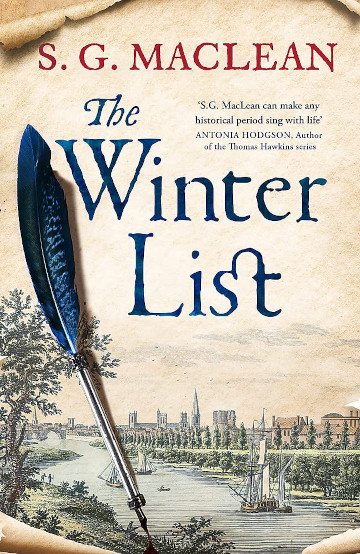
The Winter List by SG MacLean is published on 7 September, 2023.
Read more about The Winter List.
Shona MacLean has been shortlisted four times for the CWA Historical Dagger and has won it twice, for The Seeker in 2015 and for Destroying Angel in 2019. She’s currently longlisted for the prestigious McIlvanney Prize (alongside Ian Rankin) and The Bookseller of Inverness was one of Waterstones’ highest selling Scottish Books of the Month earlier this year.
Read Alis Hawkins’s review of The Bookseller of Inverness, her previous novel, which is set in the Highlands after Culloden.
You can find Shona on Instagram @shonamacleanauthor
Images:
- Photo of SG MacLean: Quercus Books
- Sir Roger L’Estrange by Robert White, after Godfrey Kneller, 1684: National Galleries of Scotland (CC BY NC)
- Bootham Bar and York Minster: © Michael Jagger for Geograph (CC BY-SA 2.0)
- George Villiers, second Duke of Buckingham: © Christ Church, University of Oxford, via Art UK (fair use)
- Kings Manor, York (a major setting in the book): © Michael Jagger for Geograph (CC BY-SA 2.0)
- Speed’s map of York, 1611: Wikimedia (public domain)


