

Having spent the best part of a decade in London with her brilliant CWA dagger-winning creation, Damian Seeker, SG MacLean is very firmly back in her Scottish wheelhouse with The Bookseller of Inverness, says Alis Hawkins.
This is a book about the power of an idea.
It’s about the revival of a man left hollowed out and traumatised by war.
It’s about the triumph of hope over endless, bitter experience.
It’s also about betrayal, revenge and the compromises we make to survive.

In her author’s note, SG MacLean tells the reader that she found The Bookseller of Inverness the hardest of her books to write. It’s not hard to see why. It takes real artistry to weave together fact and fiction as deftly as this.
The result is a brilliant tapestry of a novel: the warp a high-thread-count background of three generations of Jacobitism, the weft an intensely character-driven plot of betrayal, revenge, guilt and loss.
The blurb paints the novel as a murder mystery, but the narrative has greater ambitions. At its heart is the agonising question of why the Jacobite cause, so passionately embraced, has not prevailed, and why the Highlands are still suffering the savagery of English redcoats.
The novel begins with a prologue in which prisoners taken after the unsuccessful Jacobite rising in 1715 are plotting escape.
Thirty-six years later, six years after the Jacobites’ final, failed rebellion of 1745, Iain MacGillivray is a lost soul. He gets up each morning, dresses and goes to his bookshop where he endures another day of a life he no longer finds meaningful.
But a murder in his bookshop and the sudden re-appearance of his father, Hector, whom he had thought dead at Culloden, jolt him out of his grief-stricken fugue.
Iain and Hector barely know each other, but they are forced to put personal issues aside to discover why Jacobites are being murdered, knives in their necks bearing the white cockade of the Stuart cause.

In the complex and antagonistic relationship between father, son and Iain’s grandmother, Mairi Farquharson, SG MacLean draws the reader into a family so well-realised that it was necessary to check whether they were historically real.
And, through the web of allegiances the family owes to other supporters of the Stuart cause, we swiftly develop an empathy with the sacrifices, the commitment, and the almost religious devotion of three generations of Jacobites to their King and Prince.
Appropriately, the plot of The Bookseller of Inverness hangs on two volumes. The Jacobite Letter Book of Bailie John Steuart can be read simply as the correspondence of a successful Highland merchant, but the letters are commonly believed to be coded messages used in the Stuart cause, and SG MacLean presents them as such. The Book of Forbidden Names, in which the names of six traitors to the Jacobite cause are encoded, is MacLean’s own invention, though it seems so plausible, in context, that another foray into Google was necessary.
The Book of Forbidden Names is the fulcrum of the novel. It brings together the past of the prologue, the intervening 36 years, and the present in which the Jacobite cause and the characters who live and work around Iain MacGillivray’s bookshop are bound together by his father’s apparent return from the dead.

Hector MacGillivray is a charismatic charmer, and as we watch him raise flagging spirits and revive the hopes of men who had thought their cause lost, it’s tempting to see him as SG MacLean’s proxy for Bonnie Prince Charlie, a constant ‘off camera’ presence.
Hector’s flamboyant delivery of himself into English hands, while repaying a debt of honour, could easily be seen as symbolic of some of the Prince’s more quixotic decisions and goes some way, perhaps, to explaining why, despite their passionate convictions, the Stuarts could not prevail against the ruthless pragmatism of the English state.
Not gifted with his father’s resilience, Iain’s persisting trauma in the wake of the Jacobites’ defeat at Culloden is constantly triggered as the pair work together to discover the identity of both a murderer and the traitors he is targeting.
The ridge overlooking Inverness depresses Iain’s spirits at the thought that “there would always be new wars to replace the old”; the thundering waters of the ‘Smoking Falls’ of Foyers sound, to his battle-scarred ears, like cannon fire.

And yet, such is the strength of his father’s belief in the cause that Iain finds himself hoping against hope that all may not be lost.
The Bookseller of Inverness is a deeply satisfying book. The world it conjures up leaps off the page with a vivid authenticity: a world in which the betrayals and defeats of the past are ever present, like an overlay of painted glass which also acts a refracting mirror for the longed-for future the Jacobites are still trying to will into being.
But ultimately, it’s the characters who make the book sing. The way in which their lives are changed forever by the murderous events at the heart of the plot draws the reader into their world and makes latter-day Jacobites of us. Even though history tells us that there were no more rebellions after 1745, we will the Elibank plot to be successful and the Highlanders freed from the oppression of the Hanoverians.
We thrill at Iain MacGillivray’s re-engagement with life, so brilliantly captured in the scene, late in the book, where he ‘flytes’ joyously with another Highland fiddler in a Jacobite stronghold.

And, finally, we smile in satisfaction as the fraying strands of the prologue are neatly caught up in the denouement. Ah yes, we think, the seeds of defeat were always there because, in the end, politics is all about people.
The Bookseller of Inverness is a triumphant return to Scotland for SG MacLean.
The Bookseller of Inverness by SG MacLean is published on 4 August, 2022.
See more about this book.
You may also be interested in reading:
The Battle of Killiecrankie,
1719: the forgotten Jacobite rising and
Damn’ Rebel Bitches: Research Then and Now, all by Maggie Craig
Raising the Jacobite standard: Glenfinnan, 1745,
Remembering Culloden and
Five surprising facts about Charles Edward Stuart, all by Frances Owen
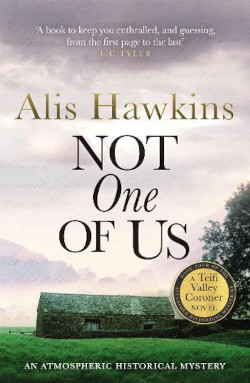
Alis Hawkins is the author of the Teifi Valley Coroner historical crime series and of medieval mysteries.
Not One Of Us, her latest Teifi Valley Coroner book, was published on 9 September, 2021. It was shortlisted for the CWA Historical Dagger Award in 2022.
The Black and the White by Alis Hawkins was published on 2 April, 2020, the first of a new medieval mystery trilogy.
Read Historia’s interview with Alis, in which she talks about writing fiction set in two centuries and two places: England in the 14th century and West Wales in the 19th. What draws her to such contrasting settings?
Images:
Detail from An Incident in the Rebellion of 1745 (the Battle of Culloden) by David Morier: Royal Collection Trust / © Her Majesty Queen Elizabeth II 2022
Prince Charles Edward Stuart, wearing a white cockade, by William Mosman: © National Galleries of Scotland via Wikimedia
Inverness, from the book cover
Upper Falls of Foyers: valenta for Geograph (CC BY-SA 2.0)


