
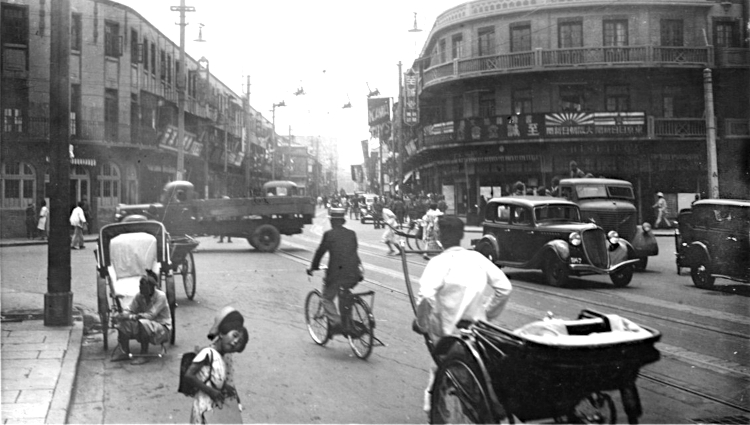
Shanghai, the ‘Pearl of the Orient’, was invaded by Japanese troops in 1941. The comfortable lives of the Westerners living in the city’s International Settlement were over. Deborah Swift looks back at the history of what happened, and her experiences of researching it for her latest novel, The Enemy’s Wife.
At the end of my last book, I left my protagonists, Zofia and Haru, in Kobe, Japan. They had just escaped Soviet Lithuania on the Trans-Siberian Express. While musing on what to write next, I discovered that in 1941, after the attack on Pearl Harbor, the Japanese forcibly moved all the Jewish refugees in Kobe to Shanghai.
As I read on, through what happened next in their history, I had to wonder if any reader would believe the extra hardships these refugees went through, once they had escaped to so-called safety. But many of the refugees did in fact have to make the journey I was about to depict. From Siberia, to Japan and now to Shanghai, and from there into the vast wilderness of China.

So began my research. It turned out that Shanghai was a haven for Jewish refugees, as most countries denied entry for Jews fleeing the violent persecution by Nazi Germany. The Jews were settled in what was known as the Shanghai Ghetto, the one-square-mile area of Hongkou, north of the Suzhou Creek, from where there was a bridge to the International Settlement.
The International Settlement was a city within a city. A walled garden of luxurious Western lifestyles dominated by the British and American concessions (areas), which were ruled by an Anglo-American council. South of the settlement was the French Concession, where many wealthy ‘Shanghailanders’ lived in luxury in palatial houses.
The local Chinese were the servant class for this elite, with Europeans encouraged to employ as many people as possible to enable the poorest of them to survive. This riverside city, the port hub of Asian trade, banking and manufacturing, was a unique blend of East and West, with high-end colonial living, its own Hollywood-style film industry, and fabulous night-life and restaurants.
There were hundreds of cabarets, nightclubs, and elite ballrooms. Perhaps the most famous of all was the Paramount, an Art Deco dance hall on the iconic Bubbling Well Road that attracted Shanghai’s rich and famous. Built in 1933, it was the biggest ballroom in the city, its transliterated name in Mandarin was Bai Le Men, ‘Gateway to 100 Pleasures’.
.jpg)
Surrounding this microcosm of the West was the sprawling Chinese nation controlled by the Chinese central government in Nanking, but recently brutally occupied by the Japanese.
The Japanese bombed and occupied the Hongkou District of Shanghai in 1937, after they had invaded eastern China. So it was only a matter of time before they would over-run the ‘Pearl of the Orient’ – the international settlement of Shanghai – and thus control the wealth of the Far East.
Previously, in 1940, sensing the looming Japanese pressure, the British Government had declared the International Settlement indefensible and withdrawn the army, and shortly after the Americans followed suit. However, thousands of defenceless British and American citizens continued to live and work in Shanghai.
The Japanese Takeover
“In a real war, no one knew which side he was on, and there were no flags or commentators or winners. In a real war there were no enemies.” JG Ballard, Empire of the Sun

I first came across Shanghai’s International Settlement in JG Ballard’s Empire of the Sun, a well-known novel based on real events in the author’s life. It describes the Japanese invasion from the point of view of Jim, an upper-class British schoolboy. The book was later made into a very successful film, directed by Stephen Spielberg.
The Japanese invasion began with the destruction of American and British naval vessels in the harbour. The chaos of the days following the takeover are well-depicted in the film, with fears that the Japanese might bomb the city as well as the harbour, leading to widespread panic among civilians.
The Japanese at this time were fearsome opponents. Japanese army training was brutal and uncompromising. Alvin Langdon Coburn, writing for the Manchester Guardian, described the aftermath of the Japanese invasion of China: “Japanese fathers show their sons the dead soldiers lying in the trenches. Some of the visitors seem to be inspired by the Samurai spirit, for they wander amongst the desolation with rusty swords in their hands collecting souvenirs.”
After invasion, houses in the settlement were requisitioned, businesses taken over, and a curfew put into place. Europeans and Americans soon became second class citizens, forced to wear identifying armbands, and later interned in camps under grim conditions.
Writing about 1940s Shanghai

Shanghai had many names, the ‘Paris of the East,’ the ‘Pearl of the Orient’ and the ‘Whore of Asia’. The latter was a gift for the novelist – an underbelly of prostitution, corruption, gambling, drug trafficking and the Chinese mafia allowed plenty of opportunity for conflict, even without wars and invasions.
But it is the melting-pot atmosphere of Old Shanghai that has always appealed to writers and film-makers. For example, Eileen Chang’s Lust, Caution, a novella set in Japanese-occupied Shanghai in 1942, became an award-winning box office hit in 2007 when Ang Lee adapted it into a film.
When attempting to research Shanghai, it was apparent that 1940s Shanghai now existed nowhere. The city has been completely redeveloped, and is now a metropolis of glass, steel and skyscrapers. In order to build ‘my’ Shanghai, I had to reflect a city and atmosphere that no longer exists, except in old film, and in other authors’ or artists’ imaginations.
Another problem I faced as a novelist was that there was almost impossible to get a clear political view. There were so many perspectives – for example the French concession sided with the Vichy-controlled Nazi occupiers, as did the Germans, leading to uncomfortable tensions with other civilians in the European settlement.

Added to this, China was so vast that, despite Japanese aggression, pockets of resistance remained everywhere. The Chinese population itself was still locked in an ongoing civil war between the Nationalists and the Communists.
Britain officially signed the International Settlement over to Chiang Kai-shek’s Nationalist government, in the Sino-British friendship treaty, while Shanghai was still occupied by the Japanese. Yet the civil war in China continued, with Mao Tse-tung (Mao Zedong)’s People’s Liberation Army engaged in a fierce battle against Chiang Kai-shek’s Kuomintang. By 1949, Shanghai had fallen to the Communists, and the Nationalists fled to Taiwan.
“What was so striking about wartime Shanghai was that no single issue or ideological position had been able to lay a sweeping claim on the allegiance or loyalty of all individuals in the city, thanks to this ceaseless mixing and reconfiguring of politics on all levels.” Wen-Hsin Yeh, Wartime Shanghai.
Wartime Shanghai was a fascinating city to research and reimagine, and I hope many of you will enjoy The Enemy’s Wife.
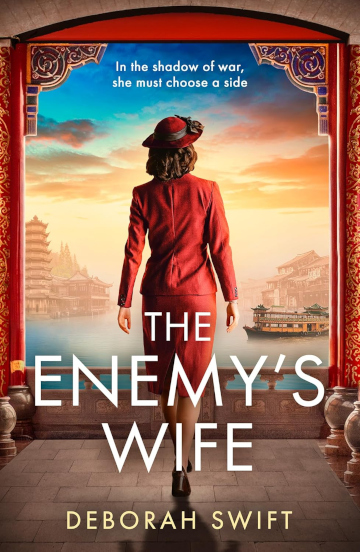
The Enemy’s Wife by Deborah Swift is published on 9 April, 2026.
Further reading:
Wartime Shanghai by Wen-Hsin Yeh
Empire of the Sun by JG Ballard
Lust Caution by Eileen Chang
Deborah is the author of more than 20 historical novels, eight of which are set in WWII. She lives in Lancashire, close to the Lake District National Park.
You may enjoy some of Deborah’s other Historia features:
A different kind of WWII resistance
Mask wearing and crime in Renaissance Venice
Slashing the face: punishing unfaithful women in Italy
In search of the animals in the Great Fire of London
And so to bed – a goodbye to Pepys’s diary
Luck or lottery? Choosing your valentine in the 17th century
Health and Hellfire: Personalising the Plague in 17th Century London
Animating Pepys’ Women
Further relevant features:
Why I started a podcast – and what I learnt by Kate Thompson, about interviewing Britain’s wartime generation
From Taranto to Pearl Harbor – spies and inspiration by Alan Bardos
Historia interviews, 2021 Crown Awards shortlists: Linda Colley (author of The Gun, the Ship & the Pen) by Frances Owen
Historia interviews, 2020 Crown Awards shortlists: Jung Chang by Frances Owen
Van Gogh and Japan by Lesley Downer
And, for earlier Japanese history, Lesley’s review of Samurai at the British Museum
Images:
- Wusong Road, Shanghai, 1930s: Wikimedia (public domain)
- Polish Association ID issued to a Jewish man living inside the Shanghai Ghetto, 1942: Huddyhuddy for Wikimedia (CC BY-SA 4.0)
- V Shanghai, the fifth of the seven maps from “Peiping–Tientsin, Kuan-tung, Wei-hai-wei, Kiaochou, Shanghai, Kuang-chou-wan, Canton–Macao–Hongkong”, showing the Chinese city and international settlements in Shanghai on the eve of World War II with an inset map of the course of the Huangpu from Shanghai proper to the Yangtze River,1935: Wikimedia (public domain)
- Japanese landing force going to the Nanking Road, Shanghai, 8 December, 1941: Wikimedia (public domain)
- Nanking Rd, Shanghai, at night, 1930s: Wikimedia (public domain)
- The Bund, Shanghai, showing a view of the World War I Memorial, destroyed by the Japanese during World War II, 1928: Wikimedia (public domain)


