Lesley Downer, author of The Shortest History of Japan, visits the Samurai exhibition at the British Museum and discovers that it’s “an exhibition of treasures” which show that the samurai were patrons of the arts as well as warriors.
Prepare to be dazzled!
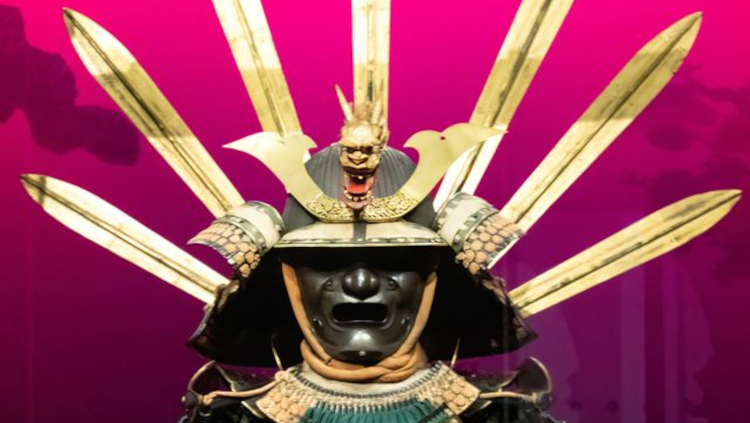
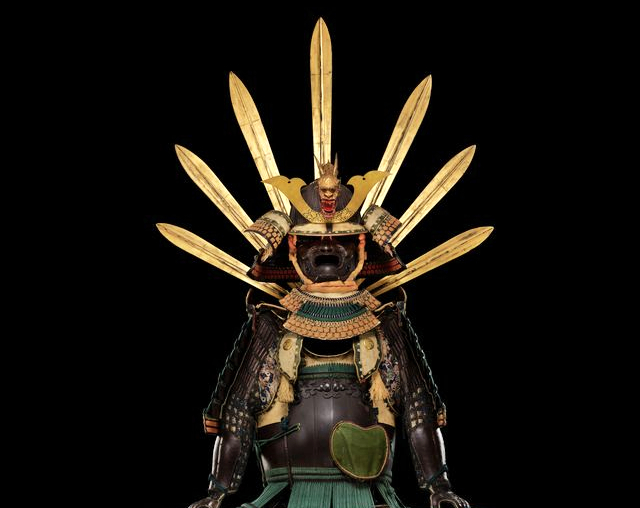
A magnificent and ferocious-looking samurai in full armour stands guard at the entrance to the Samurai exhibition at the British Museum. There’s no human being inside though it almost looks as if there is.
Unlike western armour his is not metal but made of iron and leather plates laced with silk or leather cords, with thick breast and shoulder plates to deflect arrows and swords. He wears a grimacing black mask designed to terrify the enemy on the battlefield. His spectacular helmet has seven golden blades bursting like sunrays around it and a snarling golden dragon, exquisitely modelled, bristling from the forehead.

There are several helmets in this thrilling show, surely among the most breathtaking exhibits. One sports a feathered and winged bird’s head above it, another a butterfly, another a delicately worked dragon sprouting flames. There are also swords and bows and arrows.
All of these are not just implements of war but works of art created with extraordinary attention to detail by superb craftsmen.
This is an exhibition of treasures. The key message of this exhibition is that the samurai were far more than just formidable warriors. They prided themselves as much on their connoisseurship and artistic tastes and skills.
In fact the main period when the samurai actually needed to fight was long ago. Between the 1100s when the samurai emerged and 1615 when Shogun Tokugawa Ieyasu brought peace to the country there were centuries of warfare when the samurai really were the ferocious warriors of legend.
But even at the height of the warring period, the warlords practised Noh dancing and were connoisseurs and patrons of pottery, literature and Chinese painting.
In the exhibition there are clips from the latest Disney Plus Shogun series and a splendid backdrop of samurai fighting to evoke this period. There are also exquisite folding gold screens depicting ancient battles.
The Tokugawa shoguns brought 250 years of peace to Japan, from 1615 to 1868. With no wars to fight the samurai became government officials, scholars and patrons of the arts.
This is the most expansive section of the exhibition with exquisite pots and Chinese paintings on view. There is a marvellous landscape, a whole world created with a few brush strokes, by Sesshu, the great Japanese ink painter.
There’s also the suit of armour which the second Tokugawa shogun, Hidetada, sent to James VI and I, as much a warning — “Don’t mess with us!” — as a display of artistry.
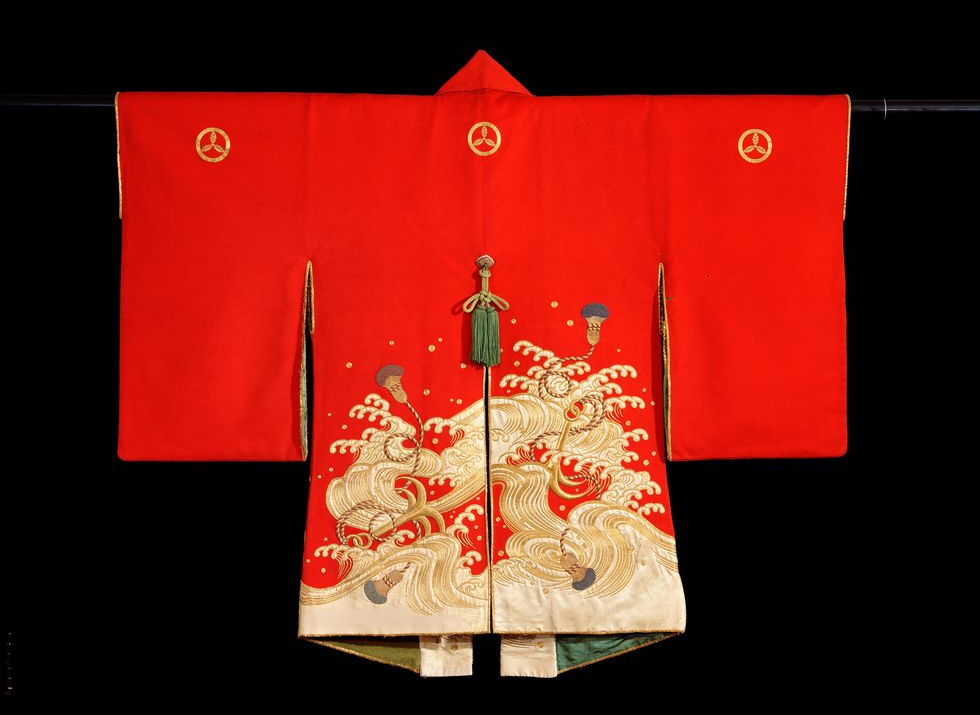
In fact the samurai constituted a whole social class, which of course included women. They were the highest social class and in a position to commission extravagant artefacts. In the exhibition there are some exquisite samurai women’s kimonos including a beautifully textured garment embroidered with blossom and boats.
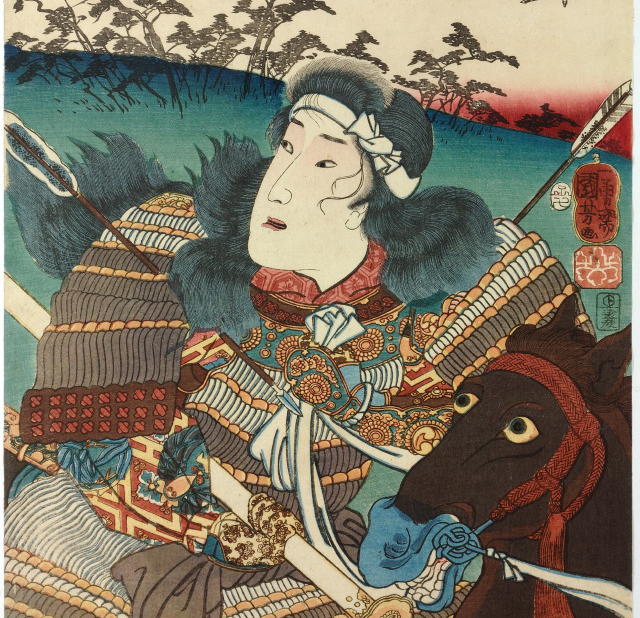
Samurai women were every bit as dauntless as the men and were trained to fight with the naginata, the long-handled sword, akin to a halberd. There were famous women warriors such as the formidable Tomoe Gozen who defeated an army of 2,000 with a force of 300.
The great Tokugawa peace ended in the mid-1800s in civil war and the samurai rose up to fight again. As late as 1868 the samurai women of the Aizu domain (near Fukushima) fought and died for their lord.
Then came the so-called Meiji Restoration when Japan hurtled headlong into the modern world. In the early 1870s the samurai were abolished as a class.
There were diehards who fought battles led by the famous ‘last samurai’, Saigo Takamori. But by then most of the samurai had cut their hair and exchanged their armour for suits and become the ruling classes of the new Japan.
Nevertheless the myth of the samurai remains strong, as seen in films, manga, anime and toys to this day. Darth Vader is modelled on a samurai, helmet and all. At the exhibition there is a huge Darth Vader on view, every bit as intimidating as the samurai armour which opens the show. Apparently it was a real coup to get it.
In fact the whole myth of bushido, the samurai spirit, the cult of samurai honour, self-sacrifice and fearless bravado, was not invented until Victorian times, long after the samurai had ceased to exist. The cult of the samurai as we know it was a fabrication, much as the cult of chivalry and knighthood in the west was idealised and invented in the same period in order to create a nationalistic myth.
So the exhibition aims to debunk some of the myths of the samurai. But at the same time it presents a really thrilling spectacle of their world. You will be dazzled!
Samurai is at the British Museum from 3 February to 4 May, 2026. Tickets are £23 (adults); members go free.
There’s much more about the samurai and their lives, adventures and background in Lesley Downer’s The Shortest History of Japan, which came out on September 10, 2024. Read more about it.
Lesley’s written about Tomoe Gozen’s warrior life in her feature, Japan’s court ladies, warrior women and courtesans.
If you’re interested in Japan’s history and culture, see her other Historia pieces:
Van Gogh and Japan
Her two other reviews, Hokusai: Beyond The Great Wave and Silk Roads
And our Q&A interview with her.
Images (all supplied by the British Museum):
- Suit of armour and helmet, iron, silk, wool, leather, gold and lacquer, Japan, helmet 1519, armour 1696, textiles 1800s: © The Trustees of the British Museum
- Helmet with butterfly crest, iron, lacquer, silk, Japan, 18th century: National Museum of Japanese History
- See 1
- Tomoe Gozen riding away after the Battle of Awazu by Utagawa Kuniyoshi, before 1861: © The Trustees of the British Museum
- Woman’s firefighting jacket and hood, wool, satin-weave silk appliqué, and silk- and gold-thread embroidery, Japan, 1800–50: John C Weber Collection; photo © John Bigelow Taylor


