
Fiona Veitch Smith immerses herself in researching her 1920s and 1930s novels, using period objects and recreating costumes – which she also wears. She tells Historia about her 10 years of historical fashion research and offers some tips for anyone who’d like to try this way of getting a feel for the era they’re writing about.
When my debut Golden Age mystery novel, The Jazz Files (now republished as A Front-Page Murder), came out in 2015 I was offered the opportunity to pose in front of a vintage 1920s car for a promotional photo shoot. I decided that I ought to be wearing a vintage 1920s outfit to suit the scene.
All I could find was fancy dress Gatsby-style flapper dresses or very expensive vintage originals that would set me back hundreds of pounds and were aimed at collectors or museum collection curators.

I endeavour to be as historically authentic as I can be in my novels, so I didn’t want to be any different in the promotional material around it. Hence, the cheap flapper frocks wouldn’t do.
In my research I had discovered the flapper frock and the shorter hems really only started to appear from 1923, with the dual influence of the Charleston becoming the leading dance craze and the French tennis star Suzanne Lenglen teaming up with designer Lucien Lelong to create a range of sporty easy-to-wear frocks that could equally be worn on and off the court.
The hemline rose to its shortest in 1926 and then lengthened again from 1927. My book was set in the summer of 1920, when fashion was still in transition from the late 1910s.
And although my jazz club singer and dancer Delilah was beginning to experiment with shorter hemlines, ordinary women like my lead character Poppy – a cub reporter on a London tabloid – were still wearing longer, more conservative skirts.
I eventually came across a pattern from Mrs De Pew Vintage that was circa 1922 (close enough) and looked like something Poppy would wear. I had done a bit of sewing in my time – mainly cushion covers and lampshades and some simple dresses for my little girl – but nothing wearable for myself since I was at school.

But I decided to give it a go. I even used a vintage 1920s Singer sewing machine! That turned out to be an absolute nightmare and I quickly switched to a modern model. But the Singer still looks good in photos.
The quality of my sewing on that first outfit was shoddy, to say the least, but it was good enough for the photo shoot. And it set a trend for the rest of my books.
I had enjoyed the process so much that for every book since then (my 10th, The Penford Manor Murders, came out in April) I spend much of my research time ‘shopping’ for my characters.
I visit vintage fashion exhibitions such as those at the Victoria & Albert Museum and the Bowes Museum, dip into online fashion archives such as that hosted by The Costume Institute at the Metropolitan Museum of Art in New York, and follow websites and blogs such as the Fashion History Timeline. The History Wardrobe, run by a team of fashion historians, led by Lucy Adlington, do online and in person talks on fashion through the ages. It is an informative and entertaining source.

But I do not just dress my characters, I dress myself. My sewing skills have not improved much in the last decade, but my enthusiasm hasn’t waned. My latest series, The Miss Clara Vale Mysteries, starts in 1929 and goes into the 1930s.
That is a relief to me as I am older and curvier in real life than the Bright Young Things of the 1920s. The more sophisticated lines of the Thirties suit my figure better.
For The Penford Manor Murders, my lead character Clara has a friend who is a fashion designer. She now makes Clara’s clothes and creates a fabulous teal crepe Georgette evening dress based on a German knock-off pattern of a Chanel style. I made the dress myself and have worn it to promotional events.
The next book in the series, which I’m writing now, is set at Berlin Fashion Week in September 1930. Juju, Clara’s designer friend, makes a set of beach pyjamas based on a picture of Marlene Dietrich she sees in a magazine.

I sourced a pattern from the Vintage Pattern Shop, made it, and then modelled it on a freezing cold day at Blyth beach, Northumberland — but at least the sun was shining!
My books have become so well known for their fashion content that I was recently approached by the Art Deco Society UK and vintage dressmaker Karen Harvey of ReinvintagedUK to run a competition for vintage sewers. The prize is for the winning outfit to feature in the next Miss Clara Vale book.
Although other historical novelists may not want fashion to feature so strongly in their books, I still believe researching the fashion of the period in which one writes is a good way to get into the skin of your characters and help set the scene for your readers.
You can start by dipping into some of the resources I’ve mentioned in this article. Enjoy your research and, if you’re that way inclined, enjoy your sewing too!
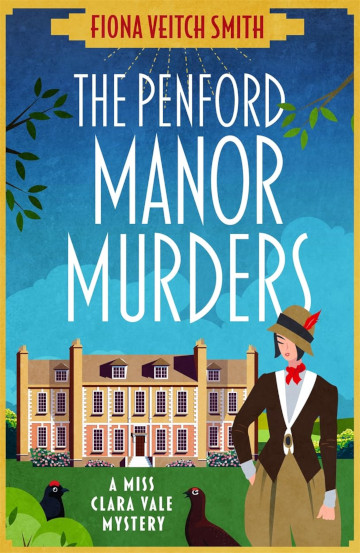
The Penford Manor Murders by Fiona Veitch Smith was published on 15 April, 2025. It’s her fourth Miss Clara Vale mystery.
Find out more about this book.
Fiona writes Golden Age mysteries and historical fiction. The Poppy Denby Investigates series and the Miss Clara Vale Mysteries are set in the 1920s and 1930s. Her debut crime novel, The Jazz Files, was shortlisted for the CWA Historical Dagger in 2016. Fiona is a former journalist and university lecturer and lives in Newcastle upon Tyne with her partner and two border collies.
Read more about Fiona’s practical, hands-on research methods (and pick up some tips) in:
How period guidebooks and maps help me write murder mysteries
Imagining Somerville: a research mystery
You may also enjoy these related features:
The Twenties, then and now by Gill Paul
Researching rural Devon in the 1920s and 1930s by Vanessa de Haan
1920s Bangalore, a city of diversities by Harini Nagendra
An appearance of serenity: the French fashion industry in WWII by Catherine Hokin
Images (All photos courtesy of Fiona Veitch Smith, © Fiona Veitch Smith):
- Fiona’s first creation, the grey and red outfit, in the making, with the pattern, material, and her 1920s sewing machine
- The pattern for the grey and red outfit from Mrs De Pew Vintage
- The finished outfit: Fiona and the Ford
- The pattern for the beach pyjamas from the Vintage Pattern Shop
- Fiona in her beach pyjamas


