
Fiona Veitch Smith explains how period guidebooks and maps help her write 1920s & 30s murder mysteries. The next, The Pyramid Murders, comes out on 13 June.
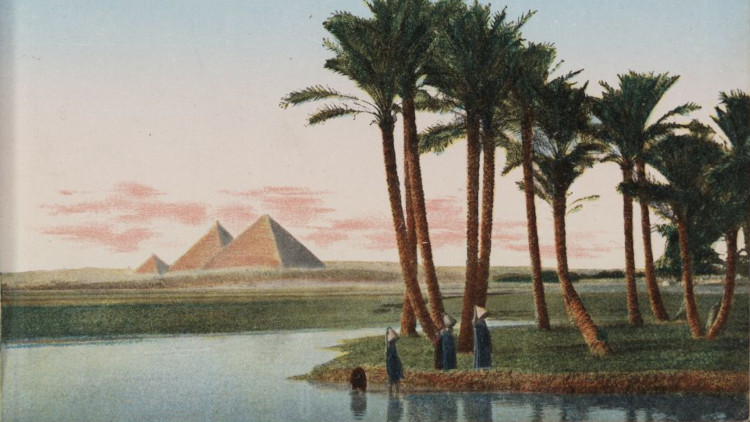
“The Pyramids – The indispensable excursion on the outskirts of Cairo is that to the Pyramids. There is an excellent tram service, and many people will find that an adequate as well as a cheap method of visiting the Pyramids; but the carriage drive has a great deal to commend it. For one thing, you may halt where you like to admire this scene and that prospect; and the slow progression through the scattered houses and cornfields admirably predisposes one’s mind to the exciting moment when, for the first time, these miracles of antiquity are seen in the distance, beyond the placid water that flows to the edge of the road unbroken save by clumps of palms rising like something unreal against the sky.” Thomas Cook’s Traveller’s Handbook for Egypt and the Sudan, 1929.
I read these words as I sipped hibiscus tea on the balcony of my hotel in 2023. My hostelry was aptly named Pyramid View – and I could indeed see the iconic monuments from my room and from the rooftop restaurant and swimming pool. But if I’d come to Cairo expecting a gentle carriage ride through scattered houses and cornfields, then pausing at the placid water unbroken only by clumps of palms, I would have been sorely disappointed.
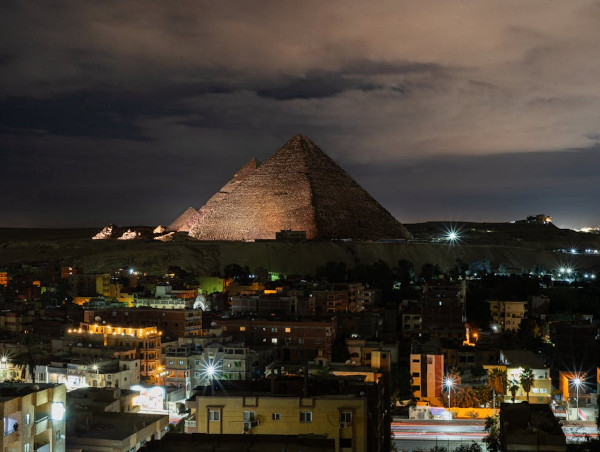
The branch of the Nile that used to run alongside the Giza Pyramids dried up in the 1950s as the river was dammed to create a reservoir for the millions of residents of the burgeoning twin cities of Cairo and Giza. A four-lane road and a concrete suburb was built in its place and now the approach to the pyramids is through a densely populated and polluted urban sprawl.
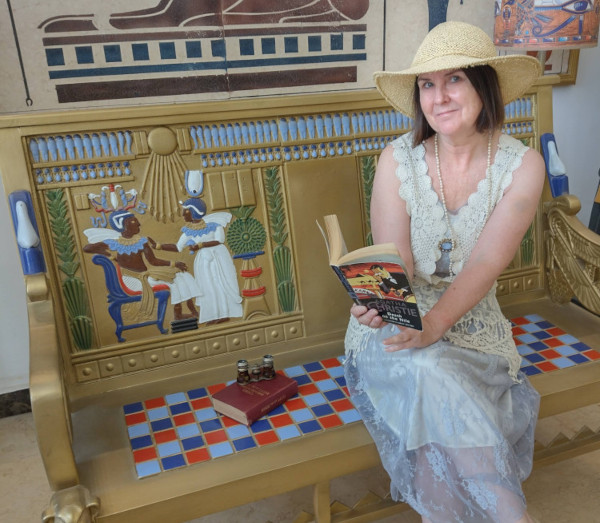
So, as I was researching The Pyramid Murders, set in February 1930, I had to close my eyes – and ears – and imagine what it would have been like in Clara’s day. It is thanks to the vintage Cook’s Traveller’s Handbook that I was able to time travel like this in my imagination. The guide was invaluable for knowing what Clara might have been advised to pack (a stash of opium for a dicky tummy), how to tip and engage local dragomans (baksheesh was expected then as it is now for good service – or any service, really) and what treasures could be found in the Egyptian Museum only eight years after the opening of King Tut’s tomb.
All of this added to the authenticity of the setting upon which I could then build a Golden Age mystery of pyramids, artefact smuggling and, of course, murder.
This is not the first time I have used period guidebooks and maps. They have been an indispensable research tool for all my novels.
For my debut historical mystery novel, The Jazz Files, which sees a young Northumbrian woman moving to London in 1920, I found Muirhead’s London and its Environs from their Blue Guide series. This was first published in 1918 but my edition was 1922. Close enough for Poppy Denby!
This guide helped Poppy (and me) travel around London, know where to catch a bus and how much it would cost and how to use a public telephone. This was the first time Poppy had ever used a telephone, so she needed instructions!
Poppy used the same guide in The Kill Fee, set the following year, which investigates the death of a Russian diva in a London theatre and the theft of a Faberge egg from the Crystal Palace. The guide helped me find out theatre ticket prices, public transport routes and which hospital was nearest to the Russian Embassy at the time.
In The Cairo Brief, set in 1922, involving the auction of the fictional death mask of Nefertiti, the guide provided me with a splendid map of the layout of the British Museum and a summary of its collections. I used this again in The Pyramid Murders, where Clara x-rays a mummy before heading off to Cairo.
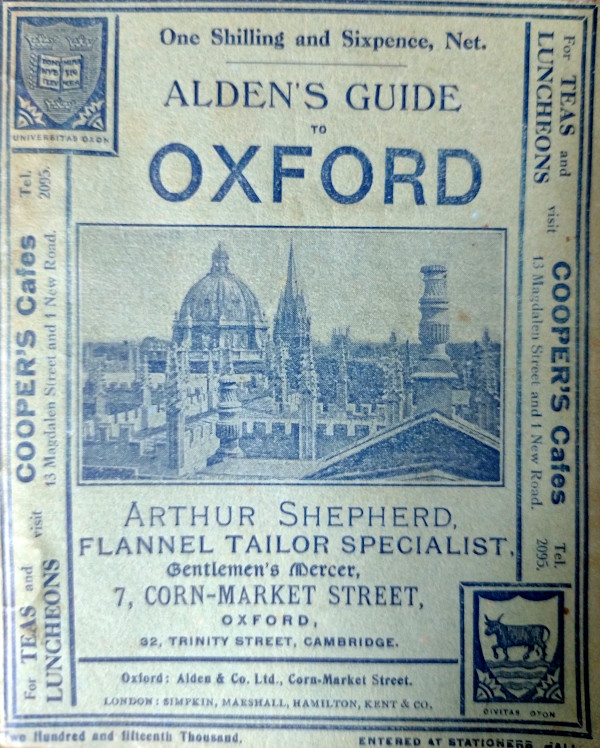
Another guide I have consulted is Alden’s Guide to Oxford (c1923), which Poppy used on her (so far) last case, The Crystal Crypt. It was thanks to this Oxford guide, with information on where to buy everything from teaspoons to marmalade, that I was able to send Poppy shopping to Elliston & Cavell department store to buy a new frock and direct her to where she could hire a bicycle.
Both Poppy and Clara have used the Official Guide to Newcastle Upon Tyne (c1924). Poppy in The Art Fiasco, where she investigates the murder of a famous artist thrown from the roof of the Laing Art Gallery, and Clara in The Picture House Murders and The Pantomime Murders, all set in Newcastle and surrounds.
It was because of this guide that I knew which tea houses and restaurants were open at the time, including one in the basement of the beautiful Emerson Chambers which currently houses Waterstones in the present day. The map in this guide was invaluable as the city layout of Newcastle changed drastically in the 1960s.
York, on the other hand, has not changed very much, but the Official Guide to the City of York (1933) still helped Clara get around when the investigation in The Pantomime Murders took her from Newcastle to York. It was again thanks to this guide that I discovered where Clara could buy a particular face cream that gave her a crucial clue in her hunt for the killer.
She was also able to have afternoon tea at Border’s Café (where refreshments are “daintily served at moderate prices”) rather than the ubiquitous Betty’s, thanks to an advertisement in this guide.
Clara is currently investigating a murder at a fictional country house in Northumberland – so she doesn’t need a guide to that other than a period map of the area. However, her next case is going to take her to Berlin in September 1930. I’m currently looking for a guide to that… wish me Viel Glück!

The Pyramid Murders by Fiona Veitch Smith is published on 13 June, 2024.
See more about this book.
Another research puzzle is the subject of Fiona’s feature Imagining Somerville: a research mystery, in which she remembers trying to see round an Oxford college, only for Covid to intervene. Again, she found ingenious ways to get the information she needed.
Fiona Veitch Smith writes Golden Age mysteries and historical fiction. Her debut crime novel, The Jazz Files, was shortlisted for the CWA Historical Dagger in 2016. Fiona is a former journalist and university lecturer and lives in Newcastle upon Tyne with her partner and two border collies.
You may also enjoy:
Six godmothers of archaeology by Alexandra Walsh
The politics of Tutankhamun’s tomb by Gill Paul
Researching rural Devon in the 1920s and 1930s by Vanessa de Haan
Other Historia features about research include:
Six tips on researching your historical novel by Stephanie Merritt
Extreme research: how far should a writer go? by Louise Morrish
The surprising joys of armchair travel by Elizabeth Buchan
The Brontë Affair: researching the scandal that enveloped literature’s most famous family by Finola Austin
Reassessing Francis Drake: what research for my novel revealed about his role in the slave trade by Nikki Marmery
Damn’ Rebel Bitches: Research Then and Now by Maggie Craig
Why I wrote about Irish history and Researching the Land of Silver by Tom Williams
Research and Reenactment by Christian Cameron
Responsible Research by Peter Tonkin
Images:
- Egypt — Landscape with the Pyramids of Giza, 1900 by B Livadas & Coutsicos: Timea (CC-BY-2.5)
- Giza City and Pyramids at Night: by Matheus De Moraes Gugelmim for Pexels (public domain)
- Fiona Veitch Smith reading Agatha Christie’s Death on the Nile; a copy of Cook’s Travellers’ Guide to Egypt and the Sudan is on the seat beside her: by Helen Fairmaner, © Fiona Veitch Smith
- Alden’s Guide to Oxford: by Fiona Veitch Smith


