
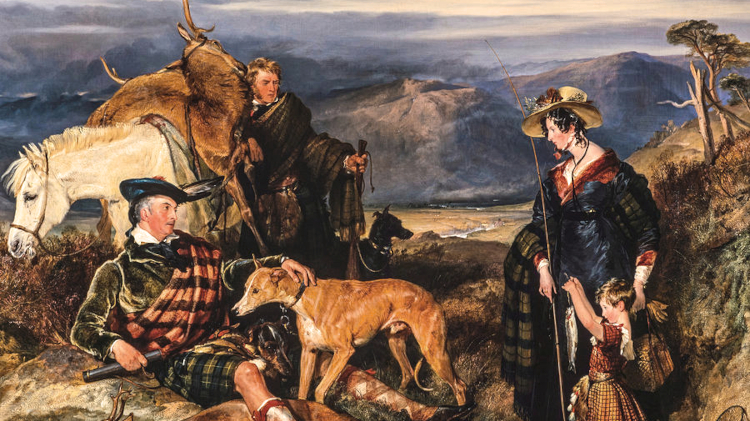
Did the Victorian artist Edwin Landseer have an affair with Georgina, Duchess of Bedford? Was his lost love the reason for his deteriorating mental health? And how is that question linked to a vanished painting of deer in a Highland run? Lucy Waverley writes about researching her debut novel.
On my honeymoon, I read about a vanished painting. It inspired my debut novel, Noble Beasts. A fresco depicting red deer on the chimney breast of a remote Highland cottage, it was created two centuries ago by a young English artist rumoured to be having an affair with his patron’s wife. When the cottage fell into ruin, the fresco was exposed to the elements and nothing now remains save old stones.
I’ve always had a thing for wall paintings, especially with stories attached, so my interest was piqued, not least because the artist involved was one I’d previously dismissed as a straitlaced Victorian stereotype: Edwin Landseer, of Monarch of the Glen fame, more often associated with shortbread-tin stags than debauching duchesses.
_-_The_Connoisseurs,_Portrait_of_the_Artist_with_two_Dogs_-_RCIN_403220_-_Royal_Collection.jpg#)
To risk sounding like clickbait, when I looked more closely into the story, what I found surprised and moved me, and was a poignant reminder that people of the past were complex, conflicted, and fighting hidden battles, just as we are today.
Edwin Landseer (1802–1873) was one of the most popular artists of the Victorian era but surprisingly little has been written about him since the end of the 19th century.
As I reviewed the few biographical gems that do exist (for recommendations, see below), I became increasingly intrigued by the relationship behind the vanished fresco. Contrary to my expectations, it was far from a run-of-the-mill Regency romp, both because of who was involved and how it played out.
For once, it was the female partner who was older, wealthier and more worldly. Georgina Russell (1781–1853) was the daughter of the fourth Duke of Gordon, and wife of the sixth Duke of Bedford. Edwin Landseer was the youngest son of an engraver and as embedded in the decidedly plebeian art world as Georgina was in the aristocracy.
When they first met, Georgina was in her late thirties. She was noted for her high spirits and occasional high jinks, but nothing outrageous by Regency standards. Twenty years her junior, Edwin was just beginning to acquire a reputation as a bright young thing – both with the paint brush and as a witty, good looking addition to fashionable parties.

As was normal for the time, he was heavily dependent on wealthy, influential patrons, one of the most important of these was the Duke of Bedford, Georgina’s husband.
Edwin quickly became a regular in the Bedfords’ circle in London, at the Duke’s country seat, Woburn Abbey, and on annual expeditions to the Scottish Highlands, where Georgina had spent much of her youth. During these visits north, Georgina had a group of cottages – ‘the huts’ – erected in Glen Feshie on land previously used for logging.
The location was (and is) spectacular, with the river Feshie spreading in shallow silver braids across the valley floor and mountains rising to the south and east, through which old droving routes climb towards passes to Atholl and Mar.
The huts were an ideal base for the Bedfords’ summer expeditions, which included fishing, shooting, deer stalking and dancing, all of which Edwin captured in drawings and paintings, as well as on chimney stacks. Rumours soon spread, however, that the young painter had also captured Georgina’s heart – and that he was the father of her youngest child, Lady Rachel Russell.
As with so much of the past, it’s impossible to be sure what really happened as no first-hand evidence had previously been uncovered to confirm or quash the rumours. To see if I could find anything more, I dusted off my master’s in historical research, spoke to Landseer expert, Richard Ormond, and Georgina’s biographer, Rachel Trethewey. I also looked to the archives, some of which had not been digitised or searchable when previous accounts were written.

Unsurprisingly, I didn’t find proof either way, but I did find that the rumours were far more widespread and long-lived than I had realised, and that they were poignantly linked to the collapse of Edwin’s mental health.
References to the alleged affair ranged from jibes in the press to pointed comments in private papers, including Queen Victoria’s diaries. And the rumours weren’t a one-season wonder: insinuations appeared in newspapers throughout the 1830s and 40s, including risqué puns, references to Georgina’s youngest daughter as ‘Lady Rachel Landseer’, and reports of an aborted elopement.
Correspondence and stories from family friends also contained second-hand suspicions of a secret marriage, and poignant first-hand evidence of Edwin’s worsening mental state.
Whether romantic or platonic, there was no doubt that Edwin and Georgina’s relationship was exceptionally close. What’s more, in spite of significant hurdles, it was no Byronesque flash-in-the-pan, continuing for almost three decades. The huts, filled with the artist’s frescoes, were a sanctuary throughout.
_by_Edwin_Henry_Landseer_(1802-1873).jpg)
Though there is a whiff of the Petit Trianon to these Highland cottages, Georgina was no Marie Antoinette. David Taylor’s recent scholarly-but-readable history of the region during the Clearances shows her to have been personally popular with ordinary people for her kindness, generosity, and the employment she provided, unlike a number of other Badenoch lairds, whose policies of improvement and eviction caused much harm and resentment.
The printed rumours about Georgina and Edwin finally ceased with Georgina’s death in 1853. Following her demise, the huts fell into ruin with such alarming rapidity that in 1861 Queen Victoria recorded in her Highland journal that she ‘gazed with sorrow at their utter ruin’.
Tragically, though Edwin continued to produce some great works (including the Trafalgar Square lions), his mental health followed a similar trajectory.
By the time I visited the site of the huts myself, I was deeply attached to Edwin and Georgina and determined not to let their story disappear like the chimney painting. For me, much of that story’s emotional resonance came from its ‘what-ifs’, so I chose to render it as a novel rather than a biography.
Exploring hypotheticals is an area where historical fiction really excels, and I hope in this case it also inspires a few readers to find out more about the real people who inspired it.
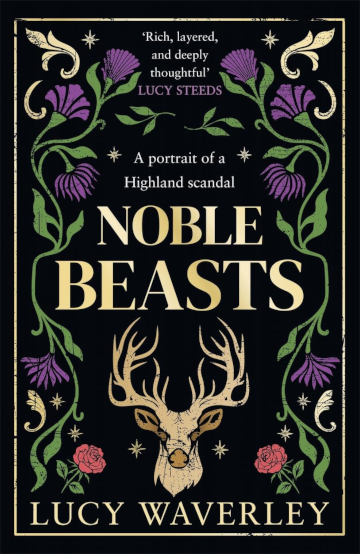
Noble Beasts by Lucy Waverley was published on 21 May, 2026.
Lucy is currently a novelist, but has been a bookseller, lawyer, and outdoors-ish feature writer, whose subjects ranged from birding with Bill Oddie to tea planting in Cornwall. She studied history and art history at the University of Oxford. Noble Beasts is her first novel and was short listed for the Cheshire Novel Prize and long listed for the Caledonia Novel Award.
lucywaverley.com
Instagram: @history_is_so_last_century
Further reading:
Meryl M Marshall, Glen Feshie: The History and Archaeology of a Highland Glen, 2nd ed (North of Scotland Archaeological Society, 2013)
Richard Ormond, Sir Edwin Landseer (Tate Gallery, London, and Philadelphia Museum of Art, 1981)
Richard Ormond, Landseer in the Highlands (National Galleries of Scotland, 2005)
David Taylor, The People Are Not There (Birlinn, 2022)
Rachel Trethewey, Mistress of the Arts: the Passionate Life of Georgina, Duchess of Bedford (Review, 2002)
Queen Victoria, Leaves from the Journal of our Life in the Highlands, 1848–1861 & More Leaves, 1862–1882 (Oxford University Press, 2024)
You may also be interested in these related Historia features:
Writing Mrs Whistler by Matthew Plampin
Honouring Adele, Egon Schiele’s muse and
The ultimatum that changed Matisse for ever, both by Sophie Haydock
Dora Maar: much more than a muse by Louisa Treger
Damned Souls: an aristocratic Victorian scandal by Jane Dismore
A Guide to Victorian Sex by William Sutton
Top ten films set in the Victorian era by Kate Griffin
Queen Victoria: a dark, if splendid, monster? by Miranda Carter
Images:
- Scene in the Highlands, with portraits of the Duchess of Bedford, the Duke of Gordon and Lord Alexander Russell by Edwin Landseer, 1825: National Galleries of Scotland via Wikimedia (public domain)
- The Connoisseurs, self portrait with two dogs by Edwin Landseer, before 1865: Royal Collection Trust via Wikimedia (public domain)
- Georgina, Duchess of Bedford, engraving after JMW Turner in The Keepsake, 1929: Wikimedia (CC0 1.0)
- Chimney of ruined hut in Glen Feshie: author’s photo
- Study of Rachel Russell by Edwin Landseer, 1835: Wikimedia (public domain)


