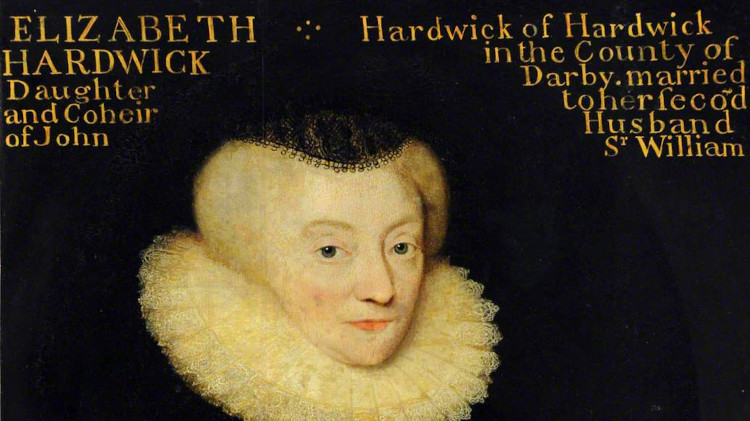
The Countess of Shrewsbury — or Bess of Hardwick, as she’s more widely known — was one of the richest people in England by her death in 1610. Yet she hadn’t even got a dowry when her father died. How did she do it? Through many fortunate marriages (and a canny mind), Sharon Bennett Connolly, author of Heroines of the Tudor World, explains.
Bess of Hardwick is perhaps the most famous Tudor woman outside the extended Tudor royal family. An accomplished needlewoman, she was also gaoler to Mary, Queen of Scots. And she is renowned for having built Chatsworth House and Hardwick Hall in Derbyshire; indeed, Hardwick Hall even bears her initials ES (Elizabeth Shrewsbury) in its external stonework. Bess’s marital history is just as remarkable.
Bess was born around 1527, one of four daughters and a son born to John Hardwick of Hardwick, Derbyshire. It was a moderately prosperous gentry family. When her father died in 1528, and with no dowry to attract a husband, 11-year-old Bess was sent into service in the household of Sir George and Lady Anne Zouche of Codnor Castle, a neighbouring family.

Lady Zouche was a distant cousin of both of Bess’s parents and a friend and lady-in-waiting to Queen Anne Boleyn. Sir George was a gentleman pensioner to the king. It was in this household that Bess would have learned the ways of the aristocracy, while acting as a lady-in-waiting. Bess would have also made connections with various families through the other young people of the household.
Husband no 1
It was while she was living in the Zouches’ household that Bess met Robert Barlow. The marriage was short-lived and possibly unconsummated, given their ages – Bess was 15 or 16. Robert fell ill and died within 18 months of their wedding day, on Christmas Eve 1544.
When Bess applied to the Barlows for her widow’s dower, one-third of the income in rents and revenues from her husband’s estates, she was refused and a lengthy court battle ensued. A settlement was finally in 1546. It did not make her rich, but the annual income of £30 gave Bess a measure of independence when she was only 17 years of age.
Husband no 2
Bess may have met Sir William Cavendish while staying at Bradgate Park with Lady Frances Brandon, Marchioness of Dorset. Frances was a granddaughter of King Henry VII and the mother of the ill-fated Lady Jane Grey, the Nine Days’ Queen. Cavendish was twice-widowed, mature, and rather rich, with three surviving daughters and no male heir.
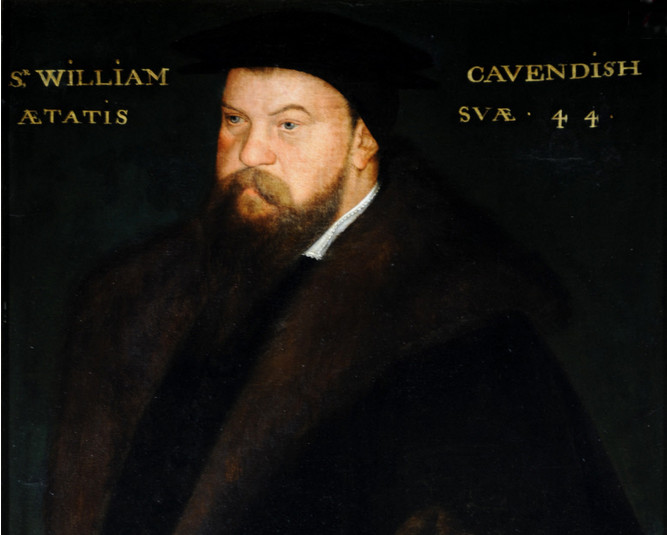
When he met Bess in 1547, she was 19 and he was 40. A strong friendship developed, despite the age gap. They were married in the family chapel at Bradgate Park on 20 August, 1547. Bess had a deep interest in astrology and the timing of the wedding, at two in the morning, was calculated as being the most propitious.
Bess and Cavendish would have eight children together, of which six would survive childhood, including three boys. And it was with Cavendish that Bess acquired the lands of her stepfather at Chatsworth for £600. There was an old manor house on the property that the family lived in until the completion of Chatsworth House.
All the Derbyshire properties were in both their names, which meant that when Sir William died before his heir came of age, the properties remained in Bess’s hands rather than being taken into wardship. Sir William died in 1557, leaving Bess in a precarious financial position, owing £5,237 to the crown over funds that had disappeared during his time at the Exchequer, apparently pilfered by an assistant.
Facing bankruptcy, Bess only avoided the confiscation of her lands by writing to many of her husband’s friends asking for their help and support. These friends voted against the bill when it was presented to Parliament. Her lands were safe, but she still owed the money.

Husband no 3
In 1559, Bess married her late husband’s friend Sir William St Loe, a widower with two surviving daughters, Mary and Margaret. As Captain of Elizabeth I’s Yeoman Guard, St Loe’s duties often separated the couple, until Bess was appointed a Lady of the Privy Chamber. Due to his relationship with Queen Elizabeth, St Loe was able to reduce the debt Bess owed and paid the £1,000 fine on her behalf.
The marriage of Bess and St Loe was a happy one and he treated Bess’s children as his own. However, Sir William and his younger brother, Edward, became involved in a property dispute. Edward visited Sir William and Bess in London to resolve the issue but shortly after the visit, Bess fell ill, poisoned. William St Loe suspected his brother Edward, and three of Edward’s associates were punished, though Edward was not.
Bess was visiting her family in Derbyshire in 1565 when she received a note from London informing her that St Loe was critically ill. By the time she arrived back in the city, her husband was dead. As his brother Edward had visited recently, poison was suspected but could not be proven.
Husband no 4
On 1 November 1567, Bess married her fourth and final husband, George Talbot, Earl of Shrewsbury. At the same time, four of their children were married, with Bess’s daughter Mary marrying George’s second son, Gilbert, and Henry Cavendish marrying George’s daughter, Grace.
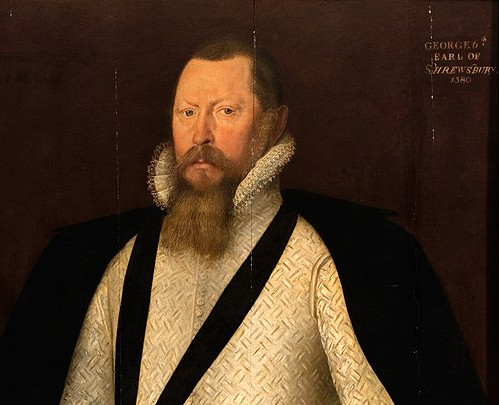
A wealthy widow until that point, Bess was well aware that all her lands and property would be controlled by Shrewsbury from the moment of their marriage.
However, Bess had a clause written into the marriage contract that in exchange for this, one-third of Shrewsbury’s unsettled income would go to Bess on his death. Arrangements were also made regarding Chatsworth, which would automatically go to Henry Cavendish on Bess’s death.
Bess and Shrewsbury spent the first few months of their married life away from court but sent the Queen a gift of venison through Bess’s nephew, Anthony Wingfield. When the young man said he did not know when Bess would be returning to court, the queen said, “I am assured that if she have her own will she would not be long before she would see me. I have been glad to see my lady St Loe, but am I now more desirous to see my Lady Shrewsbury. I hope my Lady hath known my good opinion of her… I assure you there is no Lady in this land that I better love and like.”
In 1568, Shrewsbury and Bess were given the custody of Mary, Queen of Scots, who remained in their charge until 1584. Bess, famed for her needlework, and Queen Mary would work on samples together.
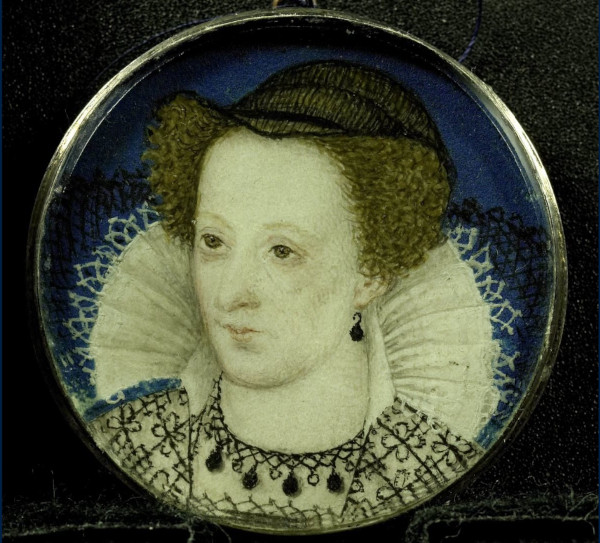
It was whilst they had custody of the Scots queen that Bess and Shrewsbury’s relationship began to break down. Bess repeatedly accused the earl of infidelities, including with their queenly prisoner, and Shrewsbury was feeling the strain of acting gaoler, with mounting debts as a result of the expenses incurred.
In 1584, Bess separated from Shrewsbury and went to live at Chatsworth, but then started a new project at Hardwick, rebuilding her family’s old hall, which was completed by 1591. Her estranged husband, Shrewsbury, died in 1590, leaving Bess with a third of his disposable lands.
As a result, as soon as the Old Hall was completed, Bess embarked on a new project, building an entirely new Hardwick Hall right next door. Bess’s final years were occupied with building and furnishing the new hall.
Having survived all four husbands, various legal challenges, poisoning and scandal, Bess died at Hardwick on 13 February, 1610, and was buried at All Hallows, Derby, now Derby Cathedral. At the time of her death, Bess was one of the richest people in England.

Heroines of the Tudor World by Sharon Bennett Connolly is published on 15 June, 2024.
See more about this book.
Sharon is the author of a number of books including Ladies of Magna Carta, Defenders of the Norman Crown: Rise and Fall of the Warenne Earls of Surrey, King John’s Right-Hand Lady: the Story of Nicholaa de la Haye and Women of the Anarchy.
She has also written these features for Historia:
The Anarchy: a true cousins’ war
At the heart of English history: the Warenne Earls of Surrey
Magna Carta’s inspirational women
You may also be interested in:
More Glass than Wall by Elizabeth Fremantle
Mary, Queen of Scots: royalty and reputation by Anna Legat
Images:
- An Unidentified Widow, known as Elizabeth Hardwick (‘Bess of Hardwick’), Countess of Shrewsbury by Cornelius Johnson: Hardwick Hall © National Trust (public domain)
- Bess of Hardwick by a follower of Hans Eworth, 1550s (a later inscription incorrectly identifies her as Mary Tudor): Hardwick Hall © National Trust (public domain)
- Sir William Cavendish after John Bettes the Elder: Hardwick Hall © National Trust/Robert Thrift (public domain)
- Elizabeth Hardwick, Countess of Shrewsbury, probably Rowland Lockey: Hardwick Hall © National Trust/Robert Thrift (public domain)
- George Talbot, 6th Earl of Shrewsbury, 1580: courtesy of the collections of Ingestre Hall Residential Arts Centre via Wikimedia (public domain)
- Mary, Queen of Scots: Rijksmuseum (public domain)


