

Bedlam, or Bethlehem Hospital, was a place of horror both for the mentally ill people incarcerated there and in the minds of others, not just in London. By the 17th century, visitors were paying to view the ‘lunaticks’ in Bedlam, plays were being written about it, and fear of imprisonment there was commonplace, Jemahl Evans, author of A Visit to Bedlam, writes.
The spectre of insanity and the asylum at Old Bedlam loomed large in the early modern mind. Founded during the reign of Henry III, the hospital originally distributed alms and served the poor. By the 17th century, it had become famous for the care of the mentally unwell.
Elizabethan and Jacobean playwrights and artists would portray Bedlam and its inmates in horrific detail, whilst the asylum became a popular tourist attraction in London. After the Restoration of Charles II, the old building was torn down and a dedicated hospital to mental health built in its place.

Bedlam was founded in 1247 as the Priory of the New Order of our Lady of Bethlehem to collect alms and support the Crusader Church in Outremer. However, the fall of the last crusading strongholds in 1291, the onset of the Hundred Years War, and the 1378 schism in the Catholic Church meant the hospital’s original purpose became quickly obsolete.
By 1403, visiting charity commissioners noted that Bedlam housed six men described as ‘mente capti’ (mentally incapable). Medieval treatment for mental health was a hotchpotch of spiritual and physical measures: bloodletting, exorcism, prayers and confinement for dangerous patients.
The hospital soon became dedicated as a mental health asylum and quickly garnered a dark reputation. It became known as Bedlam (a contraction of Bethlehem) and the loud chaotic nature of the hospital saw ‘bedlam’ enter the English language to describe any great confusion or uproar.
The City of London was responsible for the management of the hospital, but the role of ‘Master’ was mostly seen as a way of embezzling funds for the post-holder, and the treatment of patients was a very secondary concern. It is during this period that the practice of showing the inmates to tourists as a spectacle became popular. Thomas More mentions in 1522: ‘…thou shalt in Bedleem see one laugh at the knocking of his head against a post’.

By 1598, the Governors of Bridewell, under whose authority Bedlam fell, decided that the spectacles at Bedlam were a canny way to make some hard cash. In 1610, Algernon Percy was taken to see the inmates, paying ten shillings (perhaps £80 in modern money) for the privilege. He was eight years old! At the time, Algernon’s father, the ‘Wizard’ Earl of Northumberland, was imprisoned in the more tender conditions of the Tower of London.
Visits proved incredibly popular, particularly around public holidays. Whilst speculation that nearly 100,000 people visited Bedlam annually in the 18th century is far-fetched, it must have been a very lucrative income for the employees.
In 1604, Thomas Dekker and Thomas Middleton set the final act of their play The Honest Whore in the hospital. The characters view different ‘madmen’ and are confronted with the consequences of their own actions. Dekker and Middleton weave social commentary and themes of insanity, passion, and jealousy within the barbaric conditions of the asylum. The ease with which the sane can become insane and vice versa is terrifyingly stated.
As the character of Bedlam’s Sweeper points out: “I sweep the madmen’s rooms, and fetch straw for ‘em, and buy chains to tie ‘em, and rods to whip ‘em. I was a mad wag myself here once, but I thank Father Anselm: he lash’d me into my right mind again.” (The Honest Whore, part 1, Act V, scene ii).

The play was so successful that other writers quickly followed suit: Ben Jonson, Fletcher and Beaumont, Webster, and Middleton again all referred to the hospital as the physical embodiment of insanity in their work. The proximity of the asylum to the theatres such as the Red Bull and Cockpit can only have heightened the association for the Jacobean playwrights.
The broadside ballad Tom o’ Bedlam (The Bedlam Beggar) was incredibly well known, and performed widely from the 16th century onwards. The literary critic Harold Bloom called it “the greatest anonymous lyric in the language.” Its popularity further cemented the hospital as the embodiment of insanity and chaos in popular consciousness. In King Lear, Edgar calls himself Tom o’ Bedlam when he pretends to be mad:
Poor Turlygod! Poor Tom!
That’s something yet. “Edgar” I nothing am. (King Lear: Act II, scene iii.)
In 1632, the case of a Sussex man who claimed to have been defamed in a Rye alehouse, by verses of a song set to the tune of Tom o’ Bedlam, came before the Star Chamber.
The association of the song with the asylum itself, and how both were perceived by the public, was deeply engrained into society far beyond London. A fear of imprisonment in Bedlam (false or necessary) was commonplace. Given the lack of understanding of mental health, and the variety of behaviours that could get one interned, this is perhaps not surprising.

Lady Eleanor Davies, committed to Bedlam in 1636 for “insufferable profanations”, said that Bedlam was: “to exchange the grave for hell, such were the blasphemies and the noisome scents”. Davies had caused a scene in Lichfield Cathedral and claimed to have visions (hardly an uncommon experience in 17th-century England).
The playwright Nathaniel Lee commented on his imprisonment: “They called me mad, and I called them mad, and damn them, they outvoted me.” Lee, one of the Earl of Rochester’s circle of delinquents, would spend five years interned in Bedlam, his mind completely broken by the experience, and would die in a drunken fit two years after his release.
After the Civil War and Restoration, the long neglected medieval buildings were in a state of disrepair. The Governors wrote in 1674 that: “…the Hospitall House of Bethlem is very olde, weake & ruinous and to small and streight for keepeing the greater numbr of lunaticks therein att p[re]sent”.
It was proposed that a new, purpose built, hospital should be constructed at Moorfields. The polymath Robert Hooke was engaged to design the almost palatial buildings that would house up to 100 inmates. It was the first charitably-funded hospital built in England since the Reformation.

Typically, the wide galleries and ornamental gardens were more for the visitors who continued to come to view the spectacles rather than for the inmates. The governors debated iron gates to keep the inmates apart from the tourists in case “such persons that come to see the said Lunatickes may goe in Danger of their Lives”.
Caius Cibber, a Dutch artist, and father to the actor Colley Cibber, produced a sculpture of Melancholia and Raving Madness for the entrance gates of the new hospital. Visitors and inmates would be greeted by the work as their first sight of the hospital. However, despite the new buildings and new ideas of the Enlightenment, the conditions for patients did not improve. Londoners continued to tour the hospital and taunt the inmates until 1770 when access became somewhat restricted.
Hooke’s building did not last as long as the monkish priory. At the start of the 19th century, the state of the hospital was once again ruinous. A new hospital was built at St George’s Fields and opened to patients in 1815. A Parliamentary Inquiry into the treatment of inmates in 1816 saw the resignation of Thomas Monroe, the Chief Physician, for “wanting in humanity” to the patients under his care.
The treatment of mental health slowly improved during the Victorian years as reforming physicians dragged the hospital into the modern age. In 1930, the hospital moved again, to its current site in Croydon, but the asylum’s dark past still casts a shadow. In 1997, Roy Porter, esteemed historian of medicine at UCL, called Bedlam, on its 750th anniversary, “a symbol for man’s inhumanity to man, for callousness and cruelty”.
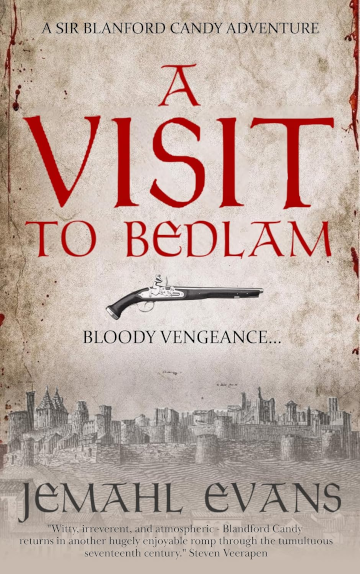
A Visit to Bedlam by Jemahl Evans was published as an ebook on 29 July, 2026. It’s the sixth in his Sir Blandford Candy series, and will be available in paperback soon.
Read more about this book.
Jemahl has an MA in History. After working for IBM in London, he spent a couple of years travelling and working abroad. He returned to Britain and began teaching, first in London, then in Wales, where he now lives. His first book, The Last Roundhead, was released in August 2015.
jemahlevans.wixsite.com/jemahlevans
You may enjoy reading Jemahl’s other Historia pieces:
Mr Beeston and the Cockpit
Merkins and masochists: a brief history of sex
Fiction and the English Civil Wars
Reinventing Thomas Becket
Stealing the secret of silk: the first international industrial spies?
and Historia’s Q&A with Jemahl Evans
Other features on related topics include:
Bedlam, Robert Hooke and Henry Hunt by Robert J Lloyd
Asylums and prisons: locking women away in madhouses by Nicola Pryce
Lady Mary Wortley Montagu, mental health pioneer by Jo Willett
And so to bed – a goodbye to Pepys’s diary by Deborah Swift
London in 1708: a surprisingly modern city by David Fairer
Images:
- Melancholia and Raving Madness, statue from Bedlam Hospital, engraving by W Sharp, 1783: Wellcome Collection (public domain)
- Plan of the first Bethlem Hospital from Chapters in the History of the Insane in the British Isles by Daniel Hack Tukes, 1882: Project Gutenberg (public domain)
- In The Madhouse from A Rake’s Progress by William Hogarth,1732–35: Sir John Soane’s Museum via Wikimedia (public domain)
- New Mad Tom of Bedlam, broadside ballad, c1670: British Library (public domain)
- Nath’l Lee the Mad Poet by John Watts,1778: Rijksmuseum (public domain)
- Most of Bethlehem Hospital by William Henry Toms for William Maitland’s History of London, 1739: Wikimedia (public domain)


