
London in the early 18th century was, David Fairer argues, a surprisingly modern city, with troubles not unlike our own: unreliable news, questionable financial deals, vicious party politics. Yet it’s a period that’s been neglected in historical fiction. His trio of books set in a chocolate house aims to change that.
A royal scandal, party squabbling, a culture war, huge City fortunes, shady dealing, noisy media, public opinion, moral outrage, fake news, European crisis, government debt, a precarious ‘union’ of England and Scotland… there is so much about the London of 1708 that seems familiar and surprisingly modern.
Setting a series of murder mysteries in that year I’ve had a lively, brightly coloured canvas on which to work, a period that hasn’t had much attention from writers of historical fiction.

The Age of Queen Anne (1702-14) can be hard to characterise, poised between the joyous excess of Charles II’s court (libertines, Restoration romps, etc) and the expansive adventures of Georgian England (Hogarthian realism, travel, empire, and so on).
And yet there is something distinct and exciting about the opening years of the century, a decade with so much of our turbulent present foreshadowed in it.
A new century, yes, and with it a new nation – ‘the Kingdom of Great Britain’ – inaugurated in 1707 through the union of the Parliaments of England and Scotland. Londoners of 1708 seem to have sensed they were part of something fresh, an experiment in the modern.
In 1701 Daniel Defoe had written of England as being “modern to the last degree” in what is the first recorded use of that word to mean ‘up to date in behaviour, outlook, opinions; embracing innovation and new ideas’.
Three years later Jonathan Swift’s brilliantly satirical Tale of a Tub baffled its readers (and mortally offended the Queen) with an all-out assault on this idea of the ‘modern.’ The word echoes throughout his book – modern wits, modern clergy, modern critics, modern philosophy.

It was a modish concept which Swift characterised as an egotistical self-belief that told you all was possible, and anything was ‘true’ if you believed it violently enough. Sounds familiar? Modern ‘truth’ was something you could make for yourself. For Swift, this mindset was a nightmare of confident entitlement.
In the Chocolate House Mysteries a modern establishment, assured and ruthless, finds itself challenged by a substratum of local sociability, good humour, and quiet determination – that other side of the period. This clash of worlds forms the novels’ social comedy and drives their plots in a combination of whodunit and conspiracy thriller.
The London coffee houses were the social media hubs of their time, gathering-places for news and intrigue, for circulating rumours and hatching plots – ideal, therefore, for a writer of historical mysteries.
The beating heart of these three books is the Bay-Tree Chocolate House, Covent Garden, where Widow Trotter presides over a world of ideas and debate, of wit and good conversation. She and her young friends Tom (a poet) and Will (a law student) form a resolute detective trio, righting wrongs, confronting villainous conspiracies, and solving murders. In the process the three of them become caught up in the national drama.
So, what were the customers of the Bay-Tree talking about during 1708?

Politics, of course. These were the years when party conflict – the endless battles between Whigs and Tories – began in earnest. In 1708 the Whigs were the party of business, trade, and the City, proud to celebrate Marlborough’s triumphs (Blenheim, 1704, Ramillies, 1706) and drive forward the European war – something resisted by the Tories, who were rooted in the local Anglican squirearchy and resentful of the land tax which was financing the conflict.
The Whigs were politically organised – a genuine modern ‘party’ in the making – and for Anne they threatened the quiet Anglican conformity in religion that was sacrosanct for her. They also challenged what she considered her right of having her own government. The Whigs played politics, and Queen Anne detested ‘party’ – she thought it brought instability (just imagine – a new government every three years!), and in the MP Robert Harley she found an ally.
In early 1708 Harley was conspiring to grant her wish, surreptitiously piecing together a coalition that would cross party boundaries. The first novel, Chocolate House Treason, is set during the twelve days of increasing drama when the Queen’s hopes were about to be realised – only to be dashed when the great Marlborough, seemingly overnight, withdrew his support for Harley and gave the Queen an ultimatum: him or me. This volte-face remains something of a mystery for the historian – a gap that the novelist is happy to fill.
Certainly, a leading player in these manoeuvres was Sarah, Duchess of Marlborough, once Anne’s dearest friend but now pushed out in favour of Harley’s cousin Abigail Masham. The novel’s murder plot interweaves with the “crooked counsels and dark politicks” (Alexander Pope’s phrase) of these days, made darker by the rumour that the Queen’s new favourite was also her lover – in the words of one ballad, “A dirty chambermaid” with whom she conducted “dark deeds at night”.

In 1708 there was also another war going on – against London’s popular entertainments, especially the Theatre Royal (‘the Cathedral Church of the Devil’ as it was called) and the annual May Fair where the actors moonlighted – this was soon to be abolished and the site developed into London’s smartest district.
The secretive Societies for the Reformation of Manners were at their most powerful in this year, and 1708 recorded by far the largest crackdown on the capital’s vice during their period (1694-1737).
The Societies were the new Puritans of the day, and in sermon, book and pamphlet, the stage came under fierce attack. Public opinion was being whipped up, and a ‘National Reformation’ called for. Queen Anne’s proclamation against ‘Vice, Profaneness and Immorality’ was repeatedly read from pulpits, and in May 1708 the Theatre Royal company was in danger of having its warrant revoked. In The Devil’s Cathedral the murder plot places Widow Trotter and her friends at the eye of the theatrical storm as the violence of the reformers reaches its climax at the Fair.

A third cause of fascination and outrage in 1708 was the shady world of the stock market and the gaming-house. Ten years earlier the ‘stock-jobbers’ had been thrown out of the Royal Exchange, only to re-establish themselves across the road in Exchange Alley, where the wildest projects could be floated, insurances and wagers taken out on anything and anyone, fortunes made overnight, and ruin descend in a single hour.
In Jonathan’s Coffee House (which eventually grew to be the London Stock Exchange) and in the gaming-houses of Covent Garden, a Londoner could risk all and have a great adventure. This hazardous world of chance was unregulated, and in the years before the South Sea Bubble of 1720 anything seemed possible. False pretences, cartels, and insider dealing were all legal, and frauds and cheats of the most ingenious kind could be practised. Money flowed freely.
In my forthcoming novel, Captain Hazard’s Game, we encounter some familiar things: a world in which a new type of currency (paper money) was challenging a stable notion of value; a punter could make money out of thin air, playing with futures; and the market was manipulated shamelessly through false reports (of a shipwreck, a battle, a death etc.) There was no law that could prevent this exploitation of ‘false news’ (the phrase was being used at this time).
Politics, religion, and money. The Londoners of 1708 in their tight-knit world of only a few square miles had a lot to gossip and argue about, and not surprisingly, conspiracies and double-dealing flourished. In my fictional Bay-Tree there’s no shortage of material for lively talk, and for plots to be laid. There was so much to generate the passions – of anger, fear, and laughter.
In these novels I hope I’ve captured something of the drama of this fascinating time.
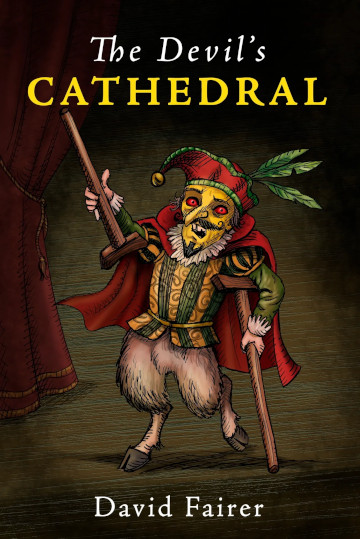
The Devil’s Cathedral by David Fairer was published on 5 October, 2021.
David is Emeritus Professor of 18th-century English Literature at the University of Leeds. His publications include Pope’s Imagination (1984), English Poetry of the Eighteenth Century (2004), and Organising Poetry: The Coleridge Circle (2009).
The third book in the Chocolate House Mysteries trilogy, Captain Hazard’s Game, will be out in the autumn of 2022.
If coffee and chocolate aren’t your early 18th-century drink of choice, how about a cuppa? Take a look at Raise your Teacup for Catherine of Braganza! by Isabel Stilwell.
And if you enjoyed the film The Favourite, about Anne, Abigail Masham, and Sarah Churchill, here’s Imogen Hermes Gowar‘s review.
Antonia Hodgson has written four acclaimed books set in the 1720s; the last is The Silver Collar, longlisted for the HWA Gold Crown Award in 2021. Antonia spoke to Katherine Clements for this Historia interview.
Images:
Drawing of a London coffee-house, c1690–1700: The British Library, shelfmark 1931,0613.2; ©Trustees of the British Museum (CC BY-NC-SA 4.0)
Queen Anne after John Closterman, c1702: Picryl (public domain)
Illustration from A Tale of a Tub by Jonathan Swift, 1710 edn: British Library (public domain)
The Coffeehous Mob, frontispiece to part IV of Vulgus Britannicus: or The British Hudibras by the London Spy (Ned Ward), third edn, 1711: The British Library via Google Books
A Proclamation for the Encouragement of Piety and Virtue, and for the Preventing and Punishing Vice, Profaneness, and Immorality: recorded in The Gazette (London Gazette), issue 4464, 19 August, 1708
London coffee houses around Exchange Alley (before the fire of 1748), William Harrison Ukers, 1922: Wikimedia


