
Paris, the City of Love, in the 1860s; Alexander II of Russia meeting a mysterious fortune-teller who predicts his death; an assassination attempt in the Imperial Palace. RN Morris tells this strange story and wonders: did the gypsy’s prophecy come true?
Part one: love
In May 1867, a World Fair was held in Paris. Tsar Alexander II was there to show Russian support for France in the face of rising Prussian militarism.
He also had his own private reasons for visiting the City of Lights.
Alexander had secretly installed his mistress, Princess Ekaterina Dolgorukova, in an apartment next door to the Elysée Palace where he was staying. In the past, Alexander had been notoriously indiscreet about his many mistresses.

But Princess Dolgorukova was different. Instead of jumping straight into the Tsar’s bed, as most young ladies who caught his eye did, Ekaterina held out against Alexander’s advances for almost a year. And the more she held out, the more he wanted her.
When their relationship was finally consummated in 1866, Alexander told her that she was his ‘secret wife’, vowing to marry her as soon as he was free to do so. Inconveniently, he already had a wife, the consumptive Tsarina Maria, who had been advised by doctors to refrain from sexual intercourse with her husband.
In Paris, the Tsar spent his days doing the diplomatic rounds. At night, a hired carriage brought his mistress to the palace under cover of darkness. It was the perfect arrangement, and the 49-year-old Tsar was as happy as a teenager in love.
Then, one day, while Alexander was walking in the Tuileries, a mysterious gypsy offered to read his palm. According to the story, the fortune teller predicted that seven attempts would be made on his life.
Part two: death
The historical novelist in me is naturally drawn to this incident, which Alexander II’s biographer Edvard Radzinsky claims is recounted in “the memoirs of contemporaries” – an infuriatingly vague phrase not backed up by any references. Despite exhaustive googling I haven’t been able to identify the sources.

But let’s go with it. It makes for great historical fiction, after all.
We can imagine the Romany woman’s expression darkening (for some reason, I picture the fortune teller as a woman) as she sees what is written in the Tsar’s palm.
I can even invent what she might have said to him: “Seven times the assassins will strike. Six times you will escape with your life.”
“And on the seventh?” the Tsar might hesitantly ask.
“On the seventh, you will die.”
The prediction seems to have come true, although it all depends on what you count as an assassination attempt. Here’s my go at adding them up:
One. April, 1866. The Tsar is shot at outside the Summer Garden in St Petersburg by a disaffected nobleman called Dmitri Karakazov. Alexander is saved because a bystander nudges Karakazov’s arm as he pulls the trigger.
Two. May, 1867. This attempt takes place in Paris itself on the very trip mentioned above. While travelling in an open carriage, the Tsar is shot at by Polish emigré Antoni Berezowski, apparently acting alone. The bullet whizzes past Alexander’s ear.

Three. April 1879. The Tsar is “hunted like a hare”, as the empress put it, by the radical Alexander Solovyov. Drawing on his military training, Alexander zigzags around Palace Square, while Solovyov takes pot shots at him. And misses.
Four (a). November, 1879. The Tsar is due to return to Moscow from the Crimea by train. Members of a new terrorist grouping called the People’s Will plant dynamite on railway tracks at Alexandrovsk on the Tsar’s route. But the terrorist responsible for detonating the bomb makes a mistake connecting the wires. Nothing happens.
Four (b). Another attack on the Tsar’s train on the same day. A back-up bomb has been placed on the tracks in Moscow. The terrorists have reliable information that Alexander will be travelling in the second of two trains (the first is full of luggage and supplies), seated in the fourth compartment.
The bomb goes off at precisely the right moment. The fourth compartment of the second train is thrown up into the air, landing upside down. However, the Tsar isn’t in it. The terrorists’ information was correct but an engineering problem meant that the order of the trains was switched at the last moment. The Tsar was in the first train. No one is hurt in the explosion, but a carriage full of Crimean fruit is turned into marmalade.
Five. February, 1880. The most audacious – and shocking – attempt to date. A bomb is detonated inside the Winter Palace by carpenter Stepan Khalturin. The blast kills several palace guards, but Alexander and his family are unharmed. The incident shows the terrorists’ reach. If they can infiltrate even the Tsar’s own home, there is no limit to what they can do.

Six. (Does this one count?) August, 1880. A bomb is planted under Kamenny Bridge in St Petersburg, over which the Tsar’s carriage is due to pass. But the terrorist who is supposed to connect the wires oversleeps.
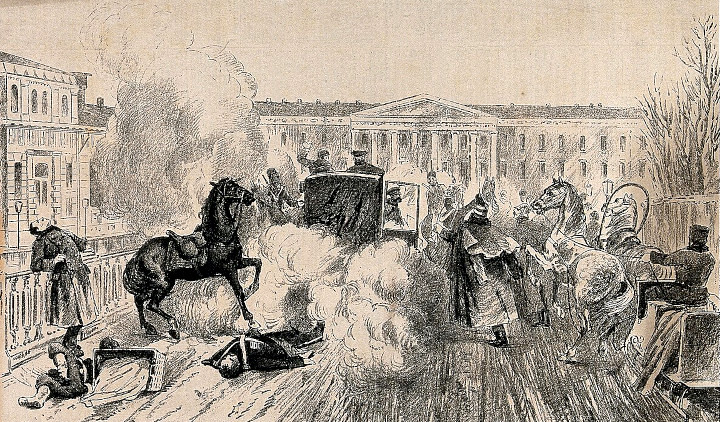
Seven (a). March 13, 1881. At around 2.15, the Tsar is returning from a troop inspection, when a bomb is thrown at his carriage as it passes alongside the Catherine Canal. One of his Cossack bodyguards is killed, as well as a boy in the crowd. Alexander is unharmed.
Seven (b). The Tsar gets out of his damaged carriage to remonstrate with the bomb-thrower, a young student called Nikola Rysakov. A second terrorist, Ignacy Hryniewiecki, is waiting in the crowd. He steps forward and hurls another bomb which proves fatal. An hour after Rysakov threw the first bomb, Tsar Alexander II is dead.
Before Alexander left to inspect the troops on that fateful day, Ekaterina – now his wife following the death of the ailing Tsarina — begged him not to go. To soothe her nerves, the Tsar, in the words of the diarist Alexei Suvorin: “toppled the princess onto the table and took her.” Love and death come full circle.

Death Of A Princess by RN Morris was published on 13 November, 2024. It‘s the third in his Empire of Shadows series.
Read more about this book.
RN Morris’s novels include the St Petersburg Mysteries series, set in 19th-century Russia and featuring Porfiry Petrovich, the investigating magistrate from Crime and Punishment by Dostoevsky.
Read his feature about how radicals and reactionaries united against Tsar Alexander II.
You may also like his other features:
Revisiting St Petersburg?
PT Barnum and the Circassian girl
Walter Raleigh: stripping away the cloak of myth
Further related features in Historia include:
Stockholm Syndrome in Ekaterinburg? by Gill Paul
When Queen Victoria was Empress Alexandra’s interfering granny by Melanie Clegg
Top ten books about the Russian Revolution by Carol McGrath
Russian Revolution: Hope, Tragedy, Myths by Jason Hewitt
And our inteview with Ellen Alpsten, author of Tsarina
Images:
- Assassination of Alexander II: sketch showing exactly how the Emperor was attacked, Illustrated London News, 1881: Wellcome Collection via Wikimedia (CC-BY)
- Princess Ekaterina Dolgorukova: Wikimedia (public domain)
- Alexander II of Russia: KraljAleksandar for Deviant Art (CC BY-NC-SA 3.0)
- Ignacy Hryniewiecki: Wikimedia (public domain)
- Detail from 1 showing Alexander getting out of his coach moments before he was assassinated


