

Did the radicals plotting to murder Alexander II and the reactionaries who thought his reforms went too far join forces to get rid of the Tsar? RN Morris explores an unlikely alliance that provides the political backdrop to his latest historical crime mystery, Law of Blood.
In his excellent biography of Tsar Alexander II (1818-1881), Edvard Radzinsky puts forward an intriguing theory. That the Tsar’s own internal security force – the notorious Third Section – was working in cahoots with the People’s Will, a radical terrorist group bent on the overthrow of the regime and the murder of Alexander II.
At first sight it’s not just intriguing but preposterous. Why would the very body established to protect the Emperor from domestic enemies unite with them to attack him?
_-_Kustodiev,_1907.jpg)
The answer lies in the murky politics of the age. Russia at the time was an autocracy, with absolute power in the hands of one ruler. Paradoxically, it was to protect this state of affairs that those on the political right turned against the Tsar.
Alexander II was the great reforming Tsar. In 1861, ‘Alexander the Liberator’ oversaw the emancipation of the serfs. He was also responsible for wide-ranging legal reforms, and even brought in representative government at a local level.
Alexander was disappointed by the lukewarm reaction to his magnanimous reforms. The reactionaries criticised him for going too far. The radicals, for not going far enough.
When, in 1866, people started trying to kill him, Alexander withdrew into a consoling affair with his much younger mistress, Princess Catherine Dolgorukova. That did nothing to endear him to either side.
The conservatives gathered round the Tsar’s son and heir, the future Alexander III. The Tsarevich’s residence, the Anichkov Palace, became their meeting place for plotting and fulminating against the Tsar.

We can gauge the depth and tone of their grievances from a letter written by the leading intellectual of the retrograde faction, Konstantin Pobedonostsev, who had once been Alexander II’s tutor. He wrote to a sympathiser: “The time will come when the champions of the healthy forces of truth and national life find themselves in opposition to the government. I fear that soon I will find myself in that situation.”
There’s no doubt that the retrogrades wanted Alexander II out of the way. They shared that objective with the People’s Will. But could they have found a way to use the revolutionaries as a cat’s paw to achieve their goal? For example, did the Anichkov Palace faction have a friend within the security services willing to turn a blind eye to the People’s Will’s activities, or even aid them?
The answer is yes. Major General Pyotr Cherevin was head of the Third Section in 1880. He was also the tsarevich’s boon companion and an Anichkov Palace loyalist. Cherevin considered the current tsar to be a false tsar, too influenced by Western ideas. In Cherevin’s eyes, Alexander, the heir, was the true tsar. And everyone who was not on the side of the heir was “scum”.
When the People’s Will set up a fake cheese shop in St Petersburg as a front for a bombing operation, the Third Section received a tip-off and dispatched officers to search the premises. However, they failed look in the one barrel where explosives were actually hidden. This certainly looks like turning a blind eye – or even colluding.

In the wake of a bomb outrage on the Winter Palace itself, the Tsar appointed General Mikhail Loris-Melikov to crack down on the People’s Will, who had flourished under the active negligence of the Third Section.
Loris-Melikov didn’t trust the Third Section and set up a shadow police department, keeping valuable information away from Cherevin’s men. As a result, the authorities experienced significantly greater success in capturing terrorists.
With his 1861 reforms, Alexander had taken the first step towards a more democratic system. On the eve of his death, he was poised to take the next and final step. A democratic constitution, drawn up by Loris-Melikov, was ready for him to sign. Before he could do so, he was murdered by assassins on 1 March, 1881.
Cherevin’s comment on his Tsar’s death? “It’s a good thing they got rid of him.”
The first thing Tsar Alexander III did was to cancel the new constitution. “Thank God, this criminal and precipitous step was not taken,” he noted.
The retrogrades had won. But the forces that they tried to suppress would not go away. And during the reign of following Tsar, Nicholas II, they would break out with more violence than ever.
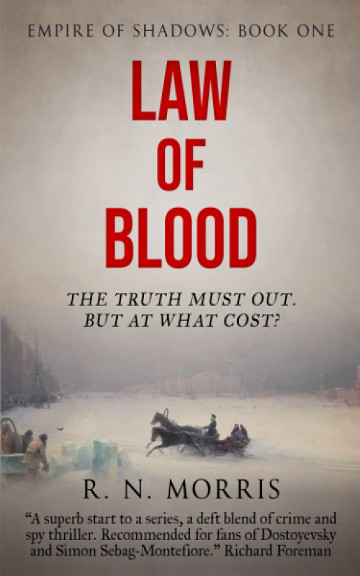
Law of Blood, the first in the Empire of Shadows series by RN Morris, was published in paperback and as an ebook on 22 July, 2021.
Roger Morris has also written Walter Raleigh: stripping away the cloak of myth, a Historia feature in which he asks how a fiction writer tackles the well-known myths attached to historical figures.
If you’re interested in the last Tsars of Russia and the Romanov family, you may enjoy:
Gill Paul’s Historia feature, Stockholm Syndrome in Ekaterinburg? about a strange event at the family’s last prison
When Queen Victoria was Empress Alexandra’s interfering granny by Melanie Clegg.
And for the Russian Revolution, have a look at:
Top ten books about the Russian Revolution by Carol McGrath
Russian Revolution: Hope, Tragedy, Myths by Jason Hewitt
Revolution: Russian Art 1917–1932 by Imogen Robertson
Images
- Alexander II on his deathbed by Konstantin Makovsky, 1881: Wikipedia
- Russian serfs listening to the proclamation of the Emancipation Manifesto in 1861 by Boris Kustodiev, 1907: Wikipedia
- Tsar Alexander II and Princess Catherine Dolgorukova with their children George and Olga: Wikipedia
- Murder of Alexander II: Wikipedia


