Julie Anderson looks back at the Festival of Britain, held 75 years ago this summer. Seen as a “tonic for the nation” after the Second World War and years of austerity, it’s the backdrop to her latest novel.
It is 1951, six years after the end of World War Two. Rationing is still in place, central London is scarred by bomb sites and life is, in many instances, as tightly controlled as during wartime.
What is about to be opened on London’s south bank, however, and in sites across the whole of the country, is a celebration of Britain’s achievements, in the arts, science, technology and industrial design, which will involve and inspire half the population of the UK and be a “tonic for the nation”1.
Celebrating the centenary of the Great Exhibition of 1851 had been discussed since 1943, led by the Royal Society for the Arts, but a governmental review resolved that international exhibitions and fairs of that type would be too costly in the cash-strapped post war years.
Yet Herbert Morrison, deputy leader of the Labour Party and formerly leader of the London County Council, decided that what the people of Britain needed was a restorative, a feeling of recovery and progress. What was also needed was direction in the rebuilding not only of London, but many of the UK’s cities.
Morrison created the framework for the Festival of Britain and made it happen, appointing Gerald Barry to have overall operational charge. He, in turn, chose bright, young architects and designers, many of whom had worked with the Ministry of Information during the war, to manage aspects of the festival.
The aesthetic was unashamedly modern, with abstract, science-based forms, open aspect architecture and applied examples of the latest technology and inventions in everyday life.
In a live broadcast from outside St Paul’s Cathedral on 3 May the Festival was opened by King George and, up and down the country, communities participated, from local village fetes to more ambitious projects.

So, in Sunderland, the Amateur Operatic and Dramatic Society delivered a short season of Tom Jones; in Glasgow the Exhibition of Industrial Power, at Kelvin Hall, included a 30-feet high, million-volt lightning machine and, around Britain’s coastline, the HMS Campania, a converted air raft carrier, toured with its huge Festival exhibitions.
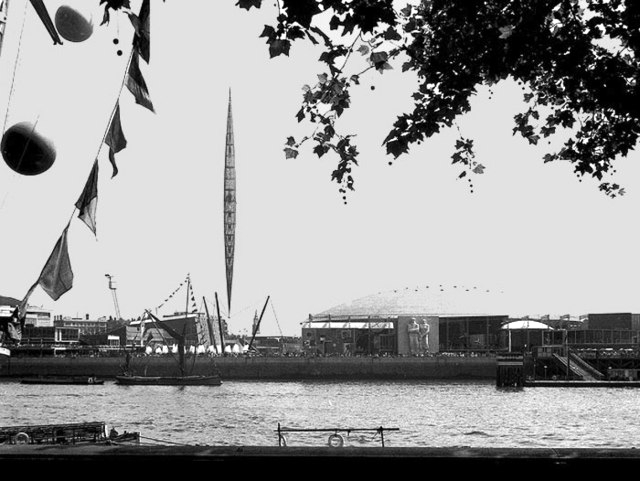
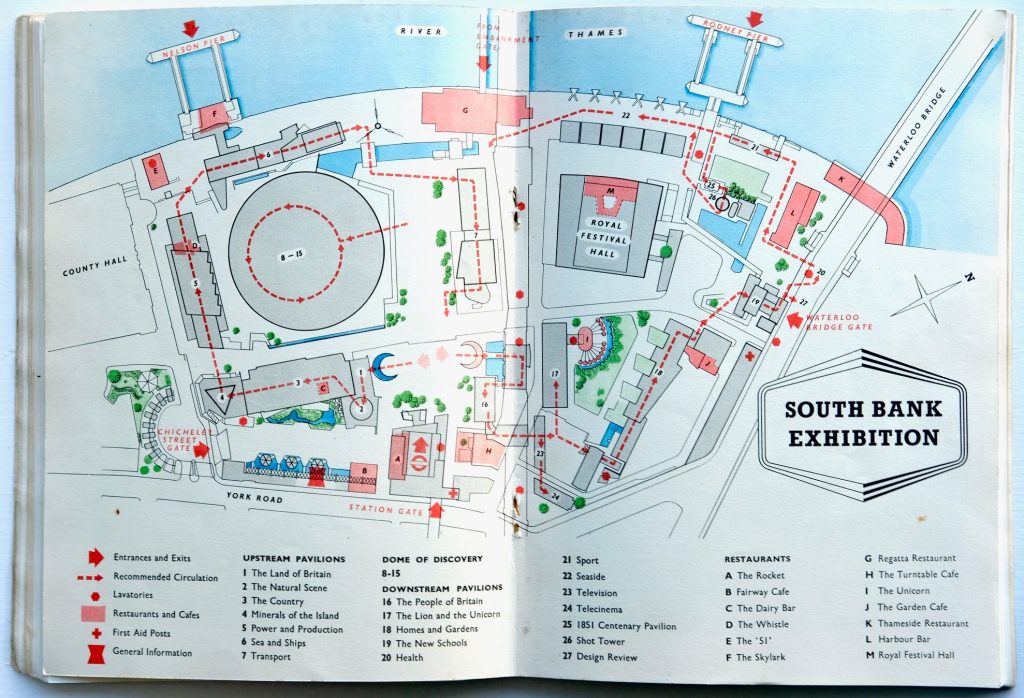
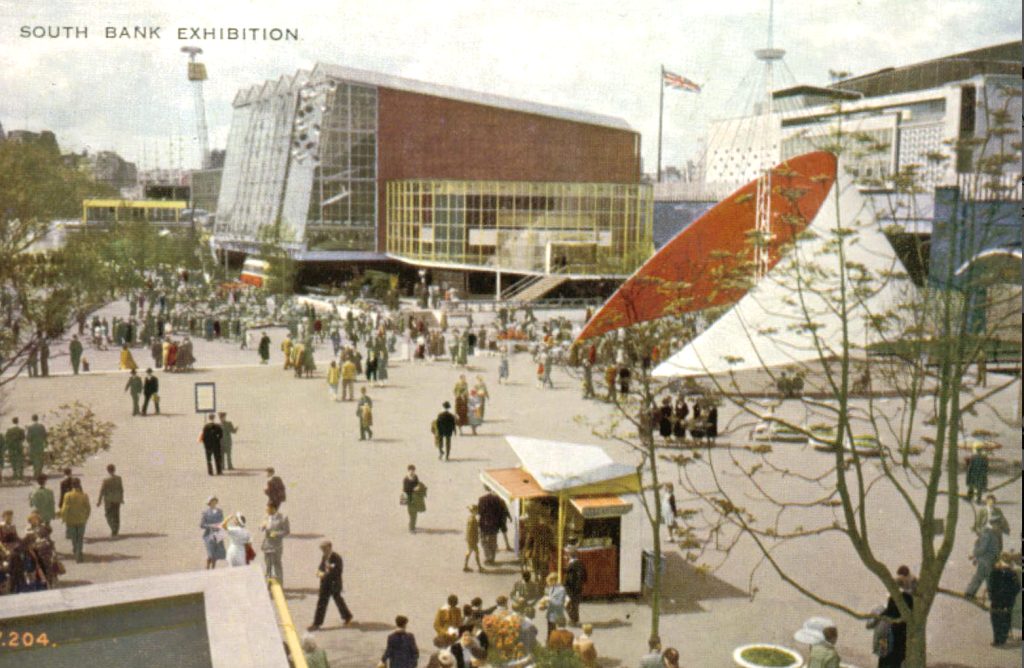
It was massively popular, with the South Bank showcase site attracting most visitors, over eight and a half million of them, who “flocked to the South Bank site, to wander around the Dome of Discovery, gaze at the Skylon, and generally enjoy a festival of national celebration. Up and down the land, lesser festivals enlisted much civic and voluntary enthusiasm. A people curbed by years of total war and half-crushed by austerity and gloom, showed that it had not lost the capacity for enjoying itself.”2
Over half of these visitors were from outside London and the capital adapted, inventively, to accommodate the influx. In Clapham, south London, the deep shelters constructed to offer shelter from wartime rocket attacks were turned into the ‘Festival Hotel’, with large posters brightening up the newly-painted tunnels.
That summer, 75 years ago, nearly 1,500 visitors paid their three shillings a night for bed and breakfast accommodation there. The beds were two-tiered bunks, each with three blankets and a pillow, with a sheet for the women and girls.
The sexes were segregated, washing facilities were cold water only and there were 192 steps up and down. The tunnels were below those of the Northern Line and visitors told of being awoken, abruptly, at six o’clock in the morning when the first tube trains began running.
Basic it may have been, but it allowed people of modest means from elsewhere in the country to visit the Festival by the coach and trainload, taking the special ‘F’ buses from the new coach park near Clapham South to the fantastic new Festival Gardens at Battersea (fare, six old pence).
It is in these tunnels that my novel Festival Days begins, when two dead bodies are discovered. For the London criminal underworld prepared for the influx of visitors, too. Pubs in central London were given special late licenses to sell alcohol, and conmen and pickpockets abounded, especially at events like the England v Argentina game at Wembley.
Protection racketeers upped their prices and, as with the arrival of the US GIs during 1944, a whole cohort of ‘working girls’ came to London from elsewhere in Britain and from the continent to offer sexual services to the visitors. Some came less willingly than others and it is the human trafficking of women for sexual purposes, something which is still happening today, which is at the heart of the book. My two heroines find themselves in peril as they race against time to find and free some of these women.
This is the third in the Clapham Trilogy of historical mysteries set in south London immediately after the end of World War Two, charting the immense social change of the time, with the creation of the Welfare State, the retreat from empire, the gradual emancipation of women and the arrival of ‘colonial citizens’ on the HMS Empire Windrush and culminating in the Festival of Britain.
Despite its popularity and its legacy in terms of design, technology and planning, the Festival was not supported by the Conservative Party. Churchill referred to it as “socialist propaganda”, although Herbert Morrison had deliberately omitted references to specific Labour policies like the newly formed National Health Service and others.
After the Conservative victory in the general election of Autumn 1951, in an act of political spitefulness, the South Bank festival ground was razed, all except the Royal Festival Hall and the Telekinema, which subsequently became the National Film Theatre.
Nonetheless, the groundwork had been laid for what is now the South Bank arts complex which we still enjoy today, 75 years later.
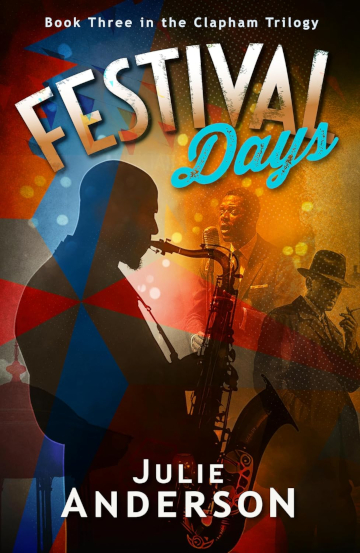
Festival Days by Julie Anderson is published on 28 April, 2026. It’s the third in her Clapham Trilogy.
Read more about this book.
1 Sir Gerald Barry, former editor, News Chronicle, and Director-General of the Festival of Britain.
2 Historian Kenneth O Morgan, Britain Since 1945: the People’s Peace, Eric Nahm OUP
Julie Anderson writes crime fiction, most recently the historical Clapham Trilogy. She lives in, er, Clapham, and you can read more about her and the, often real, places she writes about at julieandersonwriter.
Some related features in Historia include:
Historia’s interview with Elizabeth Macneal, which touches on the Great Exhibition
Historian or novelist? Writing fiction based on facts by Julie Owen Moylan
Tell Me How It Ends: writing a film noir novel by VB Grey
Women in science – a true story by Rachel Hore
Looking for radioactivity in Las Vegas by Lucy Jane Santos, all about life in the 1950s
The Second World War crime boom by Mark Ellis, on wartime crime
Images:
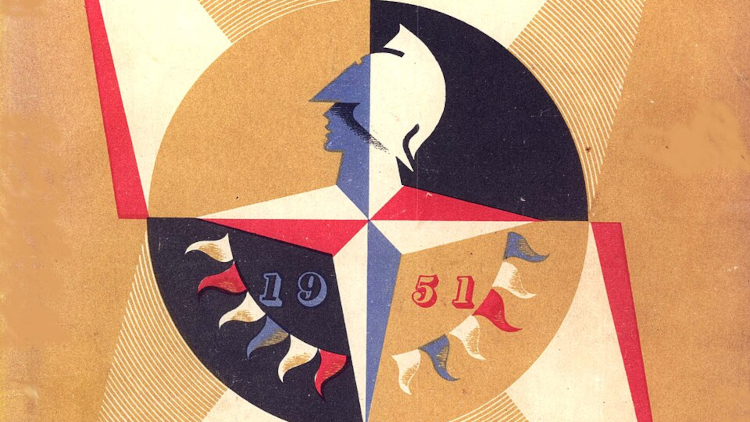
- The cover of the South Bank Exhibition Guide, 1951 (detail): Wikimedia (public domain)
- The South Bank Exhibition from Victoria Embankment, showing the Skylon and Dome of Discovery, August, 1951: Peter Benton for Geograph (CC BY-SA 2.0)
- HMS Campagnia dressed for the Festival of Britain in 1951 at Plymouth Docks: Keithpoole for Wikimedia (CC BY-SA 3.0)
- Map in the Festival of Britain South Bank Exhibition guide, 1951 (slightly trimmed): Phil Gyford for Flickr (CC BY-NC-SA 4.0)
- South Bank Exhibition postcard, the Fairway from the Station Gate, 1951 (lightened): Terry Whalebone for Flickr (CC BY-2.0)


