
Tom Williams writes about the Lines of Torres Vedras in Portugal, Wellington’s biggest secret (in terms of size, anyway) during the Peninsular War against Napoleon.
Today (7 April) sees the publication of the latest of my stories about Napoleonic-era spy, James Burke. Burke and the Lines of Torres Vedras is set in Portugal in 1810. James Burke is busy thwarting the plans of the French who are trying to discover the secret of the Lines.
What were the Lines and what was the secret?
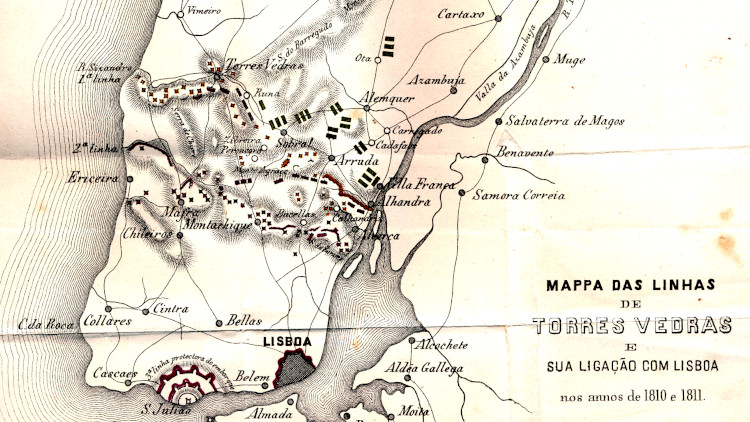
The Lines of Torres Vedras were an astonishing defensive work designed to protect Lisbon against a French attack. There were two Lines, because Wellington always liked to have somewhere to fall back to if his first position fell. (There was a third small defensive position near Lisbon, designed to protect a British withdrawal by sea if both Lines fell. Wellington was like that.) These defensive works became known as the Lines of Torres Vedras, named after the town which lay at the centre of the lines.
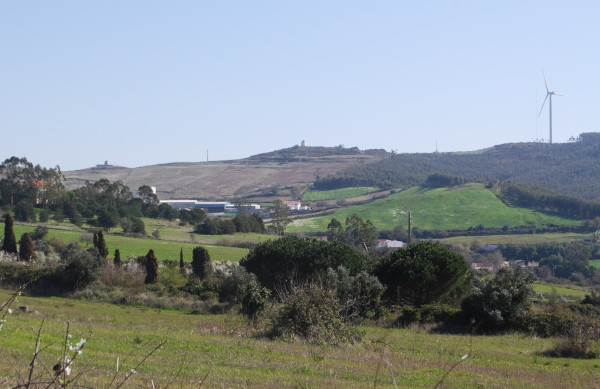
The British controlled the sea and hence also the estuary of the Tagus. Wellington knew that this meant the French would therefore have to attack from the North. His plan was to build a line of forts on the mountainous countryside around Torres Vedras.
The line ran from the Atlantic to the Tagus, a distance of over 55 miles (or 88 km if you were a damn Frenchie). Gunboats on the Tagus could deny the French access to the flat land near the river so they were unable to bypass the defensive line.
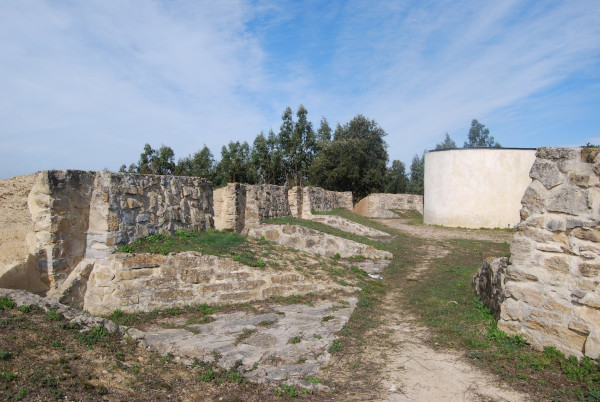
The line was not a continuous wall. Instead it relied on a series of forts (technically redoubts), which enabled Wellington to lay down heavy artillery fire on the limited number of passes over the mountains. The defence provided by the forts was supplemented by damming rivers to create artificial lakes, blocking some smaller mountain passes and blasting some gentler hills to create artificial precipices that the French would have to climb under fire.
Most of the forts were small and would not have held for long against a determined attack, but each fort was supported by other forts on either side. Behind the Lines Wellington built roads which enabled him to move reinforcements rapidly to any area where the French forces posed an immediate threat.
How could such a vast undertaking be kept secret?

The British did not try to hide the fact that they were building forts north of Lisbon. There was nothing particularly noticeable about such an idea. What they were careful to conceal was the scale of the work and the way that the forts interlinked to form an impenetrable barrier.
Had the French been aware of this they might have raced to cut off Wellington’s army before it could retreat to safety south of the Lines.
As it was, the extent of the fortifications was kept a secret. It is claimed that not even the British government knew about the Lines and was stunned when Wellington first said in despatches he had retreated to them.
The French followed Wellington on his retreat, confident that their superior force could push him all the way back to Lisbon. Instead they found themselves confronted by an insuperable obstacle. The French Marshal Masséna’s army made only one serious attempt to break through the Lines before accepting that it couldn’t be done.
Wellington had adopted a scorched earth policy north of the Lines and the French found themselves overwintering in a man-made desert. Masséna lost thousands of men from starvation, and hundreds of deserters surrendered to Wellington.
When the French finally decided to retreat northwards, they continued to take casualties as they were harried by Wellington’s army.
Masséna’s total casualties may have been up to 25,000 men as well as massive losses of cannons and other equipment.
When I was at school (back when the war against Napoleon almost qualified as current affairs) we covered the Peninsular War. We rote learned a series of battles but the strategy of the war remained a mystery to me and the Lines of Torres Vedras weren’t even mentioned.
Ever since Bernard Cornwell introduced the world to Richard Sharpe, there has been a clear understanding that if you write about a soldier fighting Napoleon you have to include the Peninsular Wars. In Burke in the Peninsula, I chose to write about Talavera.
I learned enough about the campaign to put the battle in context. Part of that context was that, although the battle is presented as a British triumph, it was little short of a disaster and ended with Wellington retreating towards Portugal. This naturally made me wonder where he went next and so I found myself learning about the Lines.
When I discovered that many of the forts still exist, I had to go and see them for myself. With the help of Robert Pocock, whose company (Campaigns and Culture) runs tours of battlefields, we organised a trip to Spain and Portugal that gave us two days to visit the Lines.

The Portuguese see the Lines of Torres Vedras both as a source of national pride and a valuable way of drawing in tourists, so the route is well signposted, though after several miles of steadily steeper and narrower roads my long-suffering wife did wonder if we were lost. No, I assured her, the forts would be at the very top of the hills. And there, indeed, was the first of the redoubts that we found: the Forte Novo or New Fort.
It was one of the smaller forts. Like many of them it was built around a windmill that served as an ammunition bunker for the powder that would supply the five cannon that were placed there. After 200 years it was in impressively good condition.
We went on to explore several other forts, including the two largest: the Great Redoubt at Sobral and Fort San Vicente. It was a wonderful experience and left me determined to write about the Lines.
For the writer of military historical fiction, the Lines of Torres Vedras pose one major problem: there was never a significant battle fought there, so there is little to write about.
Fortunately, my hero is a spy and there was certainly a lot of spying going on at the time. Oman’s classic History of the Peninsular War tells us that four spies fled Lisbon at the very end of December 1810. The plot of Burke and the Lines of Torres Vedras is built around that nugget of historical fact. And, of course, the Lines themselves.

Burke and the Lines of Torres Vedras by Tom Williams is published on 7 April, 2023.
Read more about this book.
You may enjoy some of Tom’s other features about the background to his Burke series:
When my Spanish research trip went astray
The Battle That Changed Britain
Researching the Land of Silver
Why I wrote about Irish history
Here’s another, relating to his Williamson Papers trilogy:
Re-examining the history of Empire in fact and fiction
Tom chats to another author of 19th-century military fiction in this interview with Paul Fraser Collard.
For a look at the Napoleonic Wars from the other side’s point of view, try Are we the bad guys? Writing naval historical fiction from the French point of view by JD Davies.
And to find out how French prisoners of war were treated, have a look at Asylums and prisons: locking women away in madhouses by Nicola Pryce.
Images:
- Mapa das Linhas de Torres Vedras from História da Guerra Civil e do estabelecimento do governo parlamentar em Portugal by Simão Luz Soriano, 1874: Wikimedia (public domain)
- A smaller redoubt covering the flank of Fort San Vicente: © Tom Williams
- Gun emplacements at Fort San Vicente: © Tom Williams
- The hills in the distance are part of the natural defences: © Tom Williams
- Forte Novo on Monte Agraço: Roundtheworld for Wikimedia (CC BY-SA 4.0)


