
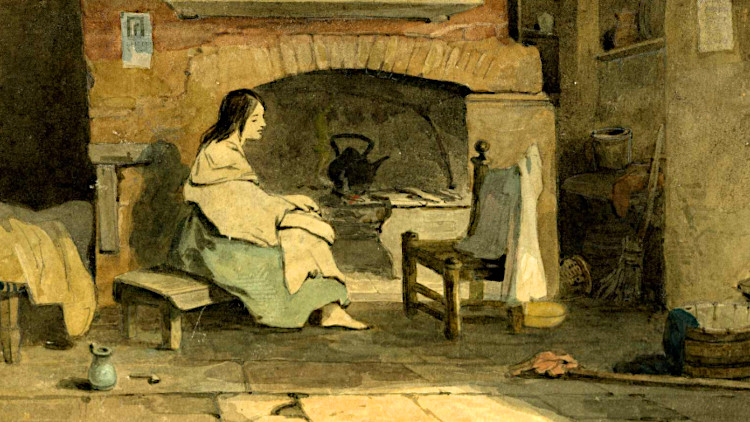
Kate Griffin writes about discovering the history of the St Giles rookery, London’s most notorious slum and the backdrop to her new book. Why was the area left in a state of shocking poverty for two centuries? Because of its geography, and financial expedience, she found.
Hogarth’s famous 1751 depiction of Gin Lane with its horrific vignettes of infanticide, madness, starvation and even suicide still has the power to shock. When you tear your eyes away from the appalling drunken scenes at the forefront of the print your attention might wander to the peculiar church in the background where large beasts ramble at the base of pyramidal steeple.
This is no architectural whimsy. Hogarth’s audience would have recognised the building instantly as Hawskmoor’s St George’s, Bloomsbury and would have been certain that they were looking at a street in the notorious St Giles rookery.
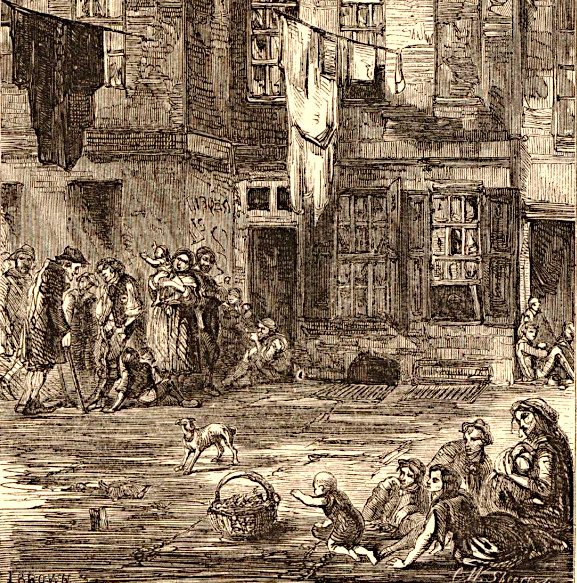
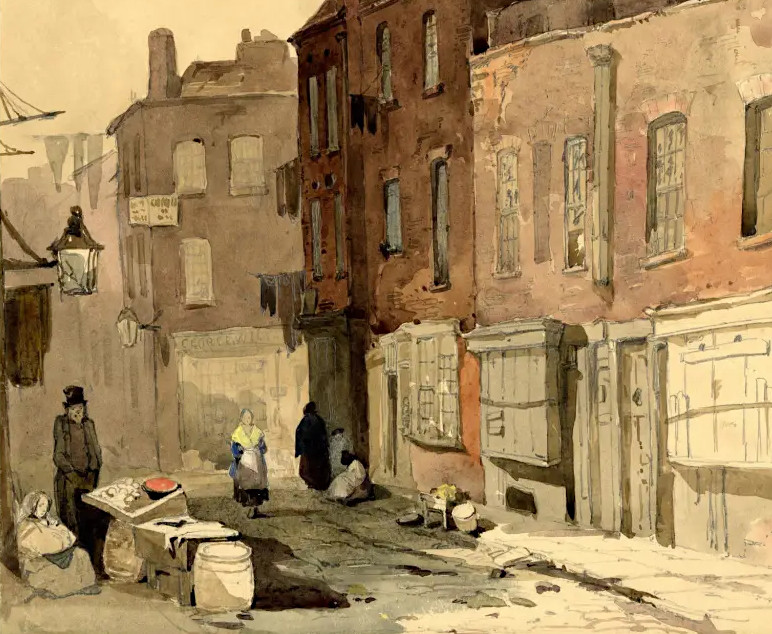
This was one of the most desolate places in Georgian London. A warren of narrow, fetid passages and courtyards that was home to hundreds of people who had nowhere else to go and nowhere further to fall.

Today, the footprint of the rookery has been obliterated by architect Renzo Piano’s towering multi-coloured development north of St Giles’s Church. Bordered by the West End, Soho and Bloomsbury, there is little indication that this compact, prosperous site, occupying an area approximately the size of two football pitches, was once London’s premier historic slum.
By Hogarth’s day, the St Giles rookery was a byword for deprivation, poverty and every evil under a sun that never penetrated those shadowed alleyways. Those who sought refuge here were disparagingly referred to as St Giles Blackbirds and, although there was certainly a significant number of black people living in the rookery in the Georgian era, the name is most likely to refer to the place’s reputation as a nest of villainy.
In The Blackbirds of St Giles, co-written by me and Marcia Hutchinson, the rookery becomes the place of last resort for siblings Daniel and Pearl, who, having escaped enslavement on a Jamaican sugar plantation, arrive in London as heirs to a fortune. Within days, they are stripped of everything they own and, with no other option, the rookery becomes their home.
It’s a hoary old trope that history is written by the victors, but in the case of the St Giles rookery it’s true. When we came to research the setting of our story it was difficult to find out about the real people who actually lived there because their lives were cheap and not worth recording. It was even hard to identify the names of those stinking alleyways.

The rookery appears on most early maps as a shaded triangular blob. This is because it had such a grim reputation that the cartographers of the early 18th century – usually so diligent and enthusiastic – were frightened to set foot in the chaotic and threatening labyrinth.
Given that the St Giles rookery bordered some of London’s early prime real estate developed into aspirational districts by enterprising aristocrats, it seemed odd that it was left to fester.
We wondered why.
What became apparent from our research was that the place has always had an affinity for outsiders. There has been a church at St Giles’s since Saxon times. St Giles was the patron saint of lepers and a monastery hospital established on the marshes here in 12th century was home to a leper colony, the site chosen to keep contagion from the nearby City of London. After the Reformation a parish church was created from the old chapel, but its associated hospital continued to care for lepers until the mid-16th century.
The parish became known as St Giles in the Fields and, as London expanded, houses of poor quality began to be built on this soggy edgeland. Early church wardens noted “a great influx of poor people”. House cellars in particular were recorded as appalling places in which whole families resided, “damp and unwholesome”.
By the mid-17th century, St Giles was already overcrowded and desperately poor. Unsurprisingly, it was where the Great Plague of 1665 claimed its first victims, who were buried in the churchyard. But pestilence did not deter newcomers. Over the next century, people continued to seek refuge in the cramped dwellings that jostled for space on the tiny site.

Vagrants expelled from the city settled in the St Giles district as it was the first place they came to. The population further increased with the arrival of French Huguenot refugees and then a steady stream of Irish emigres. By the early 18th century, there were so many Irish Catholics living in the St Giles rookery that it was nicknamed The Holy Land.
As England shamelessly mined the riches of transatlantic slavery, they were joined by a significant number of dismissed black servants reduced to begging. There were also many black former soldiers and sailors, who, having served the crown, found themselves adrift in London without a pension. We used this as a cue for Daniel’s story. Estimates vary, but it is thought that by the 18th century there were more than 20,000 black people living in England, mainly in the poorest parts of ports and cities.
But this potted history doesn’t explain why the St Giles rookery became a place of such grinding poverty. The answer is partly a tale of geography and also a case of negligent ownership.
First, geography.
In the late 17th and 18th centuries, thousands of people were on the move and the St Giles rookery was located at the exact point where three key roads intersected.
The Great North Road brought people from the north of England and from Scotland directly to the heart of London. Whether in response to the Highland Clearances or the pressures of the Industrial Revolution, they came to London to seek a better life. The road they finally tramped into London on (better known today as Tottenham Court Road) ended at the St Giles rookery, as did the two important routes leading from Holyhead in North Wales, and west from Bristol and Fishguard in Pembrokeshire.
These roads brought thousands of Irish people directly into London, and also people from Wales and the West Country seeking new employment as agriculture changed. In particular, the Oxford Road, carrying people into the city who came originally from Dublin, ended on the doorstep of the rookery. (It’s now Oxford Street.)
Today, if you stand at the bustling meeting point of three of London’s major thoroughfares, Tottenham Court Road, Oxford Street and Charing Cross Road, you are standing at the gateway to what was the St Giles rookery.
Having arrived in London, people needed somewhere to stay and, through happenstance and exploitation, the rookery was able to oblige.
This is where we come to ownership and a tale to rival Jarndyce v Jarndyce. In essence, the land on which the rookery had developed over many years was part of a 17th-century dowry shared by three sisters and their female descendants. Complications of the bequest meant that the women (and their wealthy merchant husbands) came to regard this mean plot of land as little more than a source of pin money.
After taking any payments due, successive distaff generations were happy, perhaps even relieved, to allow their agents and leaseholders to do as they saw fit. There was no financial benefit in maintenance or improvement for the leaseholders, but there was a great deal of profit to be made from letting and subletting… and then subletting the subletting, especially as there was a constant flow of poor incomers desperate for accommodation.
The most enterprising of these unscrupulous leaseholders even began to tunnel beneath the rickety old buildings to create more accommodation. These waterlogged subterranean lodging rooms became the most foul and noxious spaces imaginable. They inspired ‘the Maze’, which is an essential part of our story.
A tragedy of 1814 further illustrates the point. At the Meux Brewery, on the site of what is now the Dominion Theatre, the hoops around a 22ft-high vat of 3,555 barrels of porter split, and beer weighing in at over 570 tons gushed out. It smashed walls and flooded the basement homes in St Giles. Eight women and children died.
It wasn’t until around 60 years after the 1782 setting of our book that the slums of St Giles were finally cleared. Demolition began in 1843.
Marcia and I are both great fans of Bridgerton, a gorgeously-caparisoned TV series set in an imagined Georgian England. Ground-breaking in so many ways, it is a total fantasy. While we are happy to admit that our story of struggle, betrayal and ultimately triumph is also (partly) a caprice, we hope that in its setting we have created an alternative gritty reality much closer to the truth and to the actual experience of the poor in Georgian London, especially its black community.
Together, we salute the St Giles Blackbirds and the rookery that was their home.

The Blackbirds of St Giles by Lila Cain (Kate Griffin and Marcia Hutchinson) is published on 30 January, 2025.
Kate has been a journalist and worked in communications. Her most recent book is Fyneshade, a gothic chiller which was first published in 2023. Kate lives in St Albans.
Marcia was a lawyer and then an educational publisher. She’s also been a local councillor in Manchester. Her debut novel as a solo author, The Mercy Step, is out on 22 July, 2025.
You may enjoy reading Kate’s other Historia features, including:
The magic of full moons
Top six Turns of the Screw
Top ten films set in the Victorian era
And our Q&A with Kate
If you’d like to see more about the Georgian era, have a look at:
Crime and politics in the early 18th century by Douglas Skelton
How Mary Wortley Montagu and other great 18th-century women were forgotten by Sean Lusk
The unsung heroes of Grub Street by Ruth Herman
Unboxing Pandora’s myth – in Georgian London by Susan Stokes-Chapman
A respectable trade in brutality: Blood & Sugar by Laura Shepherd-Robinson
Historia’s interview with Hallie Rubenhold by Matthew Plampin also covers slums, though these are 19th-century ones.
Images:
- A Cellar in the Rookery, St Giles’s by John Wykeham Archer, before 1874: © The Trustees of the British Museum
- Gin Lane by William Hogarth, 1751 (detail): Wikimedia (public domain)
- A plan of the cities of London and Westminster by William Faden, 1785 (detail showing the rookery, with St Giles’s Church in red and St George’s in green): Bibliothèque nationale de France via Wikimedia (public domain)
- A Scene in St Giles’s from The Rookeries of London: Past, Present, and Prospective by Thomas Beames, 1852: British Library via Wikimedia (public domain)
- A view of Wild Court, London from The Homes of the London Poor, illustration by Charles William Sheeres, 1840–59: © The Trustees of the British Museum
- Part of the Rookery, St Giles by John Wykeham Archer, 1844: © The Trustees of the British Museum (CC BY-NC-SA 4.0)


