

Rachael Tearney reviews the first biography of Elizabeth Heyrick, Quaker, campaigner and abolitionist. The women of the Abolitionist movement are far less well-known than the men, and this timely book highlights one whose advocation of ‘immediate’ rather than ‘gradual’ abolition of slavery put her at odds with better-known figures such as William Wilberforce.
The Abolition movement is an extremely topical area of history at present and author Jocelyn Robson has unearthed and pieced together the life story of one of the most influential, yet lesser-known, voices of the campaign, Elizabeth Heyrick.
The story is complicated not just by her anonymity when writing but also by the fact that another completely unrelated woman of the same name was writing at the same time.

Robson is confident she has isolated Heyrick’s contribution to the decades long campaign and sets about detailing her life and writings.
This book is broad in its subject in that it is not just confined to Elizabeth Heyrick’s story, perhaps because the details are limited; it explores the era 1760 to 1830 and is hugely insightful and thought-provoking.
She gives a broad overview of the Abolitionist movement in general, and it is of particular interest to anyone with a connection to framework knitting or to the East Midlands, as this is where most of the book is set.
There is much background to her life, her childhood, her parents and their Nonconformist roots, including a lovely little Jane Austen parallel in the early chapters.
Nonconformists are perhaps deserving of more attention than they currently receive in historical circles; their religious dedication was such that they had rejected the Church of England and set up their own ‘nonconformist’ denominations, which allowed women to have a greater role, speak, preach and, to some extent, write.
However, it also meant they were excluded from university education and civic roles and so they tended to dominate trade and industry.

What people may not realise — and what Robson highlights so beautifully — is the role of women in the Abolitionist cause. Widowed young and deeply religious, Elizabeth found purpose in her work to reform society, not just on the plantations but also at home.
She was very much concerned with humanity, not just specifically the plight of the slaves. She pushed for better conditions for the British poor and for animals. Hers was a passion for compassion.
Whether by accident or on purpose, this book affirms that the conscience of the West which led to all these social reforms was Christian. These were not politicians driven by academic ideology, they were often women, wives and daughters who were motivated entirely by their Nonconformist belief that ‘all men (and women) were equal in the eyes of the Lord.’
Without the religious devotion of the Nonconformists, society might never have reached the point of abolition or even had its conscience pricked enough to care.
A fascinating read of a woman who often wrote anonymously, perhaps because it was the cause that mattered not the ego of the campaigner.
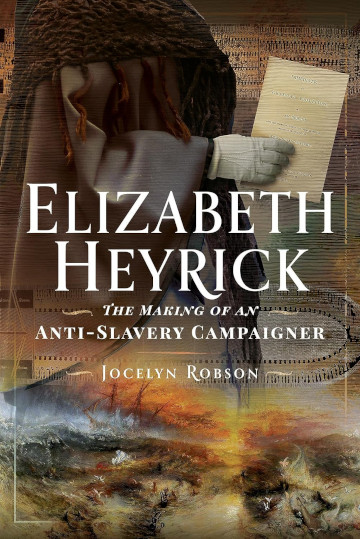
Elizabeth Heyrick: The Making of an Anti-Slavery Campaigner by Jocelyn Robson was published on 7 June, 2024.
Jocelyn is a London-based researcher and writer. This is her second narrative non-fiction book.
Rachael Tearney is a historian and writer.
Images:
- Title page of Immediate, Not Gradual Abolition by Elizabeth Heyrick, 1824: Google Books (public domain)
- The Quaker’s Meeting after Egbert van Heemskerck I, c1723–68: © The Trustees of the British Museum (CC BY-NC-SA 4.0)


