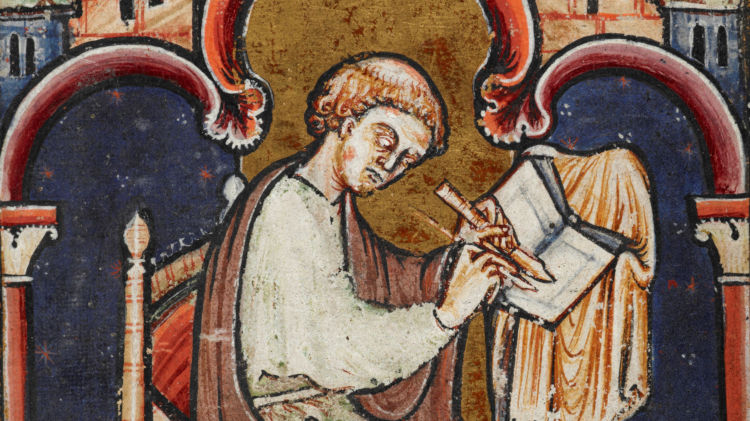
Without Bede, a monk living in Jarrow at the end of the 7th and beginning of the 8th centuries, there would be a huge gap in the early history of the English peoples. Indeed, it was Bede who first spoke of the separate tribes and kingdoms as ‘English’. That’s why, as his biographer Edoardo Albert explains, he’s called the father of English history.
History is our story to ourselves. It tells us who we are and where we came from. But without story tellers, there’s no story. Take away historians, and there’s no history.
That was very nearly the case for Britain. In AD410, the Romans left (there’s some question about how much of a cut-off date that was in reality but it serves as a marker). Britannia had been a province of the Roman Empire for 367 years but with the departure of the legions, Britannia, basically disappears.
For the whole of the 5th century, we have a couple of letters written by St Patrick and, basically, that’s it. In the 6th century, there’s a single work, On the Ruin and Conquest of Britain, by an irascible monk called Gildas which qualifies as the most frustrating historical work ever written.
.jpg)
Gildas has a complete aversion to dates and the most irritating tendency to use soubriquets rather than names when writing about the kings he excoriates in his work.
And that’s it for 200 years: two letters and a jeremiad masquerading as history. Then, amid this desert of historical sources, comes The Ecclesiastical History of the English People.
It’s safe to say that, without it, we would know next to nothing about what happened between the Romans leaving and the consolidation of England into the main Anglo-Saxon kingdoms.
Modern archaeology might have allowed us to chart the change of culture, as the pagan Anglo-Saxons became Christians and switched from burying their dead with equipment for a riotous after life to the more sober furniture of Christian burial, but we would have no names, no dates and no stories: no Hengist and Horsa, no possible name for the king buried in splendour at Sutton Hoo, no Edwin, Oswald or Penda. Just a void, half filled by the mute finds of archaeology.
But with Bede we have names, lives, stories. Bede gives us our history. But because it’s Bede, and no one else, it is history filtered through the preoccupations and aims of one single monk who lived in Jarrow at the end of the 7th century and the beginning of the 8th century in the Kingdom of Northumbria. However, given those limitations, it’s truly extraordinary what Bede accomplished.
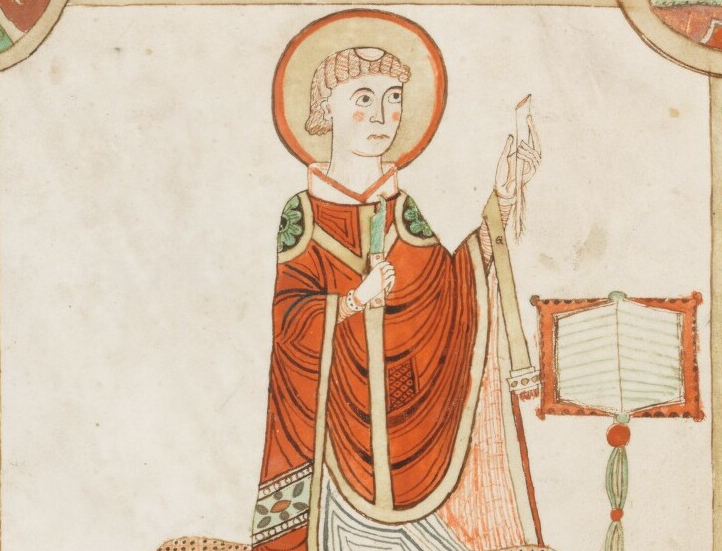
Let’s start with his account of the origins of the English. Famously, he recounts how three Germanic peoples, the Saxons, the Angles and the Jutes, sailed to Britain, leaving their own homelands largely depopulated, and basically pushed out the native Britons to carve out new kingdoms for themselves.
During the second half of the 20th century, archaeologists poured increasing amounts of cold water on Bede’s account, so much so that, by 2020, it was taken as gospel that what actually happened was an elite takeover, where small groups of warriors arrived, killed or chased away the Britonnic rulers, and took over the little kingdoms that had sprung up all over post-Roman Britain.
The local natives, faced with the incomers’ abject inability to learn their language (some things don’t change!) had no choice but to learn Old English, which slowly became the language of the peasants as well as the language of the ruling elite.
It was basically an earlier version of the Norman Conquest.
This had become the accepted narrative, with Bede’s account pooh-poohed as folklore masquerading as history. But then the technology to test ancient DNA became sufficiently advanced that samples could be taken from the teeth of people buried in 5th, 6th and 7th century graves that could establish where they came from and what their ancestry was.
To the astonishment of the academic community, the results were clear: there really had been a mass movement of people from the continent to Britain. In the gravesites tested in the south east, some three quarters of the people buried had origins outside Britain, from the regions that Bede had identified as the homelands of the Anglo-Saxons. But there was another significant group of immigrants, not mentioned by Bede, who came from what is today France.
While this was a slow-motion takeover spread over a couple of hundred years, it’s now clear that people really did come to Britain in large numbers from the continent and that much of the native population really was displaced westwards. The highest concentration of immigrants was in the southeast, with greater numbers of native Britons further north and west.
So Bede’s account of the arrival of the Anglo-Saxons has been to a large extent vindicated. This is encouraging for the later history, the times closer to his own life where he might be expected to have more accurate information.
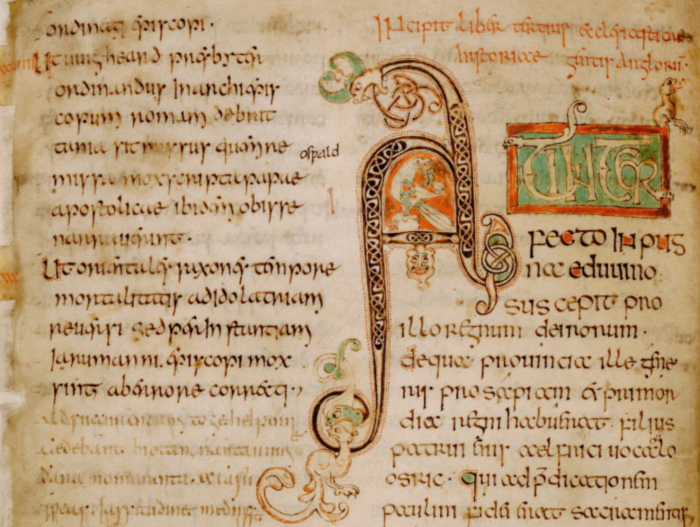
Indeed, Bede makes a point of telling his readers that, in writing his book, he sought out the people who knew the answers to the questions he was asking. Despite living his whole life at the monastery in Jarrow, Bede had a long list of contacts whom he wrote to, asking for information.

Careful analysis of the book shows what he managed to get from them – and what they couldn’t tell him. For instance, the bishops of East Anglia were able to supply Bede with the list of bishops and abbots in their diocese but it’s clear that they didn’t have dates for the early bishops and Bede was unable to connect them to the timeline for his wider history. So he gives their names, and attaches what information he can about them, but he can’t say exactly when this all occurred.
But the fact that, faced with this hole in his sources, Bede did not invent dates but worked around his lack of knowledge should give us confidence that he did not invent information in other areas where he is more specific. However, we should remember that Bede set out to write an ecclesiastical history. His purpose in writing his book was to show the working out of God’s plan to bring the pagan Anglo-Saxons to the truth of the Christian religion.
This might seem like a biased filter through which to view history but the simple fact is that every historian applies some sort of selection filter to the mess of events that constitutes what happens. For instance, Marxist historians analyse history through the filter of historical materialism, a focus that, shall we say, is at least as biased as Bede’s.
These filters decide what the historian includes and what he leaves out. Bede is interested in how God brought Christianity to the English people. As such, he selects the accounts of kings and battles that are relevant to the overarching story he is telling: there were, no doubt, many kings and more battles that he omitted because they had no bearing on his history.

But luckily, the story Bede wanted to tell was crucial for the history of England because the Christianisation of the Anglo-Saxons was critical in turning them into a distinct people: the English. Without the idea, that Bede developed and popularised, of Christianity as an identity that transcended locality and tribe it’s likely that the Anglo-Saxons would have found it much more difficult to consolidate as a single nation.
Furthermore, Bede’s vision of them as a new chosen people in a new promised land provided Alfred the Great and his children with the framework in which to build England, an ideal that provided the impetus to defeat the Norse control of the Danelaw and, eventually, also allowed the children of the Norse settlers to be incorporated into England.
So by any measure you care to apply, Bede was the most important and the most influential historian in the history of England. Not just the father of English history but the godfather of the English people.
Bede: the Man who Invented England by Edoardo Albert is published on 4 June, 2026.
Read more about this book.
Read some of Edoardo’s other Historia features:
A life of war in Anglo-Saxon Britain
How an engineer stopped Sultan Suleiman from conquering Rhodes
His review of Anglo-Saxon Kingdoms: Art, Word, War
Some related reading:
‘England’ in the 10th century and Rival kings and the fall of Mercia by MJ Porter
The Battle of Hatfield in 632 by Nicola Griffith
Murder and the law in Anglo-Saxon England and In Search of Mercia by Annie Whitehead
Matthew Harffy‘s review of Warrior by Edoardo Albert with Paul Gething
Images:
- Detail of a portrait of Bede from the Prose Life of St Cuthbert, 1175–99: British Library BL Yates Thompson MS 26 f2r via Wikimedia (public domain)
- Detail of a page (f1.27) from De Excidio by Gildas, 12th–13th century: Cambridge University Library via ThêtaBlackhole for Wikimedia (CC BY-SA 4.0)
- Portrait of Bede from Omiliae lectionum sancti evangelii Venerabilis Bedae presbiteri numero quinquaginta: Virtual Manuscript Library of Switzerland Codex 47 f1v via Wikimedia (public domain)
- Detail from Historia Ecclesiastica Gentis Anglorum by Bede, first half of the 9th century (The Tiberius Bede): From the archive of the British Library, Cotton MS Tiberius C II, f 60v (non-commercial web use)
- Frontispiece of Bede’s Life of St Cuthbert, showing King Æthelstan presenting a copy of the book to the saint (detail), c930: Originally from Corpus Christi College, Cambridge MS 183, f1v via Wikimedia (public domain)
- Detail from the Saint Petersburg Bede (Historia Ecclesiastica Gentis Anglorum), f3v, 746: Wikimedia (public domain)


