
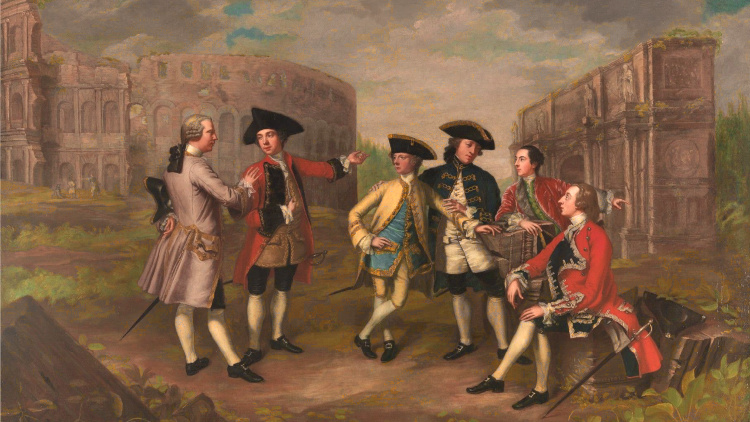
For wealthy young British men in the 18th century, travelling around Europe was not always just about education, culture, and adventure. Politics — sometimes quite dangerous politics involving a threat to the established order in Britain — were a draw as well. Dr Jérémy Filet, author of The Jacobites and the Grand Tour, explains.
Art, architecture, sexual encounters and connoisseurship were not the only things a young gentleman encountered on his quintessential Grand Tour throughout Italy in the 18th and 19th centuries.
He was also thrown into an underworld of politics, espionage, and performative courtship. At the heart of the political intrigues was a serious threat to the Hanoverian monarchy – the Jacobites.
Jacobites were the supporters of the senior male line of the House of Stuart to the throne of the three Kingdoms of England, Scotland and Ireland. Although they have been dismissed as a spent force, the Jacobites were in fact a real threat to the status quo established by the 1688 revolution. And they travelled on the Continent too.
I first engaged with this educational travel when I realised there was more to study than the cultural experiences of travelling to Italy, the Giro d’Italia. Travel was intensely political.
Travellers frequently visited France, the Holy Roman Empire, the Low Countries and Switzerland for political as well as cultural purposes. In fact, the places travellers decided to visit could be indicative of political sensibilities. I therefore decided to research the multifaceted connections between educational travel and Jacobitism. Before telling you that story: context.
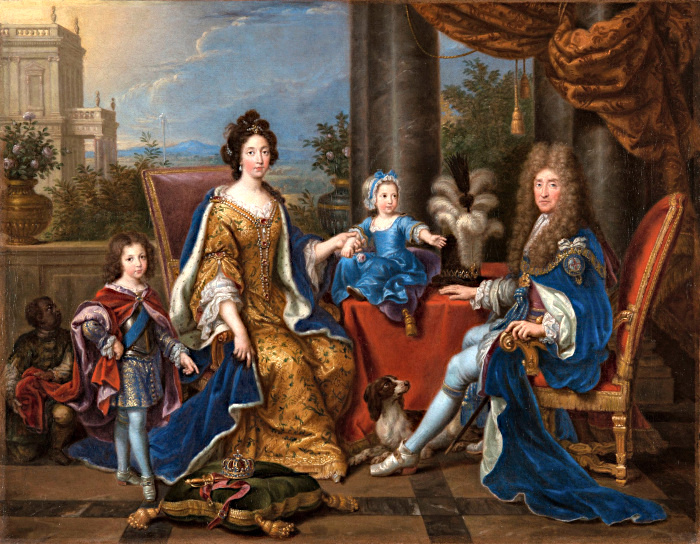
In 1688, Parliament deposed James II of England and VII of Scotland (1633–1701). After the birth of James III and VIII (1688-1766), Parliament invited William of Orange (1650-1702) to take the throne and become King William III and II. James II and VII and the Jacobites were exiled and established their court in France, where Louis XIV (1638-1715) welcomed them in the Palace of St Germain-en-Laye.
The Jacobites had to find ways to compete with the London-based de facto government and to assert their de jure right to the throne of the three kingdoms. Since the Jacobites were based on the Continent, travellers from the British Isles encountered them regardless of their own political affiliations.

Louis XIV also supported an abortive Jacobite invasion of Britain in 1708, and continued to lend aid until the Jacobite court moved to the Duchy of Lorraine. After the signing of the 1713 Treaty of Utrecht to end the War of Spanish Succession, Duke Leopold of Lorraine (1679-1729) helped the Jacobites prepare for another British rising in 1715.
During this time, travellers from all over Europe were attending the prestigious academy of Lunéville in Lorraine. This educational institution became an unmissable stop on the Grand Tour. While Leopold made the political choice to welcome the Jacobite ‘shadow court’ in his territories, travellers from the British Isles stopped in Lunéville while accomplishing their Grand Tour.
From Lorraine, James III and VIII managed a multi-media propaganda campaign that complemented local publications in favour of the Jacobites. The duke of Lorraine made sure James would be seen hunting and engaging in various princely behaviours around his court and academy to keep the Jacobite court socially and politically active on the European stage. Leopold also welcomed the mingling of Protestants in and around the Jacobite court, which was part of a wider strategy of propaganda orchestrated by Jacobite officials.

James also led a diverse cultural life interspersed with courtly celebrations and princely entertainments. The Jacobite shadow monarch met with foreign princes, who might have been able to help the Jacobite cause and improved James’s standing amongst the European nobility.
This suggests that Lorraine was a prominent location, not only for travellers from the British Isles, but also for European princes.
While the Jacobite court was preparing for the British rising in 1715 (the ’15), many nobles and gentry from Britain and Ireland visited Lorraine by using the socio-cultural ‘right-of-passage’ of the Grand Tour to engage in proscribed political intrigue.
But everything changed in 1716. The involvement of the duke of Lorraine in the ‘15 gave him a front-row seat to witness the failure of the Jacobite uprising in Scotland, and the death of Louis XIV that same year forced Leopold to review his foreign policy. The duke was now brother-in-law of the Regent of France, Philippe II, Duke of Orléans (1674-1723), an ally of Hanoverian England.
Leopold’s hospitality to James engendered no other lasting effect besides antagonising England, and now France.
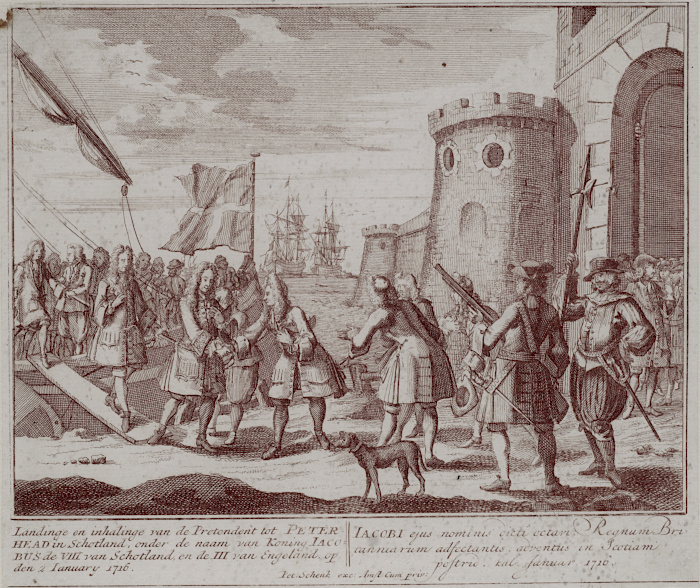
The failed rising’s confirmation of the Act of Settlement convinced Leopold to pin his hopes on travellers who were supporters of the Hanoverian succession rather than relying on a now-outdated dynastic and religious connection to the Stuarts and their allies.
In the second half of his reign, the duke of Lorraine thus welcomed travellers from the broader political spectrum who preferred to spend their free time together to gain advantage from an Anglophone sociability abroad. Travellers who supported the Hanoverian succession employed a multigenerational strategy of educational travel to better their position in England.
Lunéville was part of families’ strategies to advance travellers’ socio-political prospects, and those who kept contacts once back in Britain or Ireland could even arrange marriages for sisters or gain support to stand for seats in parliament. This shows how the Jacobite presence in Lorraine during the years surrounding the ’15 stands as a prime example of how partisan politics influenced the travel patters of the Grand Tour.
My research on this topic is presented in a new monograph published by Manchester University Press in the Jacobite Studies series in partnership with the Jacobite Studies Trust. The Jacobites and the Grand Tour: Educational Travel and Small States’ Diplomacy investigates the functioning of travel in political culture by using early-modern small states as case studies.
Although the court of Turin similarly exploited the lure of an Academy to attract the aristocratic elite of Europe and to enhance the court’s international standing, Lorraine played off the rival powers by which he was surrounded by instrumentalising Jacobitism via the soft power of his academy.

In a way, Lunéville was a little capsule of everything 18th-century; diplomacy, travel, sociability, cultural exchanges, and politics were all intertwined within the court and its academy. There was barely any difference between the performative politics at Leopold’s court and academy, and the duchy’s diplomatic relations with London. Small states were looking for a place in the Europe of the great alliances, and Jacobitism, no longer seen from a British perspective but from a continental one, became a resource, first exploited by France and then by a small state such as Lorraine.
Although my book is a useful first step, I believe more work is needed to fully understand the connections between Jacobite politics and Continental travel. The Jacobites moved to Italy after 1716, and travellers kept paying impromptu visits to the Stuart Court in exile.
Were they motivated by sheer curiosity or political commitment? What was the weight of social and familial pressures in such choices? By broadening the significance of the Grand Tour beyond the purely socio-cultural analysis, my research helps to restore its political dimension and reveal the importance of Jacobitism as a considerable political movement in the 18th century.

The Jacobites and the Grand Tour: Educational Travel and Small States’ Diplomacy by Jérémy Filet was published on 22 April, 2025.
Further reading:
Edward Corp, A Court in Exile: The Stuarts in France, 1689–1718, Cambridge University Press, 2009
Jérémy Filet, You’re Dead to Me: The Jacobites, BBC Radio 4, 2023
Jérémy Filet, Stephen Griffin, ’Irlandois de Nation’ : Duke Leopold’s Irish subjects and Jacobitism in Lorraine, 1697-1727, History Ireland, 26:3 (2018).
Stephen Griffin, Duke Leopold of Lorraine, Small State Diplomacy, and the Stuart Court in Exile, 1716–1729, The Historical Journal, 65:5 (2022), 1244–61.
Daniel Szechi, 1715: The Great Jacobite Rebellion, Yale University Press, 2006
Daniel Szechi, The Jacobites: Britain and Europe 1688–1788, Manchester University Press, 2019
You may be interested to read about a lesser-known Jacobite attempt to regain the throne in 1719: the forgotten Jacobite rising by Maggie Craig.
Other related features include:
The Protestant Wind and The Battle of Killiecrankie, also by Maggie Craig
Why the Glorious Revolution was… well, neither by Angus Donald
Raising the Jacobite standard: Glenfinnan, 1745, Remembering Culloden and Five surprising facts about Charles Edward Stuart by Frances Owen
Five surprising facts about Henry Benedict Stuart by Calum E Cunningham and Stefano Baccolo
Images:
- British Gentlemen in Rome by Katherine Read, c1750: Yale Center for British Art, Paul Mellon Collection (public domain)
- James II and VII and his family at St Germain by Pierre Mignard, c1694–5 (L–R: James, Prince of Wales; Queen Mary, Princess Louise Marie, King James): Royal Collection Trust / © His Majesty King Charles III 2025
- Leopold I, Duke of Lorraine by Nicolas Dupuy, c1703: Musée des Beaux-Arts, Nancy via Wikimedia (public domain)
- James Francis Edward Stuart (James III) by Antonio David, c1720: Wikimedia (public domain)
- Prince James Landing at Peterhead, 2 January 1716: National Library of Scotland digital collection (CC BY 4.0)
- Château de Lunéville, Lorraine, 18th century: Wikimedia (public domain)


