
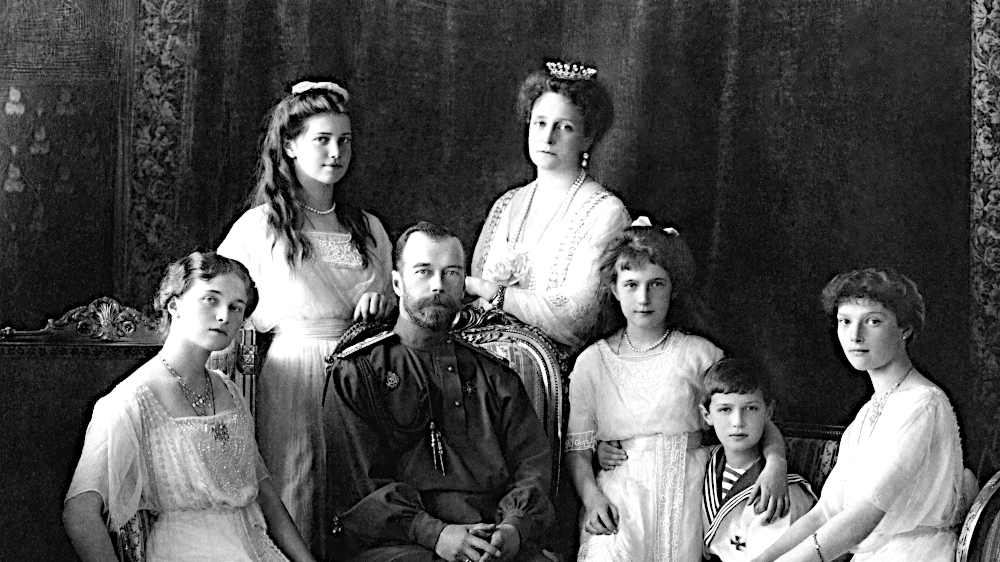
Before they were moved to Ekaterinburg and execution, Nicholas II and his family crammed most of their remaining treasure in three jars, which they gave to trusted friends to guard. Two of these jars have disappeared from the record, their hiding places undiscovered. The Romanovs’ lost treasure inspired Mark Grenside’s latest thriller, he explains.
In my books I blur the lines between fact and fiction. To take what is known and then add probability, even possibility, to create intrigue.
In my role as a film and television producer and network owner, I have been fortunate enough to travel to over 120 countries.
It is usually on the road that my rabbit holes begin. A half-heard rumour in a bar, a battered plaque outside a museum, a waiter’s memory of what his grandfather confided: that is where the itch to research starts, and it rarely lets go of me until I have chased the story to its end and then woven a mystery around it.
I have now written six books, all thrillers set against the backdrop of the film industry. Three (Fall Out, The Bastion and Sunset Circus) have recently been released, with two more out in December and one more next spring.
The most recent book is Sunset Circus, and it has a very deep rabbit hole! I have created a backstory from five seemingly unrelated historical events:
- The death of Tsar Nicholas and his family and entourage in Ekaterinburg
- The whereabouts of three urns containing lost Romanov treasure
- Files from the Okhrana (the Tsar’s secret police)
- A remote set of lakes in Siberia, a location that is also the cradle of the Vedic religion, long before it reached India
- Treachery and amnesty at Los Alamos

The main story centres on a modern-day Russian crime family headed by a fearsome matriarch and based in Mesquite, Nevada. The source of their wealth is from the lost urns of Tobolsk (fact), found by her father (fiction). The source of their protection is the Okhrana files hidden with those treasures (probable), and the shocking secrets about Stalin’s betrayal (possible).
But it is the urns themselves, and the real history behind them, that I most wanted to write about here.
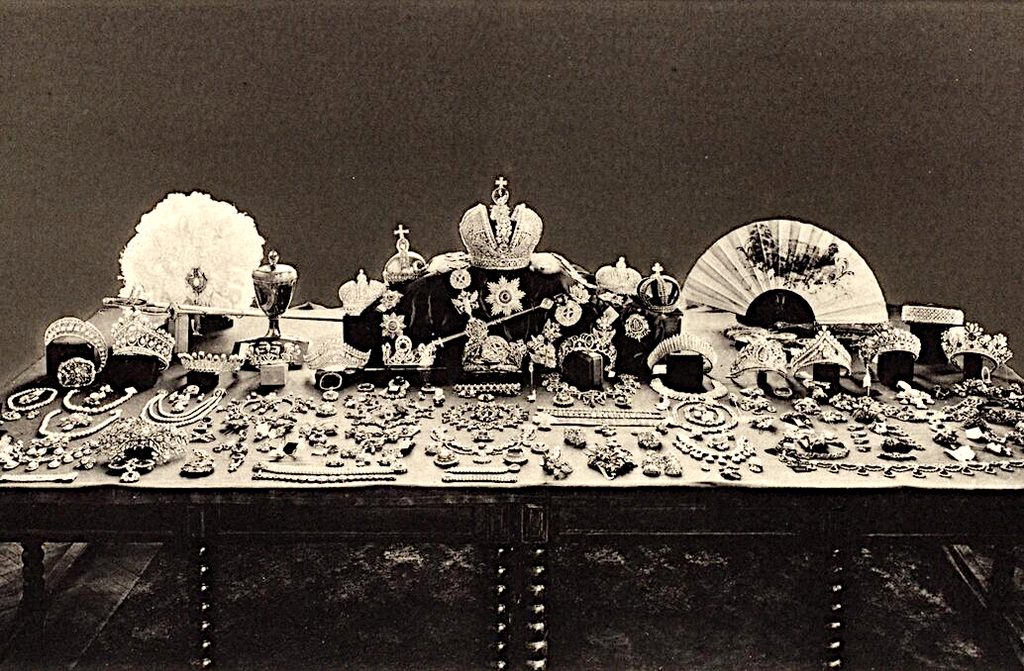
Tsar Nicholas, his family and entourage left house arrest and were put on a train at Tsarskoye Selo on 1 August, 1917. Crucially, they had been given a wagon for personal items. The Tsar and Tsarina took with them three large urns, into which they had secreted their most valuable and precious jewels, many of which the Tsar had had copied so that the Bolsheviks later paraded the fakes as the real thing.
The family was transferred by train and riverboat until they reached Tobolsk, and were put under house arrest there on 6 August, 1917. The Tsar’s family stayed at the Governor’s Mansion, while the rest of the entourage were lodged nearby, in the merchant Kornilov’s house.
The commander in charge, Colonel Eugene Kobylinsky, had previously guarded the family at Tsarskoye Selo. At the mansion, the family regularly received communion and succour from the local head of the church, Father Alexei Vasiliev.
That not-unpleasant exile did not last. The family and entourage were taken on to Ekaterinburg, and to their execution. They took very few possessions with them, though the girls had sewn a number of loose stones into the hems and seams of their clothing, some of which deflected the bullets at their massacre, which is why so many of the women were bayoneted to death.
I believe the urns were entrusted to Father Alexei Vasiliev for safekeeping, to be recovered once the Romanovs had been granted sanctuary elsewhere in Europe. Sadly, the Russian royal family were ostracised by everyone; even their cousin, the British king, declined to take them in. The family were toxic, and condemned instead to their grisly fate in that lonely basement.

One urn, previously hidden by a nun, Marfa Uzhintseva, was eventually discovered, and she was interrogated and shot for it (fact). What happened to the two other urns afterwards is where fact gives way to rumour and fiction.
I believe the second was hidden somewhere in Tobolsk by Father Vasiliev, and never seen again (highly probable).
The third was sent towards Omsk, in Siberia, and has also never been found; the strongest rumour comes from Prince Michael of Greece, privy to many secrets.
In my story, a soldier removes the boots from the dead Nicholas II “so I can walk in the footsteps of a Tsar”, to discover inside a coded parchment with details about the urns.
The parchment in the boot leads him to Father Vasiliev, who is still guarding one urn in Tobolsk and believes the soldier is an envoy sent to recover the jewels to fight on against the Bolsheviks.

As well as the urn he has hidden, Father Vasiliev gives him a name of someone in the Urals to seek out to discover the final and largest urn. The soldier murders him, then heads up to the Urals.
The last urn is hidden in one of the strange stone kigilyakhs by the lakes of Okunevo, an area sacred to the Vedic religion. Inside the kigilyakhs, the soldier not only finds the remaining treasure but also a file from the Okhrana and a shocking revelation about Stalin.
The soldier escapes to the US, building a criminal empire fronted by a waste disposal business and a small casino. He is found by Soviet agents and drawn by the threat of retribution into using the waste business to run a drop network for spies working at the Los Alamos nuclear research facility.
All of that is still to come in the story: a tale that eventually reaches a Hollywood film set, a prop, and the brutal murder of a hobo who sells a new riddle every morning in the cafes on Venice Beach. But the part I most wanted to leave you with is the part that is true: somewhere between Tobolsk and Omsk, a piece of the Romanovs’ fortune is still out there, never recovered.

Sunset Circus by Mark Grenside was published on 17 August, 2026. Fall Out and The Bastion were released on the same day.
Mark is a former film and television producer turned thriller author, drawing on insider knowledge of Hollywood to create the Marcus Riley and Mako de Turris series.
www.mngrenside.com
Twitter/X
Instagram
Facebook
You may be interested in these related Historia features:
Stockholm Syndrome in Ekaterinburg?
and Review: The Last Czars, both by Gill Paul
When Queen Victoria was Empress Alexandra’s interfering granny by Melanie Clegg
Top ten books about the Russian Revolution by Carol McGrath
Russian Revolution: Hope, Tragedy, Myths by Jason Hewitt
Images:
- Nicholas II of Russia with his family, (L–R) Olga, Maria, Nicholas II, Alexandra Fyodorovna, Anastasia, Alexei, and Tatiana, 1913. Alexandra is wearing two pieces of the Romanovs’ lost treasure, the tiara and pearl sautoir (necklace): Hermitage Museum, St. Petersburg, via Wikimedia (public domain)
- Russian Crown Jewels, 1925, from the Russian Diamond Fund album discovered in the USGS library: USGS (public domain)
- The Romanovs on the roof of the Governor’s Mansion in Tobolsk, 10 September, 1917: Wikimedia (public domain)
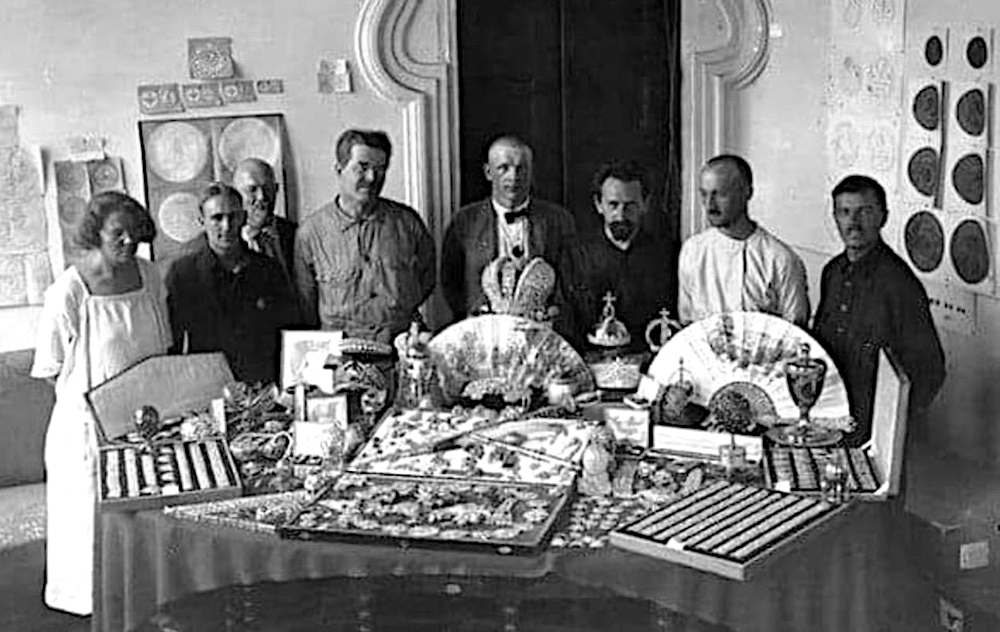
- Employees of the State Administration for Precious Metals and Stones (Gokhran) with jewels of the Russian crown. Moscow. 1923: State archival photograph, image hosted by Russia Beyond (public domain)
- Nicholas II and his family outside the Governor’s Mansion during their internment at Tobolsk, late August 1917 to April 1918 (L–R the Grand Duchesses, Alexei, a guard, Nicholas): United States Library of Congress’s Prints and Photographs divisionvia
- Ulakhan-Sis Range dotted with kigilyakhs, pillar-like rock formations, Sakha (Yakutia), Siberia (cropped): Artem Abdukakharov for Wikimedia (CC BY 4.0)


