

History, by looking clearly at the past, can help to prepare for the future. This was proposed by the Greek historian Thucydides and expanded in the Renaissance by Machiavelli, whose analysis of power structures can be seen to apply again and again, argues Michael Arnheim, making history relevant “for all time”.
Thucydides (c460 – c400 BCE) confidently proclaimed that he was writing his History of the Peloponnesian War not just for the gratification of his contemporaries but as “a possession for all time”. This boast turned out to be prophetic.
Thucydides prided himself on his accuracy, which he regarded not as an end in itself but “as an aid to the interpretation of the future, which, in the nature of humankind, must resemble the past, even if it does not repeat it.”

Machiavelli, historian extraordinaire
Thucydides had an unlikely acolyte in the shape of Niccolò Machiavelli (1469–1527), who is generally characterised as an advocate of political deceit, cunning and duplicity rather than as a historian.
But the historical analysis that he propounded in Il Principe (The Prince) has stood the test of time: “In every state two distinct tendencies (‘humours’) are found, namely that of the common people and that of the aristocracy. The common people do not wish to be ruled or oppressed by the aristocracy, while the aristocracy wish to rule and oppress the common people.”
A monarch who has the support of the common people, Machiavelli contended, is likely to be a strong ruler, while one who depends on aristocratic support will prove weak, as his ostensible aristocratic supporters will be competing with him for power. The bottom line is therefore that monarchy and aristocracy are by their very nature diametrically opposed to each other.
This analysis of the power structure implicit in every state throughout the world and throughout time forms the basis for Machiavelli’s frank advice to rulers – which is why he is thought of as an amoral and unethical cynic.

But, based as it is on a hard-headed view of reality, his advice has more practical value than the empty flattery and affected high-minded idealism of the usual ‘mirrors for princes’, a popular literary genre of the time.
More than that, Machiavelli’s analysis unlocks a whole new dimension of historical insight into any period to which it is applied – and it is applicable to any and every time and place. [See my Two Models of Government; Why Rome Fell: Decline and Fall, or Drift and Change?; and Five Thousand Years of Monarchy (forthcoming)].
French Revolution
Let us take the French Revolution as an example picked almost at random, a cataclysmic event in world history on which there is no shortage of evidence and a plethora of historical studies, hardly any of which show the slightest awareness of the significance – or even the existence – of the power structure.
The wise and wily Louis XV (reigned 1715–74) was well aware of the longstanding threat to the French crown posed by the aristocracy, particularly in the shape of the Parlement of Paris – not a legislature but a court that had arrogated to itself the right to ‘register’ (and therefore to veto) any royal decree.
,_King_of_France_MET_ep62.122.69.R.jpg)
By 1771 the King’s able chief minister, René de Maupeou, had finally defeated the Parlement of Paris and replaced it with a royal court, and then took similar action against the provincial parlements.
These were intended as merely the first steps in a wholesale reform of the judicial system, but the whole enterprise was abruptly cut short by Louis XV’s death and Maupeou’s dismissal by the new king.
Louis XV’s grandson, Louis XVI, was a callow 19-year-old who did not understand that, far from being his allies, the aristocracy were actually hostile at once to royal power and to the interests of the mass of the population. “I had won for the King a case that has dragged on for three hundred years,” lamented Maupeou. “He wishes to lose it again. It is his decision.”
More interested in tinkering with locks in his workshop than with affairs of state, Louis XVI never got to understand the true nature of power, a failing which was to prove fatal for himself and the ancien régime.
The brilliant eccentric royalist revolutionary Mirabeau (1749–91) desperately tried to make Louis recognise and develop the bond between the monarchy and the ordinary people of France: “The indivisibility of monarch and people is in the heart of every Frenchman. It is necessary for it to exist in action and in power.”

Shortly after after Mirabeau’s death, and ignoring this sound advice, Louis made a frantic run to the frontier on 21 June, 1791, to link up with France’s enemies.
Recognised (ironically, from his embossed profile on the assignat, the new revolutionary paper money), he was arrested and ignominiously dragged back to Paris as a prisoner. From there it was but a short step to deposition, trial and execution.
But that was not quite the end of the story. Napoleon Bonaparte, who saw himself as the heir to the Revolution, subsequently reinvented himself as a monarch under the style of Emperor, a title deliberately chosen for its Roman populist associations.
It is no accident that Maupeou’s right-hand man, Charles-François Lebrun (1739–1824), was picked by Napoleon to serve as Third Consul under himself in 1799 to take a leading role in the reorganisation of the national finances and of the administration – both pet projects of Maupeou’s aborted by the death of Louis XV in 1774. Casting his mind back 30 years, Lebrun also cautioned Napoleon against recreating a hereditary aristocracy.
Analysing any other period of history through the lens of its power structure will likewise result in a major reassessment and reinterpretation – as I propose to show in Five Thousand Years of Monarchy.
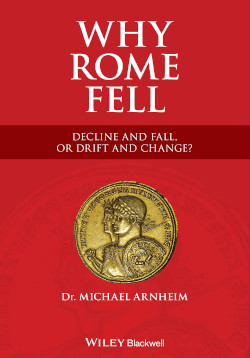
Why Rome Fell: Decline and Fall, or Drift and Change? by Dr Michael Arnheim was published on 28 February, 2022.
He’s a practising London barrister. Sometime Fellow of St John’s College, Cambridge, he’s the author of 23 published books to date and is currently working on Five Thousand Years of Monarchy for Wiley-Blackwell.
Images:
- Louis XVI wearing his coronation robes by Joseph-Siffred Duplessis, c1777: Wikimedia (public domain)
- Thucydides from a mosaic from Jerash in Jordan, 3rd century CE: Pergamon Museum in Berlin via Wikimedia (public domain)
- Niccolò Machiavelli by Santi di Tito, second half of the 16th century: Palazzo Vecchio, Florence, via Wikimedia (public domain)
- Miniature of Louis XVI by Jean-Laurent Mosnier, 1790: Met Museum via Wikimedia (CC0 1.0)
- Assignat for 500 livres: Wikimedia (public domain)


