

We’re delighted to welcome the historian Dan Jones to Historia to talk about his first novel, Essex Dogs, the Crécy campaign of 1346, and writing fiction. He also shares his top tip for new writers in this interview.
You’re well known as the author of bestselling history books; why did you decide to start writing historical fiction?
Well, for a long time I vowed not to write historical fiction. So I suppose in a sense it was inevitable that eventually I would. The immediate prompt was twofold. In the first place, I wrote my tenth non-fiction book, and turned 40 years old. Those two round numbers put me in a strange mood, and I decided that it might, after all, be the time to try something new. Or risk never doing anything new at all.
The second reason was less psychologically revealing and more practical. I had a good idea. The idea came in phases: first I started to imagine a group of ordinary soldiers in the Hundred Years War; later I placed them on the beaches of Normandy, invading France in a sort of medieval D-Day.
Finally, in the summer of 2019 I had dinner with George RR Martin, and was very impressed by this titan of historical/historically-adjacent fiction. George guzzles history, knows a lot about it, and loves it. Yet he uses history to other ends than historians typically do: namely, the Game of Thrones novels, which have achieved such international renown. He seemed to me to be having a great time doing this, so I decided to see for myself what it was all about.
Can you tell us a little about Essex Dogs?
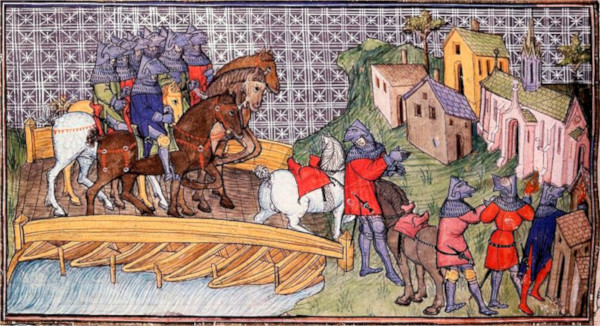
Essex Dogs begins, as I have suggested, with a medieval D-Day: Edward III’s invasion of Normandy in 1346. This is the beginning of the Crécy campaign, most famous for the exploits of noblemen such as the 16-year-old Black Prince.
We follow this campaign through the eyes of the titular Essex Dogs: a ragtag bunch of freebooter/mercenary/semi-criminal types who may have fought one campaign too many. Their chief concern is to get paid and get home. But this is not as simple as it sounds.
Why did you choose the Hundred Years’ War as the setting for your novel?
In a sense it chose itself. I had the notion of the Normandy invasion while walking on Omaha Beach one New Year’s Day. That really drove the story towards one of two campaigns: Crécy or Agincourt. I went for the former, on the grounds that it felt like there was more opportunity to have fun. That is not to say we won’t reach Agincourt one day, if the series develops.
How different have you found writing fiction?

Entirely different. As a historian and non-fiction writer I am very interested in structure, story architecture, shapes and arcs. These are all things that also belong to fiction, but I found I could not create a fictional story by planning it all out and then writing to a plan.
The writing feels as though it physically comes from a different part of my brain. Maybe it does. (Maybe it is a good job I am not a neurosurgeon.) In any case, the working process, the working day, the emotional experience of writing is all wildly removed from everything I’ve done before.
How do you approach historical research for a novel compared to, for example, researching a dynasty or a conflict?
It’s much more ad hoc, serving the needs of the story. Detail and texture is of course very important in fiction — but I tend to find myself only hunting for things as the story presents the need.
The broader historical research — into the shape and events of a campaign — is similar, but I approach it with different priorities. I am looking for ‘small’ stories rather than ‘big’ ones. The granular rather than the big sweep of events.
While working on Essex Dogs did you come across anything – a fact or an incident – you found bizarre or surprising?
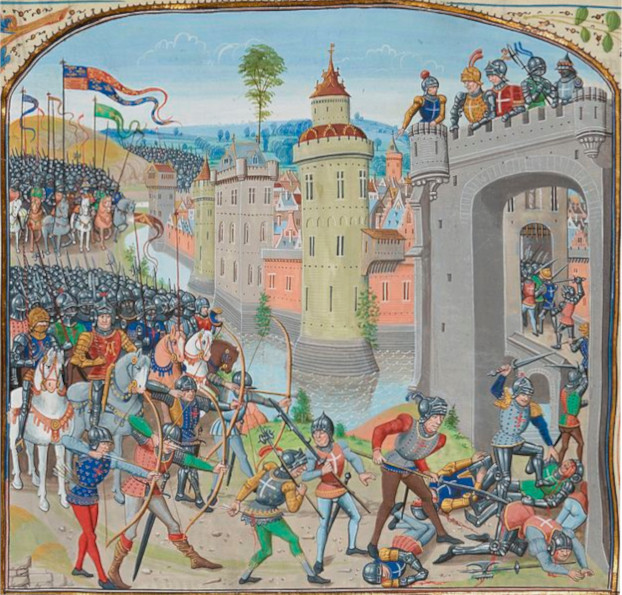
I found very many of them. But perhaps the most interesting — and useful — was coming across an anecdote about the city of Saint-Lô, which the English army sacked early in the Crécy campaign. Above the gates of Saint-Lô were nailed the heads of three Norman knights, executed in Paris for collaborating with the English.
This is of passing interest at best to the historian. It provided an entire chapter in Essex Dogs, as our heroes are charged with retrieving the heads for a nobleman — who turns out, as it happens, to be fairly ungrateful, despite the efforts the Dogs go to.
What do you think historical novelists can add to our understanding of the past?
They can play with our relationship with the past, in ways that historians have to be careful about. In historical fiction we are often trying to create empathy: to place the reader in the time and ask them how they would have reacted or behaved. That is something historians often do, too, although whether they ought to is another question.
What advice would you give someone starting to write historical fiction?
The same advice I give anyone who is starting to write anything: write.
I often say that writing is an activity not dissimilar to playing a musical instrument or doing physical exercise: you aren’t going to get better at it without practice. In fact, the whole process is practice. You must write as much as possible, whenever you can, even when you don’t want to.
And you have to accept that a lot of what you write is going to be garbage, but that doesn’t matter, because you will have to fix it, edit it, rewrite it, ditch a load of it and just keep going. So stop asking me questions and start writing. Oh, and it’s a good idea to read as well.
Essex Dogs is the first in a trilogy. Can you give Historia readers a taste of what’s waiting for the Dogs in your next book?
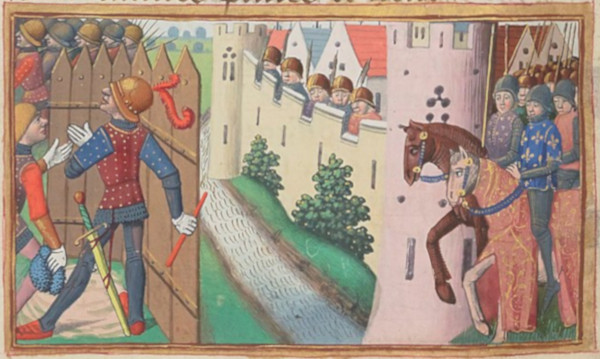
The next book is called Wolves of Winter and it is published in the UK in October. It follows continuously from Essex Dogs — the story picks up the very next day. Having been through Crécy, the Dogs are now packed off to the siege of Calais — a brutal 11-month campaign to starve that city into surrender.
If Essex Dogs is the Normandy campaign of 1944 in medieval costume, Wolves of Winter is a medieval Stalingrad. It’s a blast.
To end with a bit of fun – if you could time travel for one day, what time and place would you go to? And what object would you bring back?
There is no way I’m going back to any point before the wide and ready availability of painkillers and antibiotics. No way, hombre. The painkiller revolution is a profound change in human society that marks a complete break between our own age and the past. I would not wish to get stuck on the wrong side of that divide.
And don’t give me all that nonsense about your time machine being reliable. My Tesla is always in the garage, and that’s just a big Scalextric car. But how about this: YOU go back to the Crécy campaign and take me some photos and bring them home and we’ll all be happy.
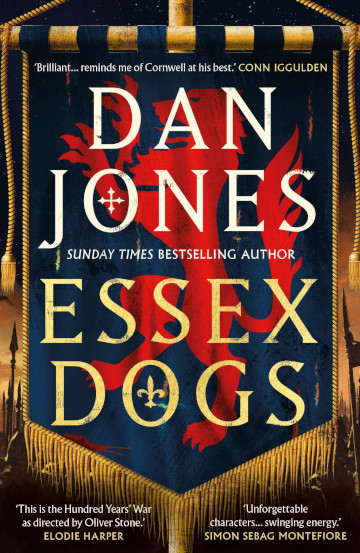
Essex Dogs by Dan Jones was published in paperback on 6 July, 2023.
Dan is the Sunday Times and New York Times bestselling author of Powers and Thrones, Crusaders, The Templars, The Plantagenets, Wars of the Roses, and Magna Carta. He is the host of the podcast This is History: A Dynasty to Die For and has produced, written, and presented TV programmes including including the Netflix series Secrets of Great British Castles.
We’ll be coming back to Dan in October, when Wolves of Winter is published.
Images:
- Portrait of Dan Jones: supplied by Head of Zeus
- The crossing of the river Seine, and the pillage of Vitry by English soldiers (detail), Royal 20 C VII f 136v, after 1380: © British Library Board (CC BY 4.0)
- The Battle of Crécy from Jean Froissart’s Chronicles, FR 2643, fol 165v, 15th century: Bibliothèque Nationale de France via Wikimedia (public domain)
- The taking of Caen in 1346 from Froissart’s Chronicles, MS Fr 2643, fol 97v, 15th century: Bibliothèque Nationale de France (public domain)
- The siege of Calais from Les Vigiles de Charles VII by Martial d’Auvergne,1484–5: Bibliothèque Nationale de France, Manuscrit Français 5054, enluminure du folio 90 (public domain)


