

Among the powerful medieval women whose stories have — against all odds — survived the years, Balthild, the seventh-century Neustrian queen, is one of the most extraordinary. A slave who became a queen and, later, a saint, she was an unexpected source of inspiration for Matthew Harffy’s latest Bernician Chronicles story, Forest of Foes.
The lives of people who lived in the early medieval period are veiled in darkness. For men of importance, such as kings and bishops, we have certain dates that punctuate their existence: coronations, marriages, battles, deaths. But all too frequently the women of the distant past are overlooked in the primary historical sources. Even women of great power, abbesses and queens, are often little more than a side note in the annals.
There are scant details of how they lived their lives, where they came from, their families, relationships, loves, enmities. Often all we have is a name, perhaps the date of their marriage into one powerful dynasty or another, and all importantly of course, the names of their progeny, who would carry on the royal line of the king to whom they had been bound as peace-weavers.

But even in that far distant, shadowy world of what is commonly known as the dark ages, there are some women who shone so brightly in their time that it was impossible for their names and their stories to be overlooked and forgotten. One such woman is the Frankish queen, Balthild (also known as Bealdhild, Bathilda, Bauthieult).
Before researching Forest of Foes, the ninth book in my Bernicia Chronicles series, I knew practically nothing about the Merovingian monarchs, so I was not prepared for Queen Balthild to burst onto the page at the beginning of the novel and for the story of my protagonist, Beobrand, to become entwined in her tale.
The main source of information about her life is the hagiography Vita Domnae Balthildis (The Life of Lady Balthild). Written by a nun in praise of Balthild for the purpose of furthering her candidature for sainthood, it is unsurprising that the book paints her as a larger-than-life character with a fantastic – some would say unbelievable – back story.
The book recounts the tale of Balthild being a slave, of Saxon blood, possibly brought from the British Isles, and serving in the household of the major domus of the palace, Erchinoald. The major domus (also known as Mayor of the Palace) was essentially the administrator of the kingdom, the true power behind the throne of the Merovingian rulers, and as such, Erchinoald was one of the most influential people in the Frankish kingdom of Neustria.
The story of Queen Balthild being a freed slave is perhaps apocryphal, but it was too good to ignore for a historical novelist. The Vita describes how she was first owned by Erchinoald, who, when he became widowed, wanted to marry the beautiful and intelligent slave girl who had caught his eye.
Balthild, though, had different ideas and she hid from him until he gave up looking and married someone else. Eventually, and inexplicably, Erchinoald then gave Balthild to his king, the young Clovis II, to wed instead.
How much of this is true we can never know, and it is quite difficult to reconcile the story into a believable narrative. But what is certainly true is that Balthild went on to influence the laws of the land, outlawing the practice of enslaving Christians, and establishing several new religious sites, such as Corbie Abbey and the Abbey of Chelles.
There are also stories of her buying slaves and freeing them in her later life. After her husband’s death, Balthild ruled as regent, crushing uprisings against her and her son, Clotaire III, before eventually withdrawing from public life, possibly forced to do so by the nobles of the land.
Whatever the truth behind the queen’s background, she must have been a formidable character to have had such an influence on Frankish society and to have elicited such strong commentary from the author of another hagiography, Stephen of Ripon, who writes in his Vita Sancti Wilfrithi (Life of Saint Wilfrid), that Queen Balthild was a ‘Jezebel’ who had nine bishops put to death! Apparently, Wilfrid, who was staying with one of the bishops sentenced to death, only escaped being killed too when the men carrying out the executions realised he was a visitor from England.

Despite the differing takes on her, there can be no doubt that Balthild must have been a forceful, intelligent woman, to be able to survive, and even dominate, in the male-oriented Merovingian court. If she had truly started out as a thrall, such accomplishments are even more remarkable.
There are sources that say Clovis II had some form of mental or physical ailment, and perhaps it was this perceived weakness that allowed her, a clever, energetic woman with experience of the major domus’ household and an eye for statecraft, to step up and help the king rule his kingdom.
It is not inconceivable that Erchinoald even placed her in that position, so that he could rule by proxy. Whatever the reasons behind her rise to prominence, it seems that her life was never dull.
With all these tantalising titbits of information about Balthild, how could I not make the thrall-queen one of the central characters of Forest of Foes? There is so much intrigue and conflict surrounding her and on top of everything else, she is a beautiful, young, Saxon woman, who might even be from royal stock. Beobrand, of course, would be powerless to resist her!

Forest of Foes by Matthew Harffy, the latest in his Bernicia Chronicles series, is published on 8 December, 2022.
Matthew Harffy lived in Northumberland as a child and the area had a great impact on him. The rugged terrain, ruined castles and rocky coastline made it easy to imagine the past. Decades later, a documentary about Northumbria’s Golden Age sowed the kernel of an idea for a series of historical novels. The first of them is the action-packed tale of vengeance and coming of age, The Serpent Sword.
Matthew has worked in the IT industry, where he spent all day writing and editing, just not the words that most interested him. Prior to that he worked in Spain as an English teacher and translator. Matthew lives in Wiltshire, England, with his wife, their two daughters, and a slightly mad dog.
matthewharffy.com
Twitter: @MatthewHarffy
Facebook: www.facebook.com/MatthewHarffyAuthor
Read Historia’s interview with Matthew Harffy.
Matthew’s books are full of battles and fights, so who better to tell us about Battling with history: how to write fight scenes and battles in historical fiction?
He’s also written Bebbanburg 2020: the lessons I learned from a seventh-century siege.
You may enjoy reading Jemahl Evans‘s review of A Night of Flames by Matthew Harffy.
For more on powerful medieval women, see:
An Easter assassination and an early medieval queen by Shelley Puhak, about the rivalry between the sixth-century Frankish queens Fredegund and Brunhild
Anglo-Saxon women with power and influence by Annie Whitehead
Magna Carta’s inspirational women by Sharon Bennett Connolly
Images:
- Baldehilde seal from ring (detail): Portable Antiquities Scheme via Flickr (CC BY 2.0)
- St Balthild from the Chroniques de Saint-Denis: Wikimedia (public domain)
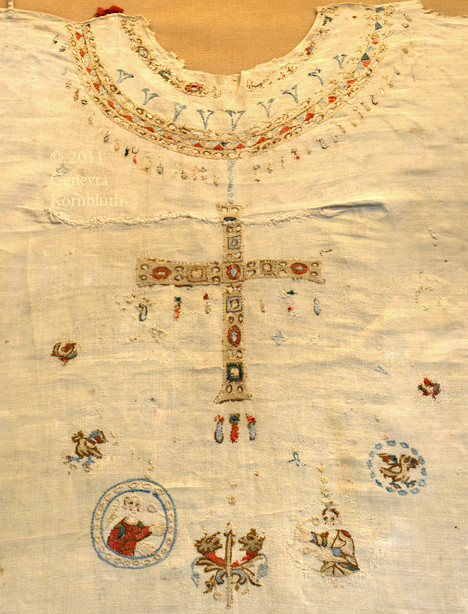
- St Balthild’s burial chemise, detail of embroidery, Musée Alfred Bonno, Chelles, Coll Commune de Chelles: ©Genevra Kornbluth
- Coronation of Clotaire III, with his mother, Bathilde, Grandes chroniques de France: Morgan Library via Wikimedia (public domain)


