
Beatrice Cenci is elusive. Even ‘her’ portrait isn’t a painting of her. Executed for murdering her abusive father, was she an innocent victim or a cunning killer? Both, says Elizabeth Fremantle, whose novel, Sinners, is a powerful reinterpretation of her story. But above all, she says, Beatrice was human.
Elizabeth won the 2024 HWA Gold Crown Award for her previous novel, Disobedient, “a brilliant example of the power of historical fiction”.
“Sometimes it takes something other than perfect fidelity to sharpen our senses, to focus our attention sympathetically, in order to give us emotional access to the past –” Lisa Jardine.
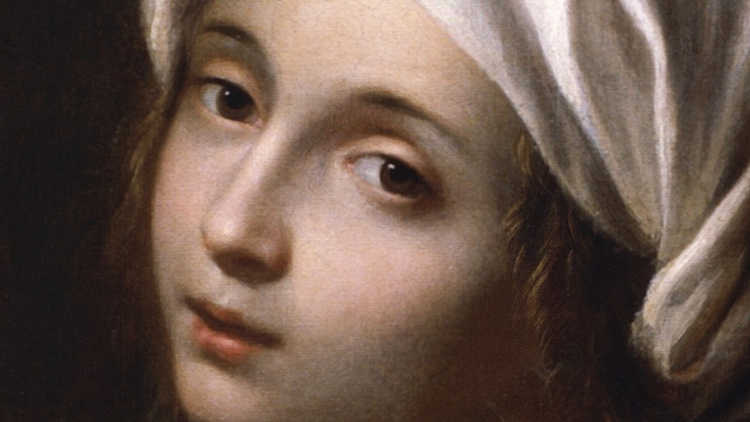
If you search the internet for Beatrice Cenci – the young Roman woman who, along with other family members, was tried in 1599 for parricide – there is a single image that comes up time after time. It is a painting of a girl, assumed to be 17, yet seeming much younger.

Her huge brown heavy-lidded eyes, set in a heart shaped face, gaze back over one shoulder at the viewer, in much the same engaging attitude as Vermeer’s Girl With a Pearl Earring. Her mouth is slightly open, her look the epitome of innocence, but the most striking thing about this girl is that she looks so very young – she is barely out of childhood. It is a picture so full of pathos as to rouse pity in even the most callous and indifferent viewer.
This painting was long believed to be the work of Guido Reni, an artist of some renown working in Rome in the early 17th century, and was labelled at some point as a likeness of Beatrice. It has been reattributed several times since, most recently to Ginevra Cantofoli, one of a school of female painters working in Bologna in the 1660s, and is very likely a self-portrait. Certainly, when compared to another Cantofoli self-portrait the features are strikingly similar.
What it is emphatically not, is a likeness of Beatrice Cenci – a fact we have known for almost a century and a half. Yet still this remains the image most closely associated with her. In many ways this erroneously attributed picture symbolises the inherent slipperiness of Beatrice’s story, which has been told and retold so many times that the truth has become almost impossible to find.
.jpg)
The Cenci parricide was a case that ignited Rome, triggering a great popular uprising in Beatrice’s favour, clamouring for her pardon. The consensus was that the circumstances for the parricide were mitigating, the belief being that she was subjected to the most heinous abuse by her father, including rape.
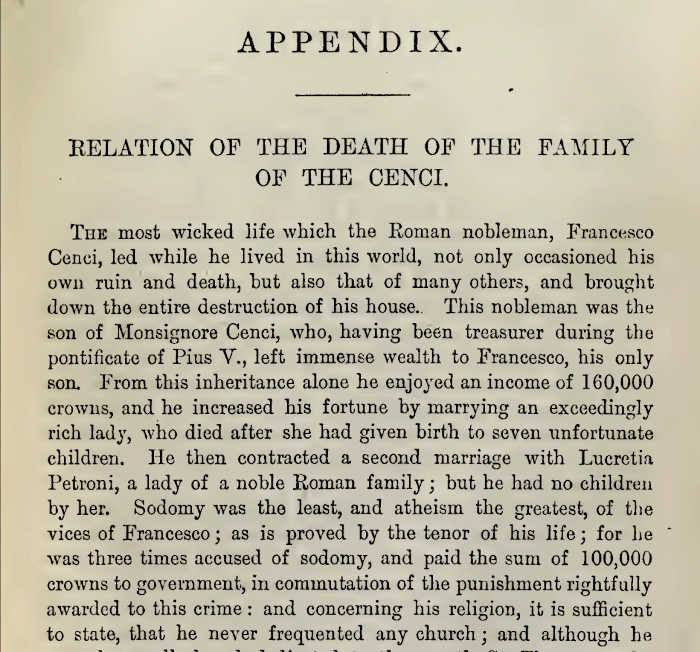
This public fervour elicited an amalgam of differing contemporary accounts, under the general heading of Relation of the Death of the Cenci Family, versions of which were widely circulated in the aftermath of the trial. And so, a legend sprang to life, which became, at some point, aligned with the painting, possibly by a collector who saw a means to increase the value of the work.
Almost two centuries later the legend, firmly attached to this beguiling image, captured the imagination of Percy Bysshe Shelley, inspiring his verse drama The Cenci, a text that gave rise two operas. Shelley was not alone in falling under the spell of the girl in the painting, convinced of her youth and innocence and seeing her as ‘more sinned against that sinning’.
A plethora of retellings from authors including Dumas, Stendhal and Dickens, who described the image in Pictures From Italy (1846) as filled with “celestial hope, and a beautiful sorrow, and a desolate earthly helplessness”.
It wasn’t until the late 19th century that eager archival researchers began to turn up transcripts from the Cenci court case, and other documentary evidence, which exposed much of the existing literature as fanciful. Several ‘serious’ accounts of the parricide and subsequent trial emerged, each purporting to tell the definitive ‘truth’.
This led to a new compulsion to cast Beatrice in a darker light, or in the words of Richard Davey in the Antiquary magazine (1886) to, “hurl her from her pedestal”. These accounts, based as they are on contemporary records, certainly offer some new facts to help pin the story down a little more firmly.
Beatrice’s birth date turns out to have been later than believed, meaning that at the time of the trial she was 22 rather than 17. It is clear, too, she had been involved in a sexual relationship with Olimpio Calvetti, one of the two men hired to murder her father. Often, in these accounts, she is cast as the seducer who inveigles a man to murder by giving herself to him.
The discovery of Beatrice’s will in which she left an enormous bequest to her friend, Catarina de Santos, for the care of a “poor boy” (poveri fancello) lead to further speculation that she gave birth to a child out of wedlock. So, much for the Victorian amateur historian to gleefully condemn.
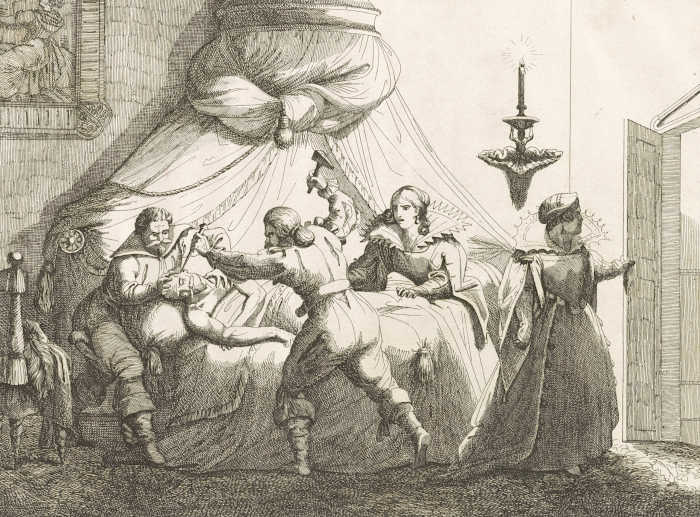
These new pieces of evidence certainly worked to change the tone of her story, raising the implied question: what did she do to elicit such a response in her father? Problematically, though, much of the material in these ‘true’ accounts outlining the archival findings is contradictory.
Bearing in mind, too, that many of the trial testimonies would have been the result of torture, as was the norm in the Rome of 1599, what we have is a vast amount of new evidence, much of which is unreliable. Moreover, the compunction to “hurl” Beatrice “from her pedestal” suggests a bias that further corrupts the findings.
The only thing that we can be sure of then, is that nothing about the Cenci parricide is clear. Perhaps this is why the figure of Beatrice Cenci became a cypher onto which artists, film-makers and writers – myself included – have projected their own ideas.
In the absence of any other image associated with her, this picture continues to carry her legend, though we know it is a lie. It is testimony to the way we tell and retell the stories of tragic women. The heroines of Tragedy typically conform to two distinct archetypes, cunning and ruthless like Clytemnestra and Lady Macbeth, or young, innocent, and preferably beautiful, like Iphigenia or Cordelia.

Beatrice has been cast as both. Perhaps the image persists because we desire her innocence, and the force of this painted girl urges us to believe in it, even while knowing she was found guilty of the cold-blooded murder of her abusive father. This says more about us than her.
As Oscar Wilde said, “sin is a thing that writes itself across a man’s face,” and we want this to be the case because we want to feel we can identify danger on the surface of people. This unblemished girl simply cannot be guilty, or so we are compelled to conclude.
I see the imagined figure of Beatrice Cenci as embodying both archetypes simultaneously, similarly to Medusa – the much-misunderstood Gorgon, a victim of rape who is transformed into a snake-headed monster and eventually decapitated. If we accept that Conte Cenci raped his daughter, an assault so monstrously against nature and firmly attached to her story as part of the public outcry around her trial, we can then accept the circumstances of the parricide as extenuating.
However, evidence for the rape is tenuous. The strongest source for it comes from the plea of Cenci’s lawyer, Prospero Farinacci, in which he makes it clear more than once that both Beatrice and her stepmother feared such an assault.

This is somewhat backed up by the testimony of one of the household maids who overheard Cenci threaten his daughter, though with burning rather than rape. There is sufficient documentary evidence that Beatrice was subjected to other abuses, too repulsive to recount here.
It could be that Beatrice was discouraged from testifying about the rape, or rapes, as it would have given her a strong motive for the murder, consequently weakening her primary defence: that she had no motive. We simply do not know the truth.
What is manifestly clear from all the unreliable evidence, is that the family lived under a reign of terror. But the more you dig for firm proof, the more the story turns to dust. In my novel, Sinners, it was never my intention to exonerate Beatrice of her crimes, or write a hagiography, nor to search for absolute verisimilitude. Rather, given the elusive nature of the source material, I sought to write a fiction that responds to the many threads of story that have embroidered her legend.
It is her courage and will to self-determination that stands out as the overwhelming truth behind all the differing accounts, and which sparked my desire to explore her character against the backdrop of the ways in which we mythologise women. If you will, I sought to reveal the tangled and knotted back of the tapestry which tells all her stories, working with impressions rather than certainty and raising, rather than answering, questions.
As for her guilt or innocence: in my mind she is not simply the blameless victim of her father’s brutality, nor the cunning instigator of her father’s murder – she is complex, she is both, she is innocent and guilty, saint and sinner, she is human.

Sinners by Elizabeth Fremantle was published on 3 July, 2025.
Read Elizabeth’s other Historia features:
Lewd Strumpets!
The Honey and the Sting: the novel that didn’t want to be written
Five infamous female poisoners
Are the Stuarts the New Tudors?
James I & VI: King or Queen?
Lewd Strumpets!
Tragedy in Minature
Or read our interview with her
More related features in Historia:
Slashing the face: punishing unfaithful women in Italy and
Mask wearing and crime in Renaissance Venice, both by Deborah Swift
Giulia Tofana: poisoner, murderer, saviour? by Cathryn Kemp
Rebuilding St Peter’s in Renaissance Rome by Richard Kurti
The truth about nuns in 16th-century Florence by DV Bishop
Images:
- Portrait of a woman wearing a turban, once identified as Beatrice Cenci, formerly attributed to Guido Reni and now attributed to Ginevra Cantofoli, c1650: Galleria Nazionale d’Arte Antica via Wikimedia (public domain)
- See 1
- Self-Portrait (Allegory of painting), Ginevra Cantofoli, 1660: Pinacoteca di Brera via Wikimedia (public domain)
- Relation of the Death of the Cenci Family, appendix to an 1886 edition of Shelley’s The Cenci: Internet Archive (public domain)
- Il Parricido from Ultimi avvenimenti della vita di Beatrice Cenci, c1850: Library of Congress Prints and Photographs Division
- La morte di Beatrice Cenci per decapitazione by Paul Delaroche, 1860: Wikimedia (public domain)
- Prospero Farinacci by Giuseppe Cesari, before 1640: Wikimedia (public domain)


