

Matthew Harffy looks at 8th-century Al-Andalus, the setting for his latest book, A Day of Reckoning. Several decades after the conquest of most of Spain by Islamic armies, Al-Andalus already had a rich culture in which the arts and sciences flourished. But it was also a place of conflict and cruelty, as he discovered.
The narrator of the A Time for Swords series is Hunlaf, an aging monk, writing sometime in the ninth century and looking back on an extremely eventful life that took him far from his native Northumbria and, if his asides in the novels can be believed, to every corner of the early medieval known world.
In A Day of Reckoning, the third book in the series, Hunlaf and his companions once again travel far from Britain. This time they head south, to the Iberian Peninsula and what is modern-day Spain, but in AD796 was al-Andalus and the Emirate of Cordoba.
I lived in Spain for over 10 years and I have visited some of the locations Hunlaf and his motley crew travel to. However, I am by no means an expert of the history of 8th-century al-Andalus, so writing this book was in many ways as much a voyage of discovery as it is for Hunlaf and the crew of the longship Brymsteda.

What both Hunlaf and I found was a complex land filled with riches and contradictions. Peril and intrigue lurked in the shadows of the fountain-cooled courtyards and colonnaded mosques, while some of the most knowledgeable scholars in the world were responsible for advancements in science, architecture and engineering. Atrocities were performed by those wishing to hold on to positions of power, while poets and musicians produced timeless works of art.
AD796 was decades from the initial conquest of Iberia, but still relatively early in the history of al-Andalus. Still, by the end of the 8th century, much of the Peninsula had been conquered and settled by Arabs and other Muslim ethnic groups from the north of Africa. These invaders were expanding the Dār al-Islam (Islamic world) through conquest.
But after taking over the kingdoms of Spain through force, they allowed Christians and Jews already there to remain, living out their lives in relative peace. These were the Ahl al-kitab (People of the Book), or dhimmi (protected peoples), who were free to follow their own laws and religions as long as they acknowledged the superior authority of Islam.

Much has been written about this seemingly idyllic situation of the three Abrahamic religions coexisting in harmony. But it should not be forgotten that the Islamic Arabs were the rulers and the upper class in the societies that had been conquered.
Arabic became the lingua franca of the region over time, and after seven centuries of Moorish occupancy, its impact on modern-day Spanish is still very noticeable, particularly in the names of things that originated from the time of al-Andalus, such as imported foodstuffs.
For example, azúcar is the Spanish word for sugar. In Arabic, the word is al-sukkar. The Spanish for rice is arroz, derived from the Arabic word aruzz. The Arabic word for orange, narang, became naranja in Spanish. The list goes on.
The mixture of different ethnic and ethno-religious groups inevitably fomented tension, and navigating the interactions with the different people he meets poses a challenge to Hunlaf, and also to me as a 21st-century writer. It is difficult to be true to the time, giving an inkling of the bigotry and division that existed, without potentially upsetting modern sensibilities.

The term ‘Moor’ that has been traditionally used to describe the Islamic people who settled Iberia has become contentious in recent years, as it can be seen as derogatory.
Despite this possible negative connotation, taking into consideration the word’s ancient roots, I decided to use it in the story when the men from northern Europe are referring to the disparate Muslim ethnic groups who ruled over al-Andalus.
Like the outmoded term ‘Dark Ages’, the word Moor has been used for hundreds of years, so many readers will instantly have a reference point. Besides, I believe it is important not to shy away from the fact that the Christians of the time would feel great prejudice towards Muslims and any other faith not their own.
I have chosen for the Muslims in the book to refer to themselves as Al-Muslimun. And to highlight that the prejudice was not one-sided, I have Muslims refer to those whom they see as non-believers, or deniers of the authority of Allah, as kuffaar (singular kafir).
As well as Moors, Jews and Visigoth Christians, Hunlaf and his friends encounter Imazighen pirates from the coastal regions of North Africa or Maghreb that would later in history be known as the Barbary (or Berber) Coast.

The exact derivation of the name ‘Berber’ is debated, but it is widely accepted as an exonym, or a name given to the people of that region by others. It is also commonly viewed as pejorative, perhaps relating to the Greek word for ‘barbarian’ or the Arab word for ‘babbling’. The term Amazigh (free man) is an endonym for indigenous North Africans, and Imazighen is the native plural term.
While the piracy in that region would become legendary later in history, there must have been men from that coast who would be more than happy to steal the riches from the Emirate of Cordoba, or perhaps even engage in espionage under the patronage of one of the rival Islamic dynasties that abounded in the Iberian Peninsula.
796 was a year of upheaval in al-Andalus. Al-Hakam took over rule of the Emirate of Cordoba from his father, Hisham, who died in April of that year after ruling for eight years.
Al-Hakam inherited a kingdom at war. Hisham had campaigned every year of his reign, fighting against the northern Iberian kingdoms of Asturias, Castile, Alaba, the Basques, and even the Franks. On top of all that Al-Hakam’s uncles, Sulayman and Abdallah, tried to wrest power from him. When they failed, Abdallah later travelled with his sons to the court of Charlemagne in order to seek the Frankish king’s help in their fight against Al-Hakam.

Charlemagne, or Charles the Great, would go on to be enthroned as the head of the Holy Roman Empire of Western Europe, and was certainly no friend of the Muslims.
In fact, Al-Hakam’s father had called a jihad against Christian Franks following Carolingian incursions over the Pyrenees, and in 778 Charlemagne himself had tried his luck at expanding his kingdom southward into Iberia, ending in the catastrophic defeat at Roncesvalles. This was clearly a case of ‘my enemy’s enemy is my friend’ on Abdallah’s part. The rebellion ultimately failed. Abdallah was pardoned, but forced to remain in Valencia, while Sulayman was defeated in battle and executed.
With enmity in the form of Christian Visigoths, Basques and Franks in the north, and rebellion from within his own family and nobles, Al-Hakam governed in a time of great strife, putting down several uprisings in the most brutal ways imaginable. In 806 it is said he ordered 72 nobles and their attendants (perhaps numbering as many as 5,000) to be massacred at a banquet. He then had their bodies crucified and displayed along the banks of the Guadalquivir. He was also known to have the heads of rebels and Christian enemies put on show at the gates of Cordoba.
With many battling factions within al-Andalus, the Emir of Cordoba employed a royal bodyguard made up of non-Arabs called Al-Haras. These non-Arabs were seen to be free of the tribal allegiances that might otherwise compromise Arab warriors’ loyalty. Similar units of bodyguards were used by several other medieval Islamic leaders.
The Mosque of Cordoba (known now simply as the Mezquita, Spanish for Mosque), while much smaller in 796, would still have been a marvel, and it is recorded as having fruit trees growing within its walls. Orange, palm and cypress trees still grow in the Patio de los Naranjos.
.jpg)
Originally built by Al-Hakam’s grandfather, Abd al-Rahman I, it was added to in several phases over the subsequent centuries until it became the massive building that now holds an extravagantly baroque Catholic Cathedral within its colonnaded interior. If you are ever in the south of Spain, I thoroughly recommend a visit!
The end of the 8th century is still long before the heyday of Moorish architecture that would see grand constructions like the Palace of the Alhambra in Granada, but it was still revolutionary in many ways and the stone towers and castles built on difficult-to-access peaks, with walls running along the slopes of the mountains, would have been extremely impressive to visitors from Britain.
The Moorish occupation of Spain lasted for over seven hundred years until 1492 when Boabdil relinquished the keys to Granada to King Ferdinand and Queen Isabella. Hunlaf was only there for a few months during the early period of Muslim rule, but what an adventure he had!
So far, three of Hunlaf’s tales have been published. Time will tell how many more, if any, he was able to commit to vellum before death claimed him. I for one look forward to finding out whether he ever returned to the sun-baked land of al-Andalus, but wherever he travelled, I’ll be there to serve as the chronicler of his epic life. I hope you’ll join me.
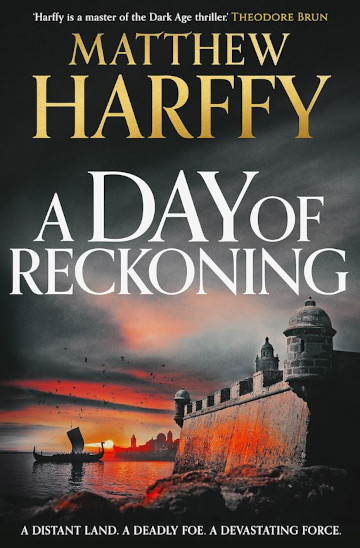
A Day of Reckoning by Matthew Harffy was published on 28 September, 2023. It’s the third in his A Time for Swords series.
See more about this book.
Matthew Harffy grew up in Northumberland where the rugged terrain, ruined castles and rocky coastline had a huge impact on him. He now lives in Wiltshire, England, with his wife, their two daughters, and a slightly mad dog. He is the author of the critically-acclaimed Bernicia Chronicles and A Time for Swords series, and he also presents the popular podcast Rock, Paper, Swords! with fellow author Steven A McKay.
A generous contributor to Historia, Matthew has written a number of features about the history behind his books, including:
From slave to queen: an extraordinary medieval woman
Battling with history: how to write fight scenes and battles in historical fiction
Bebbanburg 2020: the lessons I learned from a seventh-century siege
The power of alliance in the Viking Age
Oswald: Exile, King, Saint
Read our Q&A with Matthew Harffy
You may also be interested in:
The Templars and the reconquest of Spain by Simon Turney
Reinterpreting the Fall of Granada by Jane Johnson
Sultana Isabel: Elizabeth I and the Ottoman Empire by Jerry Brotton
Images:
- Detail from a painting on the ceiling of the Alhambra showing the first ten Nasrid kings: Rumomo for Wikimedia (CC BY-SA 4.0)
- Lute song in a garden for a noble lady from the History of Bayâd and Riyâd, 13th century: Vatican Apostolic Library, Ms Ar368 via Wikimedia (public domain)
- A Jew and a Muslim playing chess in 13th century al-Andalus from El Libro de los Juegos, 13th century: Escurial Library, fol 63 recto via Wikimedia (public domain)
- Sultan Bondoudar prepares to attack Tartus, from Cantigas De Santa Maria, 13th century: via Wikimedia (public domain)
- Moorish ships from Cantigas De Santa Maria, see above
- Charlemagne and his son Pepin (l), 10th century copy of lost original: Museo della Cattedrale, Modena, via Wikimedia (public domain)
- The columns of the earliest part of the Mezquita, Cordoba: Wikimedia (public domain)


