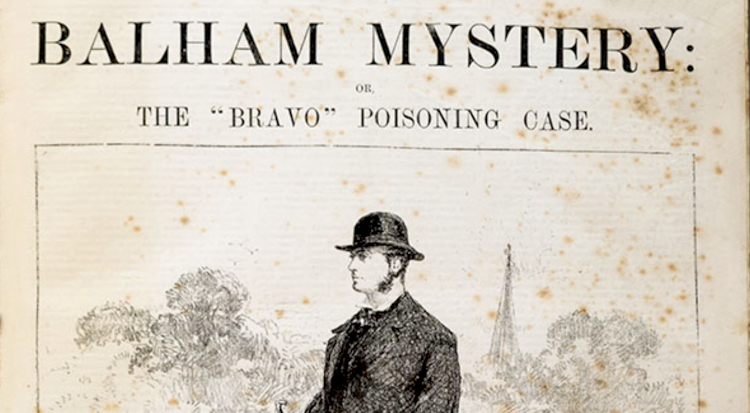
Which unsolved murder fascinated Agatha Christie so much that she decided to investigate it herself? Angela Buckley writes about the 1876 poisoning of Charles Bravo, also known as the Balham Mystery, still unsolved after 150 years.
In Agatha Christie’s Ordeal by Innocence, while Dr MacMaster is trying to prove the wrongful conviction of Jack Argyle for the murder of his adopted mother, he says to Dr Arthur Calgary: “It reminds me, you know, of the Bravo case – nearly a hundred years ago now, I suppose, but books are still being written about it”.
Agatha Christie was fascinated by unsolved mysteries, and her characters refer to many historical examples, notably the puzzling case of Charles Bravo, which the author herself decided to investigate.

Charles Bravo lived at the Priory, Balham, with his wife, Florence, and her live-in companion, Jane Cox. On Tuesday 18 April 1876, the threesome sat down to dinner as usual – a meal of roast lamb, poached eggs and fish paste on toast. They all ate the same food. The women drank sherry and Charles had burgundy wine, as was his custom.
Later that evening, Charles fell ill with violent stomach cramps. He took to his bed and, despite the attentions of six doctors, including Sir William Gull, he passed away three days later.
Eighty years after the event, Dr MacMaster alludes to this mystery in Ordeal by Innocence, observing that books written on the case were “making out a perfectly good case for his wife having done it, or Gully – or even for Charles Bravo having taken the poison in spite of the Coroner’s verdict. All quite plausible theories.”
In The Clocks, Hercule Poirot states that he has no doubt as to the identity of the perpetrator, although he declines to name them. He does suggest, however, that the companion Jane Cox might have been involved but she “certainly was not the moving spirit in the matter”.

Chief Superintendent Garroway reopens the debate in Elephants Can Remember: “We all have interests in certain cases that are past…Who killed Charles Bravo and why?” He adds that there were several different, mostly unfounded, theories for this real-life whodunit, and that people were still trying to “find alternative solutions”.
In 1968, in a rare letter published in The Sunday Times Magazine, Agatha Christie presented her own conclusion on the case. She wrote: “I think it was Doctor Gully who killed Charles Bravo. I’ve always felt he was the only person who had an overwhelming motive and who was the right type: exceedingly competent, successful, and always considered above suspicion.”
She explained that “none of the other suspects is in the least credible” – Florence was sufficiently wealthy in her own right to have left Charles whenever she wished, and as for Jane Cox, she was “an obvious suspect at first glance, but not when you look into it – a timid and prudent character”.
According to Christie, Gully fell “violently” in love with Florence and became obsessed by her, even moving house repeatedly to remain close to her. Florence, on the other hand, decided that she wanted “a young and attractive husband”, and Gully was discarded.

Although he appeared to accept this, Christie believed he concealed his true feelings: “But I don’t think he ever did accept it.” Rather than moving away – which would have been understandable – he remained in “this humiliating position”. Christie further surmised that Gully might have had a hand in the death of Florence’s first husband, Alexander Ricardo, and that he had never relinquished hope of reclaiming her affections.
Christie also considered the possibility that Dr Gully had administered a prescription to Charles, which had caused his death, and that Jane may have acted as his agent. Describing him as the ‘perfect planner’ and ‘a person of great ability’, she maintained that he was capable of devising a way to remove his rival. She ended her letter with a verdict of her own: “The man who was never found out. But I’m quite sure he did it.”
Despite Agatha Christie’s contention, this case remains unsolved. Dr MacMaster’s conclusion is rather bleak: “… but no one now can ever know the truth. And so Florence Bravo, abandoned by her family, died alone of drink, and Mrs Cox, ostracised, and with three little boys, lived to be an old woman with most of the people she knew believing her to be a murderess, and Dr Gully was ruined professionally and socially… Someone was guilty – and got away with it. But the others were innocent – and didn’t get away with anything.”

The evidence, however, does not entirely support this portrait. There is nothing to suggest that Jane Cox suffered socially from her connection to the case. Five years later, she was living in Westminster with her adult sons – one a medical student at St Thomas’ Hospital, another a clerk for a corn merchant – and she spent the next three decades living on independent means in Lewisham until her death in 1917, aged 91.
As for Dr Gully, he had already retired before the murder and, whatever reputational damage he sustained, he did not seem to face ruin, as suggested by Dr Macmaster, and died at his home in Balham in 1883, aged 75.
Florence’s fate was harsher. She was forced to sell the Priory just a year after Charles’s death and moved to Southsea where, two years later – shortly after her 33rd birthday – she died of bleeding of the stomach and heart, and liver and kidney disease “caused by excessive drinking of alcoholic stimulants”.
One hundred and fifty years later, the speculation over who killed Charles Bravo continues. As Florence herself remarked at the time, his death will “always remain a mystery”.
The Mysterious Poisoning of Charles Bravo by Angela Buckley is published on 15 June, 2026. It’s the first book in the Historical Murder Files series.
Read more about this book.
Angela Buckley is a crime historian and author. She writes about historical true crime, Victorian and Edwardian detectives, and the history of forensic science. Angela has a PhD in the evolution of police detective practice.
drangelabuckley.com
Angela is on Bluesky, Facebook and Instagram as @drangelabuckley, and her newsletter on Substack is
The Detective’s Notebook.
You may also be interested in reading:
.The ‘ordinary’ Victorian murderess by Lesley McDowell
Five infamous female poisoners by Elizabeth Fremantle
Giulia Tofana: poisoner, murderer, saviour? by Cathryn Kemp
Images:
- Charles Bravo from The Balham Mystery: or, the “Bravo” Poisoning Case, Goubaud & Son, c1876 (cropped): Heritage at Royal College of Physicians and Surgeons of Glasgow (CC BY-NC-SA 3.0)
- Florence Bravo, before 1876: uploaded from The Streatham Society by Cielquiparle for Wikimedia (public domain)
- James Manby Gully, caricature as Hydropathy by Spy (Leslie Ward), Vanity Fair, 5 August, 1876: University of Virginia Fine Arts Library via Wikimedia (public domain)
- Jane Cox, detail from a trial illustration, 1876: Wellcome Collection ICV No 2664 via Wikimedia (CC BY 4.0)
- The Priory, Balham, from The Illustrated London News, 5 August, 1876: uploaded from The Streatham Society by Cielquiparle for Wikimedia (public domain)


