

Have you considered writing a book about yourself? A memoir, autobiography, or family history, or even just a private record for your relatives or friends? Jean Fullerton, East Ender and bestselling author, has her own autobiography coming out and learned some useful tips which she’s passing on here.
Before I start, can I warn you that writing your autobiography can make you feel very old especially when your Generation Z editor asks with furrowed-brow puzzlement, ‘What is six-of-the-best?’
I actually thought my publishers Atlantic were just buttering me up when they asked me a couple of years ago if I’d consider writing my autobiography.
After all, although I’d been at the Rolling Stones Hyde Park concert in 1969 I hadn’t slept with any of them. And while I’d fluttered my Mary Quant false eyelashes at the likes of Marmalade and the Small Faces at the Marquee and Whiskey A’Go Go Clubs in Soho, I still caught the night bus back to my family’s council maisonette in Stepney. As far as I was concerned, I’d lived a pretty ordinary life.

However, as a life-long history nut I am passionate about people writing their family’s history. For goodness’ sake, one of my many talks is entitled I Wish I’d Asked My Granny More. In my head is the Fullerton family’s oral history, stretching back to the 1860s.
I was always intending to write it down for my children so, when Atlantic’s director asked me on the cusp of the Covid crisis when they were going to see this autobiography of mine, I called my agent. Having signed on the dotted line I started to mull over… what is an ordinary life?
While it’s easy enough to discover the political machinations in history through official records, newspapers and academic textbooks these often don’t contain the minutiae of everyday life.
Don’t we, as historical writers, scour local archives and bookshops for diaries and eye-witness accounts of the periods we’re writing to add colour and depth to our stories?

My family’s history is deeply rooted in East London.
I was born and grew up during the second half of last century. I lived in the streets littered with bombsites and dilapidated tenement flats that are now sentimentally portrayed in Call the Midwife.
When I was a child our everyday life was almost as far removed from the way we live in the UK today as the Regency or Tudor periods were.
As a young woman I witnessed first-hand the sexual revolution brought about by the introduction of the Pill, the colour and buzz of Swinging London and the hippy scene in the 60s, the industrial unrest of the 70s – not as someone who shaped events but as someone whose life and work was affected by them. Although I’m not unique in that regard I felt it right that I record my small part in this period of history.
However, writing your own story is very different from writing fiction as I found out when I handed the first draft of A Child of the East End to my editor. As with any story you have to be selective as to what goes in and why. Just as every scene in a work of fiction has to move the story on the same applies in an autobiography. What your nearest and dearest might find fascinating about Great Aunt Nelly your potential wider audience won’t.

Remember too that you can’t include every anecdote and incident that has occurred in your life and in some cases, it’s probably wise not to. Although I’ve been very open about my early life there were some things that I wasn’t comfortable including so I omitted them.
As the generation of Fullertons above me are all gone I could be candid about my parents, their mental health issues and marital breakup but I still have a brother and cousin. My story is not theirs so, although they are both mentioned, I have been very selective about the family anecdotes I’ve included them in.
I also anonymised school friends and teachers so if they read the book they would recognise themselves but their friends and family wouldn’t.
My tips would be firstly decide whether your autobiography is looking at one aspect of your life such as in Call the Midwife or, as in the case of A Child of the East End, has a broader sweep looking at a culture that has disappeared as told through an individual’s story.

I suggest you theme the structure so after the opening chapters setting the scene, time, place and who you are you move onto more specific areas such as family, school, work, other relationships, and anything else that’s particular to your life and story, weaving your family anecdotes and tales into each.
It may seem odd to say it but, although you know pretty much everything about your own life, you will have to research the correct times, dates and locations. I spent time and money gathering lost family certificates and documents together plus hours trawling through street directories and old maps to ensure my memory of shops and street names was correct.
We all know as writers how quickly readers will email to say you’ve got some minute detail wrong in your book – Met police officers wearing blue instead of white shirts in 1949 springs to mind in that regard – so I had to find out or confirm silly little details such as which house my friends were in at school.
Lastly, all families have secrets so be aware that you might unearth something that could have a profound effect on you and those around you. Even if you don’t find skeletons in your family’s cupboard, resurrecting childhood memories can be emotional and painful.
However, when all is said and done, as with any book the writer’s prime objective is to weave a story so enthralling that it hooks the reader in on the first page and keeps them glued until the very last word.
I know you can do it, so good luck.
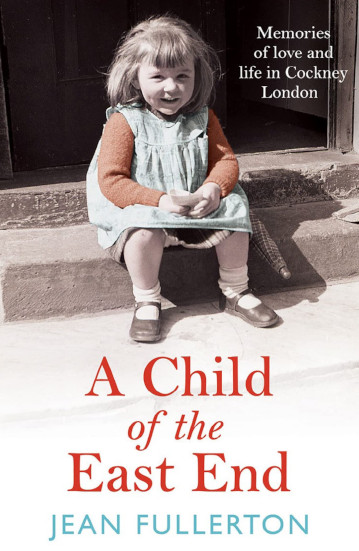
A Child of the East End by Jean Fullerton is published on 4 August, 2022.
Jean is probably best known for her Ration Book series about an East London family during the Second World War. The final novel, A Ration Book Victory, was published on 5 May, 2022. She was chair of the judges for the HWA Gold Crown Award in 2021.
jeanfullerton.com
Facebook
Twitter: @JeanFullerton_
Find out more about Jean’s autobiography.
If you enjoyed this look behind the scenes at Jean’s writing life, you may also like these pieces by her:
“Put those Christmas lights out!” The Home Front during World War Two
Sagas: they’re not all trouble at t’mill
Other Historia features on similar topics include:
Some reasons why history gets lost by VB Grey
Family memories of Italy in World War Two by Cristina Loggia
The wartime diary that led to my first novel by Cecily Blench
Bethnal Green’s underground wartime library by Kate Thompson
Images:
- Photograph of Jean Fullerton: supplied by the author
- Advertisement for the Marquee Club, December 1964: bunky’s pickle for Flickr (CC BY-NC-SA 2.0)
- Site of Poplar Station looking eastward, c1962: Ben Brooksbank for Geograph (CC BY-SA 2.0)
- Carnaby Street in 1968: arbyreed for Flickr (CC BY-NC-SA 2.0)


