
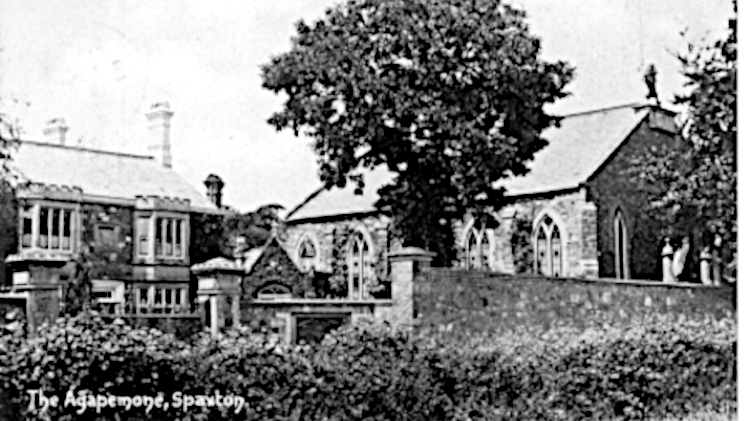
LC Winter writes about the Agapemonites, a faith community whose founder became deeply interested in ‘taking the flesh’ — and the fortunes — of female converts. It’s now probably remembered best as a Victorian sex cult and the cause of several scandals.
It started with a sickly teenage boy reading the Song of Solomon with his mother’s lodger, a woman who pined for the young man who would eventually call himself God, manufacture a spiritual excuse for the rape of a 16-year-old girl, and lead a cult that lasted a century.
The Agapemone (from the Greek for ‘abode of love’) didn’t start out as a sex cult, and Henry James Prince seems to have been something of a puritan in his early years of religious enthusiasm; he struck a glass of sherry from a minister’s hand and berated sailors for their language. Yet twenty years later the same man wrote of sex with a woman as ‘taking flesh’1.

I came across Henry James Prince a few years ago when I was researching my novel Spider, Spider. There’s a cult in the book and I was interested in how prevalent they had been in the Victorian period. I thought of their heyday as the mid-to-late 20th century; Waco and Jonestown, etc. Surely the buttoned-up Victorians weren’t even allowed such extravagances?
But no, here it all was; charismatic leaders, smitten followers, desperate relatives trying to rescue their loved ones — who are themselves determined to stay.
In 1836 Henry James Prince went to college in Lampeter intending to qualify as a minister. There he set about gathering a group around himself called the Lampeter Brethren and upsetting the Vice-Principal (it was he who lost his sherry).
After qualifying Prince accepted the curacy of the neglected parish of Charlinch in Somerset. With an absent rector, Samuel Starky, a church in poor repair and unenthusiastic parishioners, it was not a promising start but Starky, on his death bed, was miraculously revived after being read one of Prince’s sermons.
Prince’s wild preaching began to gather an audience, the Sunday school children were terrified out of their wits with threats of hellfire and people started to be divided into the saved and the not saved. In 1842 the Bishop of Bath and Wells revoked Prince’s license. When Prince moved to Suffolk, the Bishop of Ely lost patience within a year.

The conflict with the established church convinced Prince they needed to set up on their own, for which they needed money. He set to fundraising and directing building at a site in Spaxton from a house in Weymouth which appears to have been a proto-Agapemone with men and women separated and a hierarchical system among the faithful.
Among those faithful were the three wealthy Nottidge sisters; Agnes, Harriet and Clara. Once they came into their money they were manoeuvred into marriages with Thomas, Price and Cobbe, three of the Lampeter Brethren.
These marriages were intended to be barren, presumably to protect the cash, and this did not sit well with Agnes, who believed procreation was the godly purpose of marriage. She persuaded her new husband Thomas into a mutiny and they headed off to Thomas’s mother in Llandeilo.
Prince brought them in line, telling Agnes that “God will crush you”, but she wrote to warn her younger sister Louisa not to fall into the same trap. Her letter was intercepted and Agnes, pregnant now (to Prince’s disgust), was thrown out and went home to her mother.
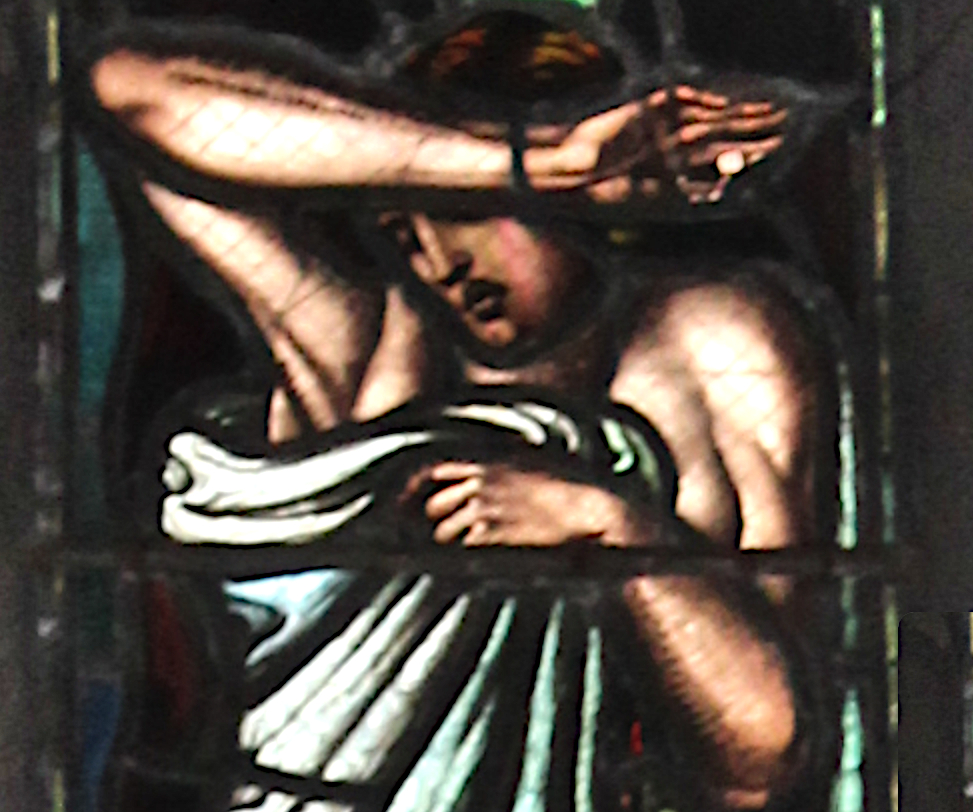
Louisa was well and truly enchanted by Prince and was at the partially built Agapamone in Spaxton when her brothers arrived and carted her off to an asylum. Prince and his acolytes didn’t find her until she escaped and managed to meet up with Cobbe. She was recaptured but the Lunacy Commission got involved and determined that she was sane. She immediately headed back to Prince and signed over her money.
In the completed Abode of Love in Spaxton, the group lived a life of relative ease. The faithful either contributed financially to the group, or worked as domestic staff. They played games and took carriage rides and were mildly entertaining to the surrounding district who seem to have enjoyed disapproving. Anyone who tried to get a closer look found that bloodhounds roamed the grounds.
Then in 1856 came the biggest scandal of Prince’s tenure as ‘Beloved’ of the Agapemone. Prince seems to have regarded women as two things; either flesh or fortunes, and with the Nottidge sisters (among others) having supplied the latter, he turned his attention to sex. His own writing on this time is pretty repulsive, referring to women as “flesh” he can “take… with the power and authority of God.”2
It was generally agreed that, one of the faithful, Miss Paterson, was particularly beautiful and when Prince lined up the young women of the Abode so that God could indicate his choice, what do you know? Miss Paterson (probably 16 at the time) was the divine choice. The idea was that love would be brought from spirit to body, from heaven to earth — the ‘Manifestation‘.
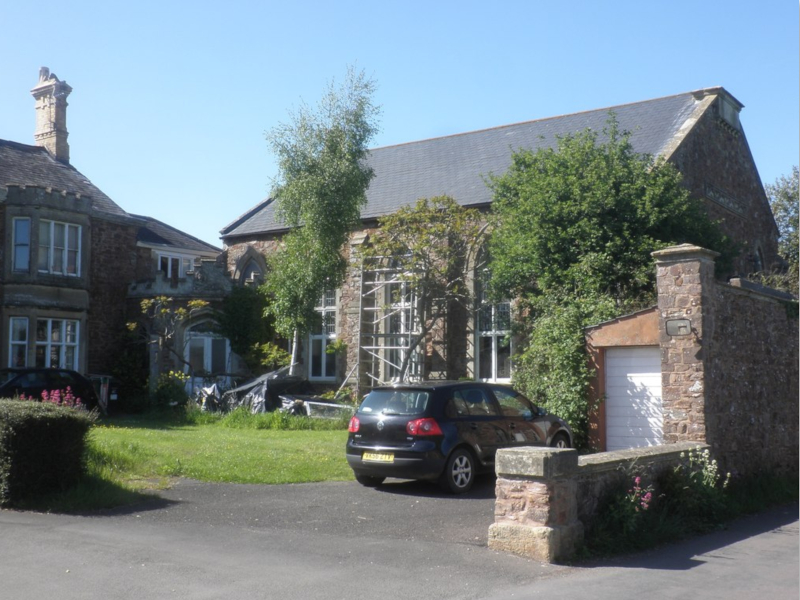
The reports of the actual event come from Prince’s own self-aggrandising writings, or from a journalist who gained access to the group over 10 years later, but it does seem the ritual took place before the faithful in the church.
There is, naturally, no report on what Miss Paterson thought of the whole thing, but later it became clear she was pregnant. It was concluded that the devil had intervened in some way and the poor child was devil’s spawn.
While most of the group seem to have accepted their leader’s behaviour it was clearly a breaking point for some. Lewis Price left his wife Harriet behind and then made several dramatic attempts to ‘rescue’ her, hindered by the fact she didn’t want to be rescued. After a judge decreed that she ought to be with her husband the Prices returned to the Church of England and normal life in Kent.
At around the same time, Louisa Nottidge died and the rest of the family set about contesting her will, successfully claiming she had been under undue influence at the time she handed over her money to Prince.
By this time the Abode of Love was rather smaller than at its height before the ‘Manifestation’; it had suffered several major defections or deaths. Death was not supposed to happen to Agapemonites – they were the saved and were simply waiting to be transported to heaven at the end, which was coming any day now.
.JPG)
If it hadn’t been for John Hugh Smyth-Pigott perhaps the group would have faded away after Prince’s death in 1899; but for some years the charismatic preacher had been advancing in the group. As it was, Prince named him his successor on his death bed and the Agapemone went on for another 30 years under his leadership and a bit beyond, the buildings in Spaxton being sold in 1956.
Smyth-Pigott’s leadership was almost as controversial as Prince’s as he called himself the Messiah, had several illegitimate children and took ‘soul brides’.
In the end neither Prince nor Smyth-Pigott strongly influenced my Victorian cult leader; Mr. Darner is not afraid to use other people’s fleshly weaknesses to control them but he’s not much given to carnal temptations himself.
There are common threads that run through these sorts of organisations; dominant leader, extreme control of the people on the inside, seclusion from the outside. It’s perhaps a little surprising that the Agapemonites are not more famous as an example but perhaps that’s because they faded away rather than going out in a dramatic fashion.
I’m glad I took the detour in my research and had my ideas, both about cults and about Victorian society, adjusted just a bit.
1 Yes, I pulled that face too
2 Prince’s The Little Book Open as quoted by Flinders in ‘A Very British Cult’, p 63
Further reading:
The Reverend Prince and His Abode of Love by Charles Mander
A Very British Cult by Stuart Flinders
The Abode of Love by Kate Barlow

Spider, Spider by LC Winter is published on 5 March, 2026.
LC Winter is a professional gardener, having worked in the gardens of several historic buildings. This provides a healthy compost for her words. This is her debut novel.
Find out more about this book.
You may be interested in these related Historia features:
A guide to Victorian sex by William Sutton
Merkins and masochists: a brief history of sex by Jemahl Evans
The wizards of west Wales by Alis Hawkins
Asylums and prisons: locking women away in madhouses by Nicola Pryce
Top ten films set in the Victorian era by Kate Griffin
Images:
- Postcard of the Agapemone, Spaxton, Somerset, 1907: Wikimedia (public domain)
- Henry James Prince, before 1899: Wikimedia (public domain)
- St David’s College, Lampeter by Henry G Gastineau, c1830: Llyfrgell Genedlaethol Cymru/National Library of Wales via Wikimedia (public domain)
- Sin, stained glass panel from the Agapemonite Church of the Ark of the Covenant, Upper Clapton, London by Walter Crane,1892–5: WereSpielChequers for Wikimedia (CC BY-SA 4.0)
- The Agapemone Chapel, Four Forks, Spaxton, 2015: Roger Cornfoot for Geograph (CC BY-SA 2.0)
- John Hugh Smyth-Pigott,drawing labelled Baby Glory, hailed in the Abode of Love as divine, Weekly Dispatch, 20 August, 1905: Wikimedia (public domain)


