
 In early 2013 I found an intriguing old photograph in a local charity shop. I love anonymous old pictures of people, especially if they hadn’t realised they were being photographed: they’re like a stolen glimpse into a vanished life. This scene was of a narrow street running between rows of small, conical stone houses, and along it walks a sparse procession of people led by a smiling young woman and a strange, stunted man. Their neighbours line the street to watch, dressed in worn, battered clothes. In the foreground is a little girl whose head has been shaved, and skinny chickens scratching at the cobbles.
The picture was labelled ‘Alberobello 1920’ although their clothing looked more like something I’d expect to see in 1820, rather than 1920; and the houses were so alien that I wondered if Alberobello was somewhere in South America. I bought the picture, excited by the idea of finding ou.t where this place was, who these people were, and what had been happening when the photo was taken. It’s hard to resist that thrilling feeling of setting out to solve a mystery, and straight away a half-formed idea I’d had for my next novel was supplanted – I wanted to find out everything about this picture, and I wanted to write its story, the story that would become The Night Falling.
Alberobello is actually in Italy – in Puglia, far down in the southern ‘heel’ of the country. I’ve spent time in Italy before: I lived in Venice for a year, and have travelled around most of the major cities of the north and centre. But even though I’d heard about the north-south divide in the country, nothing had quite prepared me for the shocking situation in the south at the time the photograph was taken. The majority of Puglian people lived incredibly hard lives, in abject poverty. They had no means of acquiring land or property, and could only sell their labour in the fields for a below-subsistence wage. The climate was harsh and very dry. In years of bad harvest or drought farm workers simply starved to death in the streets.
But after centuries of labouring under this oppressive norm, people were at breaking point. Angry war veterans, returning from the trenches of the First World War, demanded change. Socialist politicians brought word of uprisings in Russia and elsewhere in Europe, and began to be elected into town halls around the region. With strikes, demonstrations and desperation, the Puglian workers won rights that they had never had before – to contracts of work, rotas, and fixed wages. But in 1921, the landowners rallied. The newly formed fascist party was the perfect tool for them to take back control of the region, and by the end of 1922 the worker’s socialist movement had been violently suppressed. The old photograph I found here in Wiltshire had led me to an incredibly interesting, saddening and volatile period in Italy’s history.
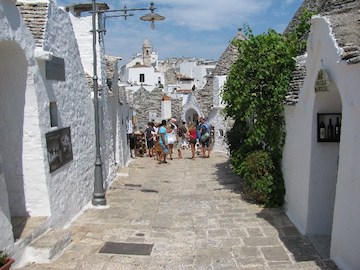 On my research trip to Puglia, with the help of a local guide, I found the exact spot in Alberobello where the photo had been taken, and stood there for a long time, noting all the ways in which the view had changed. I learned that the procession in the picture is a wedding party – the smiling young woman is the bride, the short man at her side is her father, shrunken and bent by years of toil. The town is full of tourists these days; the street is spanking clean and the houses have become souvenir shops. But it is still the same street, and I could still picture the wedding party there, in their ragged clothes – all the more poignant now that I knew how hard their lives had been. I wrote my novel, The Night Falling, with something of a sense of duty to those peasants who’d laboured and died in Puglia, largely unnoticed by history and the rest of the world.
Katherine Webb is author of best-selling historical novels including The Legacy and A Half Forgotten Song. Her latest, The Night Falling, is out now.


